• Hey Guest!
    British Car Forum has been supporting enthusiasts for over 25 years by providing a great place to share our love for British cars. You can support our efforts by upgrading your membership for less than the dues of most car clubs. There are some perks with a member upgrade!

    **Upgrade Now**
    (PS: Upgraded members don't see this banner, nor will you see the Google ads that appear on the site.)
Tips
Tips

computers

  • Thread starter Deleted member 8987
  • Start date
D

Deleted member 8987

Guest
Guest
Offline
Well...I now have to get used to a monitor that is about 20" wide. Geez. Can't beat the price...
Got a BIG new tower...Dell Precision 490....next day or two I get some XP discs...has Server 2003 on it with a dynamite video driver setup...
 
I wanted to put XP on my backup machine - but couldn't find a CD drive or floppy disk slot. Oh well -

4175840101_5f98070d27_o.jpeg


Does anyone recognize the "WITCH"?
 
Kind of looks like telephone switch gear
those are XY mailbox switches on the far right.
 
Along with this stuff was a floppy drive. Remote, USB plug.....talk about mis-match....when floppy's came out, did they even have USB ports? I can't recall.
None of my early boxes did.
So now I can use this floppy remote drive to load 95 onto...something..
 
....when floppy's came out, did they even have USB ports? ....

No.

USB was many years away.


Along with this stuff was a floppy drive. Remote, USB plug.....talk about mis-match....

.....

...So now I can use this floppy remote drive to load 95 onto...something..

Remember, back then, hard disks were expensive, removable hard disks were rare and flash drives didn't exist. If you had critical data to store you stored it on floppies.

As hard drives combined the storage media with the read electronics the were much more complex and less reliable than floppies as an archival format. A floppy sitting in a vault for ten years can be stuck in a drive (assuming you can find one) and will likely read just fine. A old hard drive sitting on the same shelf probably won't. (Most of the hard drives I've tried to use for archival backup failed long before the continuously used drives they were supposedly "backing up.")

While any old software on floppies is probably all useless, anybody that stored important business or personal data way back when is likely to have it sitting in a box somewhere. A USB floppy drive will allow them to access their data and transfer it to more modern media. (If you want it transferred to optical disk, CD or DVD ROMs, be sure to use archival quality disks. Standard disks can fail very quickly.)
 
I just couldn't remember time frame. I know my old Dell laptop has one...one USB port. Makes life difficult sometimes.
 
I love the new, BIGGER monitors. I'll never go back.
 
I found it's killing my neck scrolling back and forth...so things like this page are narrowed down to the old width.
 
I still have a box of 5.5s! Must be a hundred in there. 3.5s, I can't count how many I have, even after destroying a couple hundred of them. My first Hard Drive was 164 Megs. I couldn't believe how much stuff I could get on it by zipping it giving double it's capasity! :highly_amused: Then, every time you turned around someone made one bigger and of course we had to buy it! Just think how far we've come in the past 20 years, scary isn't it! PJ
 
Looks like 24"...straight across. not diagonal.

XP Pro, 64 bit, we log this in and MS is gonna go nutz.
 
I still have a box of 5.5s! ...... Just think how far we've come in the past 20 years, scary isn't it! PJ

This image is of a PC I had at work about 30 years ago. It's an IBM "Industrial" PC-XT with a 10 meg hard drive and a single 5.5" floppy. The box on top of the computer is an external 8-inch floppy drive and the unit to the left of the computer is a paper tape reader-punch. The PC had a serial port connected directly to a CNC machine & a coax connection to a mainframe. The 8-inch and the tape were used for CNC machines also. This was pre-Windows era & IIRC this had 64K of memory. Yep - we've come a long way in terms of speeds & capacities but a lot of that improvement got sucked up in overhead.

 
I also remember the Ohio-Scientific down the hall... had two 8" floppy drives an a HUGE (64kb) amount of memory. :glee:
 
The first "computer" I used for "programming" was a punch card machine at Trenton State College.

The physical cards (hundreds of them sometimes) were the "memory storage device".

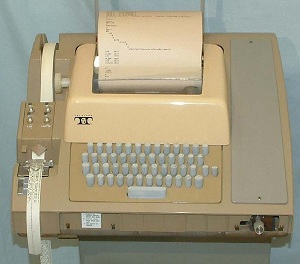
Later I used a teletype to create NC tapes for machine tool programming (see below). It punched one inch wide paper tape with up to 8 holes including a "parity check". Some tapes were 30 or 40 feet long. Later we got "high tech" Mylar tape. If you screwed up and typed the wrong thing there was no erasing. You started over (or in desperation) you might cut out the bad section and try to Scotch Tape in a corrected section.

I still remember: "Line Feed, Carriage Return" :smile:

smallASR331.jpg
 
...
I still remember: "Line Feed, Carriage Return" :smile:

Generally it was the other way around. "CRLF" - so that you got the carriage headed back home while the line feed occurred. CRLF is still the standard line-end sequence used in MS Windows for disk files.

I'm sure Nial also remembers CNC controls with their memory specified in "feet". We had a small mill with a controller that boasted 66 FEET of memory.
 
Tally Tape readers....IBM Selectric output units....BCD nixie tubes....aux register, index register.....drum memory, core stack......wire wrap.....

I got a full on licensed MS XP Pro 64 bit disc this afternoon, plus the Dell discs....so I am going to attempt to use the license key in the BIOS for Dell factory loaded XP (key on tag) before I do anything else.

Getting a KVM switch to use both boxes on one monitor, keyboard and mouse.

Get to play with 64 bit XP for a while.....
 
Here's the first computer I used. Still have it, though it's slowed down and does lock up from time to time. Freezes, too - especially if too much ice cream is taken in at once. Still prefer it over all the others I've had.

Brain_diagram.jpg
 
Generally it was the other way around. "CRLF" -
I'm sure Nial also remembers CNC controls with their memory specified in "feet". We had a small mill with a controller that boasted 66 FEET of memory.

Whoops! Yes "CRLF".....I guess after 30 years I'm out of practice! :smile:

An yes, "feet" of memory. I had forgotten that term. ;)
 
"feet of memory" wow, how technology has changed.

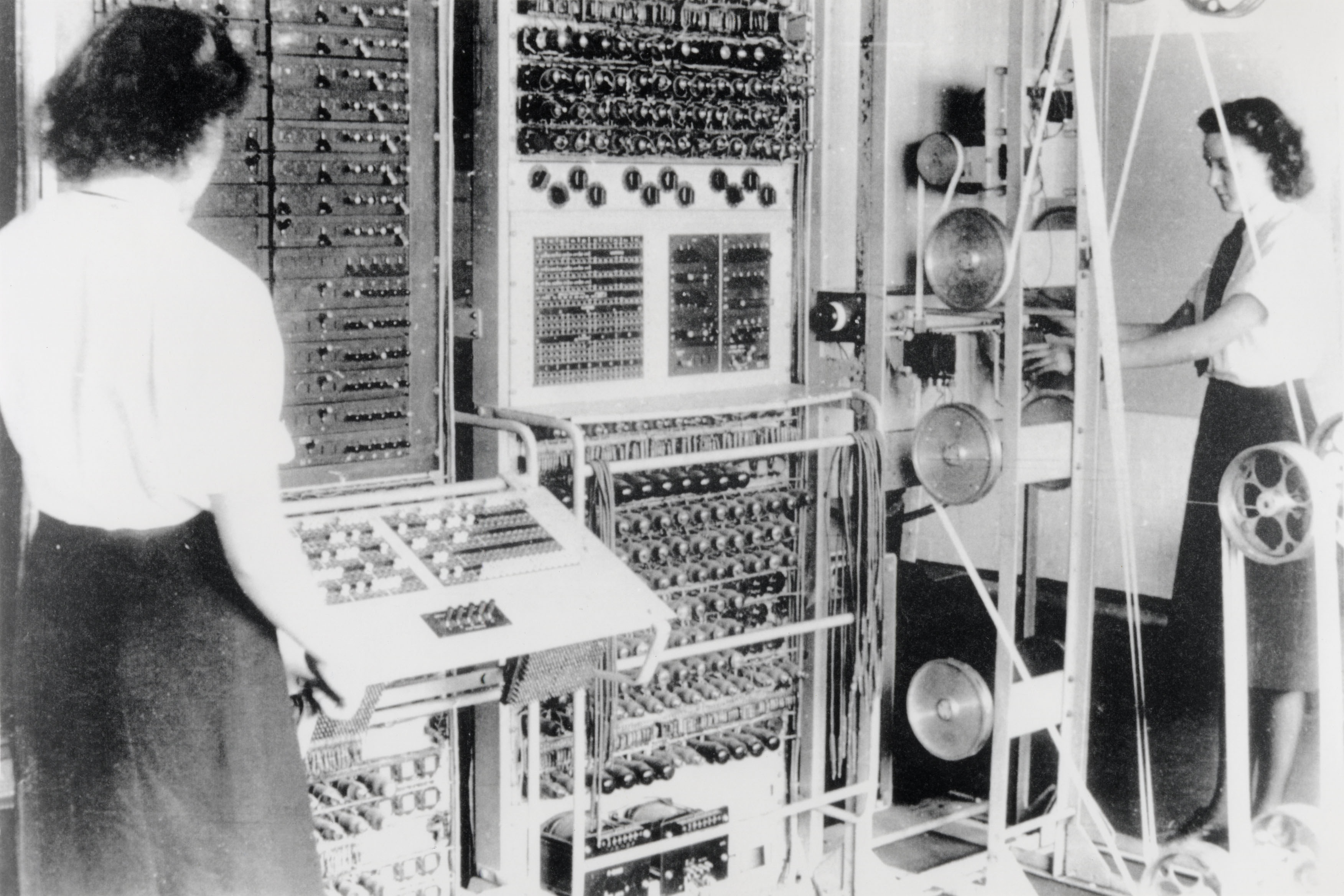
If I recall, the original British Colossus system had a long strip of punched paper tape for data input. You see the loop at the right of the photo:

Colossus.jpg


And, there was no "memory".
 
Back
Top