• Hey Guest!
    British Car Forum has been supporting enthusiasts for over 25 years by providing a great place to share our love for British cars. You can support our efforts by upgrading your membership for less than the dues of most car clubs. There are some perks with a member upgrade!

    **Upgrade Now**
    (PS: Upgraded members don't see this banner, nor will you see the Google ads that appear on the site.)
Tips
Tips

TR2/3/3A Commission Numbers TR3

angelfj said:
This is valid for any TR that has not been stripped to the bare metal.

Or assembled from parts of 3 or 4 other cars! (as most of mine have)
 
Thanks again for all of the input from the group.....I will get to see this car again in a few weeks. It is in storage, so to speak, so will be able to put all the advice to work and maybe pull the rest of the numbers for some more research....
 
Wow, that is one LOW number car; certainly in the earliest batch of TR3B production! I'll be interested to see especially what your engine number is (not to mention the body number) and whether said engine is the original. With a car that low in commission number, it seems likely that it could have a high TS engine number or a TSF engine number. Years ago, a local club member had just the opposite: a completely original very, very late 3A with a very low TSF number engine!
 
I have a British Motor Industry Heritage Trust Certificate for my 1959 TR3A. My car is TS37971-LO. It was built on October 22, 1958. Yours is about 2000 numbers ahead of it on the line. 1958 went from TS25633 to 41629. Sixteen thousand cars over the year or roughly 1333 per month, assuming a regularized process (hah!). Should put you in August or September, 1958.

My car was shipped on November 4, 1958 to New York.

Remember that British cars were registered in the year they were first sold so, even though the car was built in 1958, mine is registered as a 1959. I this why I have seen people selling "1963" TR3B's even though none were built after September, 1961. (All per the Moss catalog)

Hope that helps.
 
smdichter said:
Remember that British cars were registered in the year they were first sold so, even though the car was built in 1958, mine is registered as a 1959. I this why I have seen people selling "1963" TR3B's even though none were built after September, 1961. (All per the Moss catalog)

Hope that helps.
I don't know where Moss got that information, but according to the VTR page on TR2-3 production dates and numbers:

<span style="font-weight: bold">TR3B</span>

<span style="font-style: italic">1962</span> (Mar)
TSF1 TR4 all synchro gearbox
TSF219 Changed Disc Brake Caliper Mounting
TSF265 Changed Rear Shock Absorbers
TSF284 Minor Change to Front Suspension

<span style="font-style: italic">1962</span> (Sep)
TSF530 Last w/TR3 engine

<span style="font-style: italic">1962</span> (May)
TCF1 First w/TR4 engine

<span style="font-style: italic">1962</span> (Oct)
TCF2804 LAST TR3B

At one time I owned TCF1564L, which was built in late summer 1962 according to the build record I got for it (don't remember the exact date at the moment).

As for "date built" v. "date sold," what applied to British cars back then pretty much applied to all cars. Seems to me that, for many, many years, the US automaker "changeover" date would've been sometime in August of each year, as it was invariably in September that the "new" models would be introduced.
 
Our Tr3 is TS37148L and the build date was Oct. 7 1958. And the shipping date was Oct. 22nd Delivered to Los Angles.
 
Andrew Mace said:
As for "date built" v. "date sold," what applied to British cars back then pretty much applied to all cars.
I don't believe that is quite right, Andy. American cars were always different from year to year, making it more or less impossible for dealers to claim that last year's model was actually this years. Typically in the fall, you could choose either this year's model (at a discount) or next year's model (with no discount or at least less discount).

But Triumph dealers appear to have never sold a car as "last year's model" even if it was. You may recall, I had a Sports 6 that was made in 1963, and sold as a 1965 model. I have also heard of TS- series TR3As being sold as 1963 models (and bearing the STC tag to prove it)
 

Attachments

  • 23208.jpg
    23208.jpg
    41.7 KB · Views: 398
TR3driver said:
Andrew Mace said:
As for "date built" v. "date sold," what applied to British cars back then pretty much applied to all cars.
I don't believe that is quite right, Andy. American cars were always different from year to year, making it more or less impossible for dealers to claim that last year's model was actually this years. Typically in the fall, you could choose either this year's model (at a discount) or next year's model (with no discount or at least less discount).
Well, I think we're both right! :wink: Perhaps I could have worded that a bit better. My point was that Acme Motors (or any other company) didn't necessarily call everything it built from 1/1/61-12/31/-61 a "1961" model. Yet there are those folks who have long insisted that -- for example -- their early Spitfire 4 built in November or December 1962 is in fact a 1962 model. Kinda silly when you think about it, as the US introduction of the Spitfire 4 was in January 1963, when it would have looked pretty silly for them to have introduced their brand-new 1962 Spitfire!

And then there's the famous 1964 1/2 Ford Mustang. I vaguely recall hearing way back when that Ford was successful ultimately in getting most if not all of those early Mustangs to be considered 1965 models. But even today, any number of new models have been introduced early in the year preceding their "model year."

TR3driver said:
But Triumph dealers appear to have never sold a car as "last year's model" even if it was. You may recall, I had a Sports 6 that was made in 1963, and sold as a 1965 model. I have also heard of TS- series TR3As being sold as 1963 models (and bearing the STC tag to prove it)
On this point I agree about 99.9%, with the only "qualification" being that it would appear not all the dealers or regional distributors used (or needed to use, perhaps depending somewhat on local laws and/or interpretation of same) the "STC-" tags. Classic example is the Herald 1200 convertible my dad bought new in early January 1964. Many years later, I received a BMIHT certificate confirming what I'd long suspected: it was actually built in late June 1963, was shipped a good bit after that to the US...and first sold in 1964. It's always been considered by NY's DMV as a 1964 Triumph, and I have no problem with that!

In thinking whilst composing this reply, I wonder when a "year" designation was first required on the "Monroney" sticker. If this is typical, I'm guessing it might not have been required until sometime after the various Federal safety and emissions standards began to take effect. (I say sometime after, since some of the early standards were applied to "cars manufactured for sale on or after 1/1/68, for example.)
 
Andrew Mace said:
Perhaps I could have worded that a bit better. My point was that Acme Motors (or any other company) didn't necessarily call everything it built from 1/1/61-12/31/-61 a "1961" model.

Not a car, but later Triumph motorcycles had year models which spanned from August the year before through the following July. The VIN/commission number also included alpha codes to indicate the model, month and model year.

My 1972 Tiger's VIN number is TR6RVEG56755 and the EG indicates it was produced in May 1972 (E=May and G=1972), but one that had JG (J=August and G=1972) would actually have been made in August 1971.

A little confusing but kind of nice to have that information without sending off for it!

Scott
 
Andrew Mace said:
My point was that Acme Motors (or any other company) didn't necessarily call everything it built from 1/1/61-12/31/-61 a "1961" model.
Yes, of course. The definition of a "model year" is pretty much up to the manufacturer, the only legal definition appears to be that it must include Jan 1 of the given year. That means that as early as 1/2/61 (to follow your example) could be billed as a 1962 model year!
https://www.law.cornell.edu/uscode/html/uscode42/usc_sec_42_00007521----000-.html

And as I recall, for a long time, the American maker's start of a "model year" kept creeping up, because each wanted to be the first to announce next year's model. In fact, here's an interesting chart I just found, showing that GM announced some 2010 models as early as April 2009!
https://images.thetruthaboutcars.com/2009/03/image004.jpg

<div class="ubbcode-block"><div class="ubbcode-header">Quote:]... it would appear not all the dealers or regional distributors used ... the "STC-" tags.
[/QUOTE]Agreed.
<div class="ubbcode-block"><div class="ubbcode-header">Quote:]
In thinking whilst composing this reply, I wonder when a "year" designation was first required on the "Monroney" sticker. [/QUOTE]
As best I can tell, it is still not a legal requirement on that sticker. Here's a link to the US Code section, and there seems to be no mention of dates:
https://www.law.cornell.edu/uscode/html/uscode15/usc_sec_15_00001232----000-.html

However, I believe the (permanent) emissions tag is required to have the model year for which the car meets the standards, which is generally the same as the model year of the car.
 
Below are posted two copies of bulletins from CAL Sales, Inc. which could be relevant to this discussion:


CAL Sales, Inc.
Bulletin #26
28 October 1954

Notice To All Dealers:

This will serve to confirm that the Factory is agreeable to cars held in stock being redisignated as 1955 models, in view of the fact that no new model is being presented at the Earl's Court Motor Show, and that any changes are regarded as progressive manufacturing improvements.

This applies equally to Doretti's which you have in stock.

----------------------------------------------------------------------------

CAL Sales, Inc.
Bulletin #132-A
22 October 1956

To: All Triumph Dealers

We want to thank you for the prompt response to our Bulletin No. 132.

Your immediate action will undoubtedly assist you with our sales program and help us reorganize our records for this reclassification.

In accordance with your request, we are pleased to acknowledge the following Triumph TR3 Sports Cars as being 1957 models:

TR3, Serial Nos. : TS-12630-L
TS-11379-L


gary
 
It is my understanding, that the model years designation was not required until 1982, when the current 17 digit VIN # was required by the feds. At that time, and still, the 10th digit is the designation for the year model. Each decade <span style="font-weight: bold">can</span> bring a new system, for example a 2011 has a "B" for the year code, and 2010 had an "A". The rest of the word has generally followed our 17 digit VIN #, but all have not used the same code for each digit.
Also, it appears that the British car industry was on a different planet from the American car industry.Duh
The American car industry was very resistant to making changes in mid year, and mid model, unless absolutely necessary, while the Brits made on-going changes, regardless of the year, or time of year. Most of the Brit cars were improved and modified during the model build to "improve the breed" and hence the problem of knowing what part was in what car, except by the tracking of the vehicle #.
Cheers,
Scott in CA
 
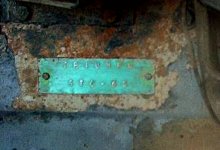
So found out some more information on Car # two....the body number and the engine number are all within 40 numbers of each other.....the only thing that doesn't look original is the overdrive transmission.....If so it would have a O stamped after the commission number.....

Anyway all in all I would say I am pretty happy with the rest of the numbers....got some more photos of the other parts also.
 
My 59 (60) TR3 commission number is exactly 100 numbers from the engine number. From what I've read from TRA the numbers should be within 100 of eachother.
 
One of the other JP's has a wicked sense of humor.
Just a long diatribe that didn't work
 
OK....I was hoping that my disheveled appearance didn't have me categorized as a schmegeggy like other JP's. But I would like to hang around and contribute to the group and gain enough knowledge to become impecunious while working on my project.
 
Back
Top