
I read the Faq on the Buckeye site about using a 1/4 bolt as a back up for the pin. They recommend drilling the hole with an undersized drill bit so the bolt can be a force fit. Can someone confirm that a D(0.246) is the correct bit for a 1/4 bolt? Are these Lettered bits a specialty item? Can you get them individually or do you have to by a complete set. Karl


-
 Hey Guest!
British Car Forum has been supporting enthusiasts for over 25 years by providing a great place to share our love for British cars. You can support our efforts by upgrading your membership for less than the dues of most car clubs. There are some perks with a member upgrade!**Upgrade Now**
(PS: Upgraded members don't see this banner, nor will you see the Google ads that appear on the site.)
You are using an out of date browser. It may not display this or other websites correctly.
You should upgrade or use an alternative browser.
You should upgrade or use an alternative browser.
Clutch fork fix Re: the 1/4" bolt repair.
- Thread starter karls59tr
- Start date
Karl-The body of a 1/4" bolt that I have is .246" as is a D drill. The problem is that a drill bit may cut slightly oversize and the bolt won't be a tight fit in the hole. On the last fork I drilled, I used a C drill (.242")and used a lathe to fit the bolt to the hole. Letter drills are available indivdually or sets from industrial suppliers or you might persuade a local machine to drill the hole. The alternative by Tom using a taper pin is also a possibility. The Buckeye article has a good explanation of why the pins break-the hole on the "far side" of the fork is too large to support the pin. A solution is to make a bushing in the hole that is a tight fit for the pin.
Berry
Berry
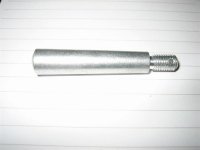
I used a second taper pin. It is a specialty pin with a threaded end on the small end of the taper. I wrote it up and placed it in the WIKI. I have also looked but the links to the WIKI don't seem to be up yet.
Do you mean you posted a link to Wikipedia thru this forum? I'm not sure how to access the link?

dklawson
Yoda
Offline
Speaking for him... I believe he means he turned down the diameter of the bolt until it just fit the hole. Alternatively you could drill first with a C drill, then finish with the D drill. The bit may still cut a bit oversized but the use of a close diameter pilot hole should minimize that.
Local machine shops may sell you the bits you need. Failing that, try McMaster-Carr (mcmaster.com). McMaster will have the bits you need and sell you any quantity or a set. If that is not in your budget, buy a complete set from someplace like Harbor-Freight. If you use Harbor-Freight bits... measure the bits carefully before use to make sure they are correctly sized and be sure to use that close pilot hole before drilling the final hole to size.
Local machine shops may sell you the bits you need. Failing that, try McMaster-Carr (mcmaster.com). McMaster will have the bits you need and sell you any quantity or a set. If that is not in your budget, buy a complete set from someplace like Harbor-Freight. If you use Harbor-Freight bits... measure the bits carefully before use to make sure they are correctly sized and be sure to use that close pilot hole before drilling the final hole to size.

tomshobby
Yoda
Offline
Do you mean you posted a link to Wikipedia thru this forum? I'm not sure how to access the link?
I used a pin like this. The WIKI pages were linked on BCF. I did not find the link so it may not have been added yet.

TR3driver
Great Pumpkin - R.I.P
Offline
Here's the link for MMC, but I'm not sure if they will ship to Canada or not.
https://www.mcmaster.com/#catalog/118/2447/=k96t4f
Probably best to check your bolt though, before ordering the drill. They aren't necessarily all the same size.
https://www.mcmaster.com/#catalog/118/2447/=k96t4f
Probably best to check your bolt though, before ordering the drill. They aren't necessarily all the same size.
tomshobby
Yoda
Offline
Speaking for him... I believe he means he turned down the diameter of the bolt until it just fit the hole. Alternatively you could drill first with a C drill, then finish with the D drill. The bit may still cut a bit oversized but the use of a close diameter pilot hole should minimize that.
Hi Doug, I used to do it that way with a drill a little smaller than the finish drill. Had trouble with the finish drill wobbling while starting it and often having it chip the cutting edges. Then I found that a pilot drill the size of the web thickness worked better, at least for me. I use a caliper to measure the web and use a drill that size or slightly smaller for the pilot.
Karl-Sorry for the fuzzy description. I did turn the dia. of the bolt to fit the hole. Actually, just a file and emery cloth was needed. A taper pin is the best solution, but requires a tapered reamer, that will probably never be used again. It is good advice to check the dia. of the bolt before ordering a drill.
Berry
Berry
When I replaced my clutch fork, I had a machine shop drill the fork and shaft as an assembly. Although I asked them to drill so that the 1/4" bolt (which I supplied) would be an interference fit, they didn't - they used a 1/4" bit so the hole was oversized. The 1/4" bolt measured something like 0.240" along the shank and the hole was on the order of 0.258". After I was not mad anymore, I bought a 7mm bolt of the correct length and turned it down using only an emery cloth and a cheap electric drill. In this case, the bolt only serves to prevent the fork from rotating if the taper pin should break - it doesn't provide much reinforcement to the taper pin, I think.
If I to do this again, I'd first measure the bolt then I'd determine the bit size, which is what I assumed the machine shop would do.
If I to do this again, I'd first measure the bolt then I'd determine the bit size, which is what I assumed the machine shop would do.