• Hey Guest!
    British Car Forum has been supporting enthusiasts for over 25 years by providing a great place to share our love for British cars. You can support our efforts by upgrading your membership for less than the dues of most car clubs. There are some perks with a member upgrade!

    **Upgrade Now**
    (PS: Upgraded members don't see this banner, nor will you see the Google ads that appear on the site.)
Tips
Tips

clutch-any conversions out there?

trfourtune

Jedi Knight
Offline
hi all,
has anyone found a clutch conversion that uses a different pressure plate and disc other than a racing item. i've heard too many bad clutch stories out there. i was thinking of something like a toyota twin turbo supra clutch being used, redrill the flywheel to suit with a different clutch dis-engagement system. i have read all about the center relase mechanisms from the uk suppliers and the hvda ? system with the toyota conversion but it seems to me that the tr4a,250,6 clutch basically sucks and i want a street clutch not a racing clutch.
or am i going to have to engineer this myself.
rob
 
Bought an upgraded clutch set up for my TR6 from Scott Harper at Team Triumph in Warren, OH. (330)392-7176. I've heard good things about it but only have about 15 miles on mine. Feels about the same as my old one foot pressure wise, but only time will tell on durability.
 
rob, your biggest problem will be the splines in the disk. From all I have seen and heard, it's the pressure plate that gives most of the problems. TRF has a good German one. Wayne
 
i hear of trouble with the borg & beck pressure plate "coming apart"
i realize the spline issue.
rob
 
Hello all,

with more than twenty years (continuously) of everday driving of Triumph 2.5's (saloon rather than sports car) the only weak part of the clutch that I now always replace is the nylon flexible hydraulic hose. (I replace it with metal and a short flex) Other than that I haven't had clutch problems. I don't know why so many people seem to have trouble? Really it is far easier to do a proper rebuild than go the modification route.

Alec
 
Hi,

Alec, /ubbthreads/images/graemlins/iagree.gif with you.

For normal, daily driving most standard TR clutches are fine. Just my opinion, but I think a lot of so-called "clutch problems" can be traced to a list of relatively small things that eventually turn into major issues and actually have fairly easy solutions. A partial list of common problems/solutions:

- TO bearing improperly installed (It needs to be spun while pressing in place, or there is a risk of damaging it. TRF sells an inexpensive tool to do this. Or, buy one pre-installed, which TRF also sells. Or, use a Gunst bearing if concerned about the quality of the OEM style TOBs. Some folks have had good luck with other brands of TOBs, search the archives.)
- Misalignment of the gearbox & engine (add dowels to help it align, earlier cars had them and didn't have the problems)
- Broken dreaded taper pin (always replace with a new, high strength pin *and* add a backup bolt)
- Worn pins in the ends of the release fork. (Replace the two actuating pins in the release fork that get flattened on the sides over time and become sloppy, or replace the entire fork if concerned about replacing those pins yourself.)
- Worn and sloppy linkage, Triumph changed to non-servicible/non-adjustable stuff on the later cars (Replace SC pushrod with an adjustable type, use a new clevis and cleavis pin. Also use the early type cross shaft that's greasable, along with the wider/greasable early bushings in the bell housing, all of which the earlier cars had and didn't have problems).
- Incorrect attachment of linkage. (All TR's should use the middle hole in the clutch lever, to attach the SC pushrod... using the top or bottom holes in the lever can over- or under-extend the clutch, or might hide a problem such as a broken dreaded taper pin).
- Triumph changed the master cyl. to .70" on later cars to make the clutch pedal softer and easier. (Change to earlier size .75" MC that will give you more margin for error and adjustment, although the pedal will be slightly heavier).
- Leaky master or slave cyl. (Check that there is a minimum of 5/8" movement of the SC pushrod. If not, MC and/or SC need rebuilding or replacement. Also, probably many MC & SC have just had rebuild kits put in them, but still have scored cyl. walls that makes them fail. Might need to buy new or have the old one sleeved to correct for this. www.applehydraulics.com installs sleeves.)
- Incorrect mounting of the slave cyl. (Check the service manual or a restoration book for a photo of the correct mounting. It's possible to install wrong, so that the pushrod isn't reaching the linkage to move it.)
- Avoid incorrect clutch pressure plates. (For example, a B&B pressure plate was being sold in years past that was too heavily sprung and caused rapid wear and tear of TOB and linkage, early failure of the clutch system. It can be recognized by a dot of green paint on it. Good, reputable vendors will sell you the right stuff. Stick with the blue dot B&B, or AP/Lockheed replacement pressure plates to avoid concerns. Or, have an original Laycock rebuilt, if you have one. www.revingtontr.com does rebuild/exchanges.)

If memory serves, that covers the majority of items. But, there probably are other things, so search the archive.

There are aome alternative clutches. For example, I know Tilton makes a good 7.25 or 7.5" clutch set that can be used. Actually they make two: but one is a lightweight race clutch and probably not the best idea for a daily driver. The other is a slightly heavier but more durable "rally" clutch that might be best for all-around use. On my TR4 I'm thinking about trying this clutch combined with an annular hydraulic release. Should make for a pretty bulletproof setup, plus give a nice pedal and fast shifts.

It is a pain to have to pull a gearbox and do clutch work after only a few miles on a new setup. Done carefully and right, I think this can be avoided in most situations. It's mostly just a matter of good installation to insure these clutches last a long time. There have been poorly matched or poorly made items sold in the past, but today most good reputable vendors know what to offer and what to avoid.

/ubbthreads/images/graemlins/cheers.gif

 
alan,
i looked into the "rally clutch" alternative and found it "not recommended" for street use. you may want to investigate further. remember i am building a hot tr4 as you are also and the tr4a/tr6 clutch is not reliable when pushed! i plan to push!
rob
 
I never thought there was a problem with the Beck and Borg clutch. Every time I had an engine out years ago, I would just change the clutch because I had heard the rumors.
In January my clutch went out. I estimate that I had 25-30,000 miles on it. It was not slipping or giving me any indication of failure. After pulling, I found that the disc backing plate had broken allowing a spring to drop and take out the pressure plate.
If my bearing had been improperly installed or anything else done wrong at installation, the unit surely would have failed before this time. I don't beat on the car, my idea is I always want to have my own ride home so take care of the machinery. The disc was in very good condition excluding the breakage. Everything else appeared to be in good working order except for the damage caused by the spring.
I've heard of large trucks having this same problem, but not small cars. This problem I would blame on the clutch assembly.
The new clutch I mentioned earlier is heavier duty. The most notable item is the TO bearing which is considerably beefier. I had a list of what cars these parts came from, unfortunately I can't find it at this time. I seem to remember Isuzu Trooper and maybe Toyota.
I have about 100 miles on the clutch and it is working great,as it better.
 
[ QUOTE ]
i looked into the "rally clutch" alternative and found it "not recommended" for street use.

[/ QUOTE ]

Hi Rob,

I might be wrong, but I believe the main complaint against the Tilton rally clutch is a heavy pedal due to strong springs, that would make it uncomfortable on the street. Actually, the same thing makes it more durable.

I was under the impression that using an annular hydraulic clutch release would make it more useful for street (wouldn't consider it for street use, unless combined with the release).

Could be wrong, though, and I will investigate some more before spending any $$$s. (Tilton stuff ain't cheap!)

Thanks for the heads up about this!

/ubbthreads/images/graemlins/cheers.gif
 
Hi All,

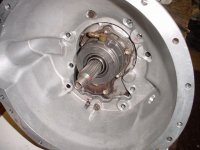
I just finished a HVDA Toyota 5-speed conversion using the McLeod hydraulic TO bearing (pic attatched). I don't have alot of miles on it but so far I'm very happy with the pedal feel & control. This set up shortens the pedal travel as well. Herman has done all the research and testing in order to offer a truly superior product. Although this is used on the track it would work very well for street use. Even using a B&B pressure plate the pedal effort is light.

To be fair I have to say that I have used a B&B disc/pressure plate combination for years with perfect results. The only time I had a problem is many years ago I used a remanufactured pressure plate & the fingers were improperly set or tensioned & this required the use of the top hole in the lever arm to work properly. After using the Gunst bearing with new bronze sleeve, adding the second fork bolt and adding additional clutch shaft bushings it worked perfectly for many miles of street abuse. It also handled the additional HP. Realisticlly a standard replacement clutch should handle all that a highly modified TR4 can throw it's way. Once again I'll quote from Kastner's Prep manual "The majority of our testing was accomplished with the standard clutch and flywheel units. The clutch is of the diaphragm type and completely adequate for the job of racing with increased power". He does go on to mention that higher revs would shake the cover loose & additional dowels would be installed.

Over the years many questionable parts have hit the market but eventualy because of forums like this , these inferior parts are exposed and manufacturers & suppliers are forced to source out better parts or get a bad reputation. This also makes suppliers bring new & better products to market to fill the demand to make these cars reliable.

I am amazed at some of the improvements and cool stuff that has been developed in the past five years alone.
 

Attachments

  • 195664-hydclutch.jpg
    195664-hydclutch.jpg
    136.2 KB · Views: 96
I agree with the comments that (other than the clutch fork pin problem) the stock clutch should be pretty reliable. That said, my pressure plate came apart at one of the ears that hold a finger (how's that for a mental picture?).

clutch1.JPG


Proving that no system is bullet-proof. I did add the extra quarter-inch grade 8 bolt thru the fork and cross-shaft while i was in there.
 
Back
Top