• Hey Guest!
    British Car Forum has been supporting enthusiasts for over 25 years by providing a great place to share our love for British cars. You can support our efforts by upgrading your membership for less than the dues of most car clubs. There are some perks with a member upgrade!

    **Upgrade Now**
    (PS: Upgraded members don't see this banner, nor will you see the Google ads that appear on the site.)
  • When posting a classified ad, you MUST select a prefix from the drop-down next to the subject line. If you don't you will get an error and your ad will not be posted!
Tips
Tips

Charging Issue....still

D

DougF

Guest
Guest
Offline
Having replaced the wiring harness, ammeter, voltage regulator, and had the alternator checked out with the rectifier being replaced, my TR6 ammeter is still reading about +20 while running. Same problem as prior to all this work. Also part of the old problem was that the battery was not charging. I can only assume this still exists.

The harness had a major short, the rectifier was bad, and the regulator was replaced as more of a precautionary measure, figuring the old one was damaged as a result of the prior issues. The ammeter, I swapped out this morning because of the problem still existing. The old one showed strong evidence of high heat that I thought could have caused damage.

I'm going to test the alternator output. I can't think of anything else that could be causing the problem.

I don't want to cook my new harness. Any thoughts?
 
The original battery(new last summer) worked with the same results as the one month old unit I just purchased. My hot cable was new when the car was restored and finished in '02. The ground cable is original to the car, and seems to work well. All cable ends have been treated with an anti corrosive, conductive copper antiseize that is made for this purpose.

The engine runs fine and doesn't demonstrate any grounding issues. All ground wires and butt connections have been treated with the same antiseize.
 
First step, get a good voltmeter and check the voltage right at the battery, with the engine at fast idle. If it is over about 14.5 volts, then the alternator is definitely putting out too much voltage, meaning you have to figure out why and fix it. Could be that the internal regulator has failed, or possibly just that the 'sense' input is not sensing true battery voltage. Lots of other possibilities too, but it has to be something causing the voltage regulator to not reduce the voltage output.

If it is less than 14.5, then you need to find where that 20 amps is going. Could be just that the battery is not fully charged, or it may be defective. Or it may not be going into the battery at all, indicating a wiring problem of some sort.

BTW, have you checked that the ammeter acts normally with the engine off; ie deflecting substantially to the "-" side when you flip the headlights on then returning to zero when you turn them off?
 
My measurement at the battery was 13.78. The battery spent the past day on a trickle charge and was holding a good charge. The engine copped an attitude this afternoon and required considerably more cranking than normal and it held up fine.

Both ammeters were showing a negative jump from the electric fan and of course the starter.
 
Well, the battery should not be taking 20 amps at 13.78 unless it is somewhat discharged (perhaps from starting the engine) or defective. How long have you driven with it reading 20 amps? At that rate, it can take an hour or more to fully charge a battery that was at 50%, which is still plenty to start the engine.
 
Since the new wiring harness was installed, the car has travelled 5 miles. The engine hasn't run but 5-10 minutes beyond that.
After the initial start up this AM, a fairly quick one, it read the -20. After the hard start, it was closer to -25.
The only thing electrically different from before this all started is the electric fan, which is wired on full time because of a prior overheating problem.
 
DougF said:
After the initial start up this AM, a fairly quick one, it read the -20. After the hard start, it was closer to -25.
Oops, wait a minute. You said before it was reading charge, now it's reading discharge? Very unlikely if you are seeing 13.78 at the battery.
<div class="ubbcode-block"><div class="ubbcode-header">Quote:]
The only thing electrically different from before this all started is the electric fan, which is wired on full time because of a prior overheating problem. [/QUOTE]
Any chance the fan is wired to the wrong side of the ammeter? If it's wired on the battery side (eg at the starter solenoid), then you would expect to see a constant charge indicated (of the current going from the alternator to the fan).
 
Sorry Randall. I was rushing out the door when typing the last entry. They were positive readings.

I'll look at the wiring again in the morning. I wired it as per the supplied diagram from the fan maunfacturer.

On second thought, I'll disconnect the fan to check if it is the culprit.
 
Disconnecting the fan put the ammeter to zero. The hot wire was connected to the positive side of the battery.
 
Time to hide a fan switch. :wink:
 
With or without a switch, you should move the take-off point to the alternator side of the ammeter, IMO. The instructions were written for cars without ammeters (which is practically everything since 1975 or so).
 

Attachments

  • 23378.jpg
    23378.jpg
    10.9 KB · Views: 196
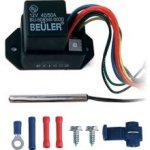
Thanks for the help. I'll look into the controller. Easy winter project.
 
In addition to the thermostat switch, since I'm a fair weather driver, I hooked the fan to the windscreen washer switch that was not in use. Just push the wiper button in and it comes on. Made sense at the time because of relay problems that have since been cured (new relay). Some next owner will cuss me for that, I'm sure.
 
Back
Top