• Hey Guest!
    British Car Forum has been supporting enthusiasts for over 25 years by providing a great place to share our love for British cars. You can support our efforts by upgrading your membership for less than the dues of most car clubs. There are some perks with a member upgrade!

    **Upgrade Now**
    (PS: Upgraded members don't see this banner, nor will you see the Google ads that appear on the site.)
Tips
Tips

Carb Leakdown

go_inbroke

Senior Member
Offline
I'm having an issue with leakdown. I changed the seals between the bowl and carb and found now the issue is at the bottom of the HU. Question: Can I replace the seals at the bottom of the carb (4 at my count) without tearing the whole carb down?
 
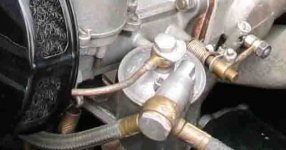
The replacement job will go a lot easier if it's on the bench. It's not that hard to do. My early 1958 TR3A has the original banjo fittings and it was leaking this month under the centering jet for the front carb. There is a cork seal at the bottom and I put in the two gas-resistant O-Rings that Moss sells. It doesn't leak any more and the engine starts immediately on the first push of the starter button. But that was only after I drained out 2 gallons of old gas left in the tank over the winter. It wouldn't run on that old stuff. Might be the Ethanol ! Sure sounds nice now.
 

Attachments

  • 20681.jpg
    20681.jpg
    32.7 KB · Views: 256
That sounds like my problem. After sitting long time button push to start. Both carbs are leaking at the bottom. Do any of the adjustments change during or after you remove the carb?
 
It's not after you remove the carbs, but things will change when you remove the innards to replace the seals. Then you have to follow the steps to re-center the jet, tighten the bottom hex nut and make sure that the center jet is sliding up and down smoothly when you actuate the choke lever on the bottom. Just follow all the assembly steps in the manuals.
 
Just removing the carbs is going to upset the synchronization to some extent; although it shouldn't be much.

I would suggest trying to determine which seal is leaking first. If it is only the bowl mount seals; they are reasonably practical to change on the car, and doing so won't disturb any adjustments. Fairly easy too, as long as you are good at working by touch. Mine seem to only last a few years at best, so I've gotten pretty good at changing them. (Maybe next time, I'll try some of Mark Macy's polyurethane ones.)

Jet seals are more difficult to do on the car, although still quite possible. But you have to disturb the jet centering to get them out, and most likely you'll need to tweak the mixture after changing them. The upper seal leaks fuel into the carb throat, so it screws up the mixture.

Personally, I prefer to set the mixture full lean while checking the jet centering anyway, as that provides a 'worst case' check and ensures they are centered well enough to avoid wearing the jet/needle during normal operation. Worn jets (due to improper centering) are a frustrating and apparently common malady, that can lead to overheating and worse. (Dad's TR3A once scattered engine internals all over the highway, due I believe to worn carb jets.)

If you've never been in there before, I would suggest also changing the spring that goes between the two jet seals. It's not unusual for original ones to be weak from age and corrosion; or to have been distorted by a previous owner frustrated with constant leaks. You'll have to buy the springs separately, they don't come with the kits.

 
I'm having a similar problem on my 59. Carbs were rebuilt and work well.........I finally got rid of the hesitation on acceleration! I have the banjo fittings and both bowls have overflowed and on occasion leaked heavily after starting. Took the tops off and did not see any junk interfering with the float. Reassembled and the problem went away. While I have not pulled the tops BEFORE starting it seems to take a long time to fire. Could the bowls be leaking and emptying? I have an electric pump. Heavy odor of petrol in the garage.. I must have a leak SOMEWHERE. Ideas? Where do i start/
Gordon
 
With an electric pump, dry bowls should not be an issue when starting. As soon as you turn the key on, the pump should fill the bowls. Of course, they still might be leaking.

You might want to check the fuel pressure, as many pumps put out too much for SU carbs. Many vacuum test gauges will also read fuel pressure, eg https://www.harborfreight.com/cpi/ctaf/displayitem.taf?Itemnumber=93547
SUs don't want more than about 4 psi, while most carbs want 7 psi.

Also worth pulling the floats out and shaking them, I found fuel in one of mine just the other day.

Check for any signs that your soft lines are crumbling internally and shedding bits of themselves into the fuel. The bits can block the float valves open and cause intermittant flooding/overflowing. That was the cause of my last overflow.
 
Moss sells complete "jet bearing kits" for about $30 dollars a carb, which came to me in "genuine SU parts" packaging. I was real happy to receive this, as I was having problems locating a correct upper bearing seal that was of the correct thickness. You might just want to consider replacing the whole thing, along with new jets and what the hay, new needles too, to alleviate different sources of leaks (seals, or springs) and replace any worn parts.
 
Joe Curto also furnishes "Genuine SU" bits. He can be a pill at times but usually VERY helpful if you need odd bits for 'em.
 
The carb to bowl seals I just changed. I guess I'll order the jets seals and spring and see if I cant do it on the car. If not, I'll learn how to do it on the bench. Ahhh...another spring (no pun intended) adventure.
 
Back
Top