

-
 Hey Guest!
British Car Forum has been supporting enthusiasts for over 25 years by providing a great place to share our love for British cars. You can support our efforts by upgrading your membership for less than the dues of most car clubs. There are some perks with a member upgrade!**Upgrade Now**
(PS: Upgraded members don't see this banner, nor will you see the Google ads that appear on the site.)
You are using an out of date browser. It may not display this or other websites correctly.
You should upgrade or use an alternative browser.
You should upgrade or use an alternative browser.
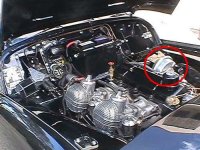
Can you identify this mystery component.
- Thread starter angelfj1
- Start date

wingsandwheels
Senior Member
Offline
That appears to be a remote brake servo. W


YankeeTR
Luke Skywalker
Offline
[ QUOTE ]
Pretty sure it's a remote brake servo, Lockheed and other had them - here's a weblink with a similar photo of the part:
servo
Randy
[/ QUOTE ]
My TR's have always had manual brakes but they come standard with "Armstrong" power steering.... /ubbthreads/images/graemlins/square.gif
BTW...Randy...That's a pretty nice website. It's too bad our British parts suppliers couldn't put together a nice on-line catalog with pictures that actually SHOW you what you are buying!
I've got a hunch if Moss published Playboy all we'd have to look at would be illustrations of girls...not real girls!
Pretty sure it's a remote brake servo, Lockheed and other had them - here's a weblink with a similar photo of the part:
servo
Randy
[/ QUOTE ]
My TR's have always had manual brakes but they come standard with "Armstrong" power steering.... /ubbthreads/images/graemlins/square.gif
BTW...Randy...That's a pretty nice website. It's too bad our British parts suppliers couldn't put together a nice on-line catalog with pictures that actually SHOW you what you are buying!
I've got a hunch if Moss published Playboy all we'd have to look at would be illustrations of girls...not real girls!
OP

angelfj1
Yoda
Offline
The reason I asked, I recall when I was a kid, during the 1950's and 60's, we never owned a car with "power brakes" and of course, nearly all American cars had drums on all wheels. I remember a friend and I went out one night in his father's new Olds 98, a big heavy dinosaur with power brakes. The pedal even said, "POWER". But when I drove it I was constantly locking up the brakes and leaving streaks of rubber everywhere. Todays cars are all power assisted braking and they don't have that old jerky feel. BUT, if you are on a hill and lose power assist it can be fun.
Back in the day when power brakes were somewhat of a novelty, I think we all did the same thing. Applied the brakes as we would on our normally equipped cars, and over braked. I put down a few skid marks myself getting used to assisted brakes. Even now, when I've been driving nothing but manual brakes for awhile, it takes some getting used to when I jump into one of the later, boosted, vehicles.
Jeff
Jeff

martx-5
Yoda
Offline
[ QUOTE ]
... and of course, nearly all American cars had drums on all wheels. I remember a friend and I went out one night in his father's new Olds 98, a big heavy dinosaur with power brakes. The pedal even said, "POWER". But when I drove it I was constantly locking up the brakes and leaving streaks of rubber everywhere. Todays cars are all power assisted braking and they don't have that old jerky feel.
[/ QUOTE ]
Drum brakes generally always have at least on leading shoe, which meant that because of drum rotation, they would tend to self-engage without the need to apply more force on the brake pedal. Adding power assist to this made the brakes much more sensitive, and unpredictable. The worst were the Chrysler products, as they had two wheel cylinders per drum and, therefore two leading shoes. Those brakes could lock up by breathing on the brake pedal. /ubbthreads/images/graemlins/eek.gif
Disc brakes don't have this self-engaging feature, so brake modulation is much more linear in relation to force on the pedal.
... and of course, nearly all American cars had drums on all wheels. I remember a friend and I went out one night in his father's new Olds 98, a big heavy dinosaur with power brakes. The pedal even said, "POWER". But when I drove it I was constantly locking up the brakes and leaving streaks of rubber everywhere. Todays cars are all power assisted braking and they don't have that old jerky feel.
[/ QUOTE ]
Drum brakes generally always have at least on leading shoe, which meant that because of drum rotation, they would tend to self-engage without the need to apply more force on the brake pedal. Adding power assist to this made the brakes much more sensitive, and unpredictable. The worst were the Chrysler products, as they had two wheel cylinders per drum and, therefore two leading shoes. Those brakes could lock up by breathing on the brake pedal. /ubbthreads/images/graemlins/eek.gif
Disc brakes don't have this self-engaging feature, so brake modulation is much more linear in relation to force on the pedal.

NickMorgan
Jedi Knight
Offline
There used to be someone in the TR Register in England who had owned his '54 TR2 since it was a year old. It was the most original car you could imagine, despite it having covered a very high mileage. Anyway, he had a servo fitter there, but it acted on the clutch as he had a bad left leg.