• Hey Guest!
    British Car Forum has been supporting enthusiasts for over 25 years by providing a great place to share our love for British cars. You can support our efforts by upgrading your membership for less than the dues of most car clubs. There are some perks with a member upgrade!

    **Upgrade Now**
    (PS: Upgraded members don't see this banner, nor will you see the Google ads that appear on the site.)
Tips
Tips

Can a Triumph be art?

Swift 6- It is oil paint on canvas, I was using natural ("natural") lighting in the photograph. At CCC we have an Art Studio where I have been painting my car. As a photographer, wouldn't you agree that natural lighting is one of the better lighting methods for color in photographs and paints?

Well, we have lights in the studio which give the appearance of natural light because our studio is in the basement of the school with a strip of windows for the ceiling in the back corner :cry:

I used the strip of light in the studio, Tomorrow I'll try out your idea of using two lights at 45 degree angles. I wish to get a new camera soon. I need a DSLR camera, I've been doing most of my projects in black and white film so I haven't the need for one. I love film so much, but I guess I need to step into the 21st century if I'm going to a 4 year school :frown:

Ken- Ribbon? I plan to stop by Thursday after class, around 4pm. I'm working again at Giuseppe's Italian Restaurant. So sometime you'll have to order food from there :wink:
 
We will be around! We will be dropping the engine in a BMW getting it ready for a track day at the Glen.
 
NikolausConrad said:
Swift 6- It is oil paint on canvas, I was using natural ("natural") lighting in the photograph. At CCC we have an Art Studio where I have been painting my car. As a photographer, wouldn't you agree that natural lighting is one of the better lighting methods for color in photographs and paints?

No, I wouldn't necessarily agree to that statement. Thats the short answer.


Here is the long answer.

"Natural" light is constantly changing; in direction, intensity, color temperature etc... Making repeatability difficult unless you photograph in exactly the same place, same time of day and adjust for seasonality for the suns declination in the sky. Remember that the suns path slightly changes its arc across the sky, constantly but predictably. Using either electronic flash, which is balanced to a color temperature of 5500 Kelvin, which is what color daylight film is matched to, or hot lights (either halogen or tungsten) which are generally close to 3200 Kelvin in color temperature and is what "Tungsten" color film is balanced to. On a digital camera you can find "White Balance" settings that match those numbers to equivalently match the light source. Using "Artificial" light gives you control, which also gives you repeatability. When you are learning how to photograph oil paintings, or planning on photographing more than one, then that control is something you should have in order to achieve the best results.

As far as the lighting goes though; if you don't have the ability to cross polarize the lights and the camera, don't bother, the glare will be too intense and wash out some of the painting. Your best results may come from photographing the painting in the indirect light of open shade (no direct light). In your geographic locale, that would basically mean the north side of a building where you are in the shadow of the building. The color temp could go up to the 7000’s though so you may have to adjust the digital camera accordingly to get a proper balance.

Oil paintings can be very difficult (the brushstrokes can refract the light, which is what makes it look washed out) to photograph correctly and the absolute best way is with cross polarized light. As I mentioned before, it can increase the contrast but if done correctly it is only a slight contrast increase. Properly lit, and exposed, the brush strokes on an oil painting can become clearly defined and as much a part of the photograph as they are of the oil painting.

That is of course from the point of view of a commercial photographer and representing the subject (if that is the task) as truthfully as possible. A fine art photographer is creating the desired expression through the use of the subject, but not necessarily representing the subject truthfully.
 
I do my best to work with whatever lighting is available to me, personally, natural lighting is one of my favorites, which is why I have such a problem with the art studio being in the basement.

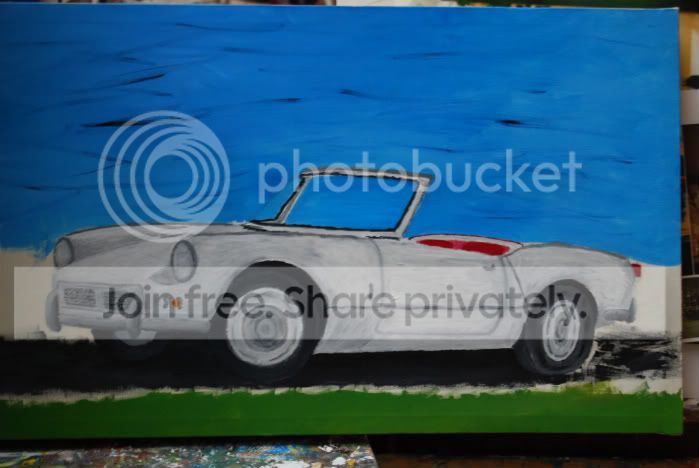
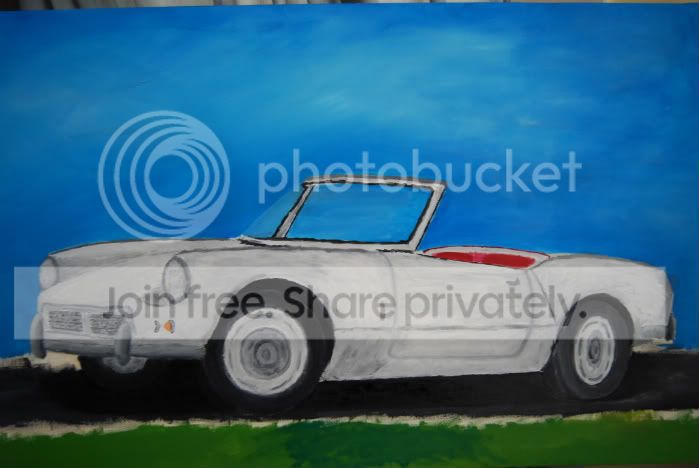
I took pictures with a Nikon DLSR my friend gave me but, I left the memory card at home along with other files :frown: Soooo it looks like that's what I'll be doing tonight. I started painting the foreground and road, touched up the car a bit with turn signals, door handle, and bonnet lift hinge. I also added another layer to the sky giving it more of a range of blues.
 
Update number 5 on my painting. I started the foreground and road and I'm having a tough time getting all the perspectives in place, but it is slowly all coming together. I added door handles, bonnet hinge, and turn signals.

DSC_0197-2.jpg


The main difference between these pictures are I was working with the sky a little. Nothing really was touched up on the car.

DSC_0345-1.jpg


I'll be working on it more this week as the student art show is on the 29th and all works need to be turned in by the 21st of April. I'm freaking out :shocked:
 
Back
Top