• Hi Guest!
    If you appreciate British Car Forum and our 25 years of supporting British car enthusiasts with technical and anicdotal information, collected from our thousands of great members, please support us with a low-cost subscription. You can become a supporting member for less than the dues of most car clubs.

    There are some perks with a member upgrade!
    **Upgrade Now**
    (PS: Subscribers don't see this gawd-aweful banner
Tips
Tips

TR2/3/3A Cam Bearing Tool Dimensions

mastaphixa

Jedi Trainee
Country flag
Online
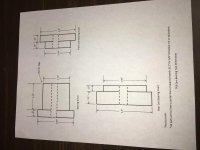
Would someone please provide me the dimensions of the cam bearing tool piece that fits inside the cam bearing and drifts it into place? I have access to a lathe and would like to make one.
Steve Baker
 
Just measure an insert, and subtract about .030 or .040 from the measured od and id.
 
Randall, if I had an insert I certainly would. Mine are all in my block and I want to remove them. I can figure the id from the cam, that's no problem. I'm just not sure about the size of the od of the insert. I'm sure someone has an insert laying around they could measure for me?
Thanks,
Steve
 
Autozone/O-Reilly’s rents a kit that will pop and replace them, whatever the size.
 
I made one not too long ago. The ID is 1.715 inches and the OD 1.830. Mine is only a half inch thick; it works OK, but would be better if it were and inch--it would hold the bearing straight more easily as it is inserted. You can see it in action at https://www.nonlintec.com/tr4a/engine2/#assembly .
 
Have you considered having your old bearings remetalled and then line bored with the bearings in situ for accurate fitment of the camshaft.
 
Have you considered having your old bearings remetalled and then line bored with the bearings in situ for accurate fitment of the camshaft.

Cool...that’s a really old school technique, like Model T!
 
The important part is that once the remetalled bearings are in place, the line boring is done to suit the camshaft perfectly.
IMHO...Just installing new bearings and then the camshaft without a line bore check is not precise enough.
 
What problems have you seen doing it the way the factory intended?
 
I have not "seen" any problems.
My thoughts are....How can you be sure that new bearings pressed into place with either old or new camshaft have the correct clearance and alignment.
 
I measure the bore with mics and hole gages. If not in alignment, the cam will bind. Like I said above, your technique is a throw back to the Model T era, when bearings were cast in place and had to be line bored to size and alignment. As old as our TR’s are, they fall into the more “modern” manufacturing era, when bearings are precision cast using layers of different soft metals within steel shells and sized to 1/10,000,000 of an inch. Unless the block was bored wrong during initial manufacture, mis-alignment of the cam bores is just not a problem. If it were, the cams would have failed, like 50 years ago, showing the flaw long ago.

I am not at all criticizing your meticulousness. After all, your technique of bearing repair was used to keep thousands of Model T’s on the road for over a million miles each! Here in the states it’s pretty much a lost art, though. I live in a city where, Boeing, Lockheed, Bell, and several other companies produce aviation products. I am blessed with being driving distance to many very cool, state of the art, metal processing companies...and I would be hard pressed to find a company willing to cast and bore bearings inside a 60 year old block!

 
I've removed and insatalled cam bearings in wet liner engines a number of times and never experience cam binding. You must be careful that the oil holes line up as well as the holes for the block bolts. The rearmost bearing has 3 holes that need aligned. Sometimes the bearings rotate while going in so double check hole alignments. My last set were from BPNW and went in with no rotation. Cam bearing manufatures know what they're doing, no need for any boring in my opinion.
 
Have you guys heard of the Aussie song by the group "Men at Work".........."I come from a land down under"..... I am fortunate enough to have a highly skilled engineer close by.
If I was ever to rebuild another TR engine, I would do the same again ........Happy Christmas every one.:smile-new:
 
Below is a drawing I used to make a workable cam bearing installation/removal tool. The rear bearing insert is to be used (after the cam blanking plug is removed from the rear of the engine block) to install/remove a bearing from the back of the block. Hope this helps. Sorry, for some reason the attached image insists on loading sideways.
Steve Baker
 

Attachments

  • IMG_3432.jpg
    IMG_3432.jpg
    40.7 KB · Views: 139
I have new cam bearing in my re-built engine but, The builder forgot to re-install the cam bear bolts (3). Is there a safe way to now install these bolts as I can just imagine the oil that would come out of those holes.

Dick
 
Yeah, they pour oil pretty good. I had one fall out years ago. Fortunately, a friend of mine was behind me and complained I was oiling his windshield :smile:

As long as everything is just right; the insert holes are accurately centered in the holes in the block; and you have the right pins with the right flat washers; it should just go together with no fuss. But the devil is in the details; if the pin catches the edge of the bearing insert, it can bend it and cause the bearing to bind. I elected instead to install a shorter bolt, with a nut & washer (plus of course the pin is somewhere along I-70 east of Indianapolis). Never had a problem with the insert moving, but of course YMMV.
 
Yes, those bearings fit pretty tightly, and I have a hard time seeing how you could spin one. (Having said that, I expect that someone will chime in and say he spun one once!) I was tempted to leave out those setscrew bolts, especially since the holes didn't line up well when the oil holes were correctly located, but I eventually got everything to fit.
 
Back
Top