

-
 Hey Guest!
British Car Forum has been supporting enthusiasts for over 25 years by providing a great place to share our love for British cars. You can support our efforts by upgrading your membership for less than the dues of most car clubs. There are some perks with a member upgrade!**Upgrade Now**
(PS: Upgraded members don't see this banner, nor will you see the Google ads that appear on the site.)
You are using an out of date browser. It may not display this or other websites correctly.
You should upgrade or use an alternative browser.
You should upgrade or use an alternative browser.
caliper?
- Thread starter mtlman8
- Start date


Offline
Split the two halfs and use compressed air and towels to guard against spilt brake fluid and flying cups. I place the half caliper face down to the bench, so there is not much room for the cup to escape. Do not loose or damage the seal that fits between the Halfs, as these are not supplied with the re-build kit. Be sure to use plenty of the red brake assembly grease when you re-fit the cups.
Cheers,
D.
Cheers,
D.

Geo Hahn
Yoda
Offline
Not necessary to split the caliper unless that is what you really want to do.
If the caliper is still attached to the hose -- I remove the old pads and use the brake pedal to ease the pistons out as far as possible.
I use some shims (e.g. pieces of 1/8" masonite) to let the pistons out a bit at a time trying to keep them about equal. IOW if one piston wants to move more easily I secure it with the shims between it and the rotor until the other piston has moved as far. In the end one of the pistons will come out completely (be prepared for a mess as the fluid pukes) but if you were careful the other will be very close to coming out and can be removed with channel locks (if you are replacing the pistons) or something more gentle if you hope to reuse them.
Once one side is done I use hose clamping pliers on that line whilst I give the opposite side the same treatment.
If the caliper is still attached to the hose -- I remove the old pads and use the brake pedal to ease the pistons out as far as possible.
I use some shims (e.g. pieces of 1/8" masonite) to let the pistons out a bit at a time trying to keep them about equal. IOW if one piston wants to move more easily I secure it with the shims between it and the rotor until the other piston has moved as far. In the end one of the pistons will come out completely (be prepared for a mess as the fluid pukes) but if you were careful the other will be very close to coming out and can be removed with channel locks (if you are replacing the pistons) or something more gentle if you hope to reuse them.
Once one side is done I use hose clamping pliers on that line whilst I give the opposite side the same treatment.
Offline
The above will work, but as stated, brake fluid will spill everywhere. Since the idea is to re-build, the caliper needs to come off of the vehicle in order to paint, clean the bore, etc. The choice is yours. Some seals need to be fitted a certain direction, and some seals have a thin metal retaining ring. Not easy to refit while in situ.
Cheers,
D.
Cheers,
D.

TR3driver
Great Pumpkin - R.I.P
Offline
In addition, Girling said specifically not to split the calipers.Geo Hahn said:Not necessary to split the caliper unless that is what you really want to do.
If you do, be sure to get the O-ring that goes between the halves. It's not included in the kit, but is available separately from the usual vendors.
IIRC, last time I did a caliper, I just removed the dust boot and stuck two small pry bars into the groove on the piston, one each side, so I could pull it out straight. But that was a long time ago (I love DOT 5!) so I'm not certain. If you have access to an air line, that will pop them out quickly (unless they are badly stuck).
Offline
I have not had great results from using the "o ring" as it does not compress the same as the square sided original seal.
Girling does state do not seperate...but I have done so many that I can not count with-out an issue.
Cheers,
D.
Girling does state do not seperate...but I have done so many that I can not count with-out an issue.
Cheers,
D.
Offline
OH, Bill! You should know better than to go against my word? These cars are my life.
Are you coming to the show?
Cheers,
D.
Are you coming to the show?
Cheers,
D.


Offline
:lol:
The square-cut rings are all ya should use. Compressed air will work to shoot the pistons out if they ain't been rusted inside the seal, but that's a crap-shoot with these cars. It can be a real contest to get 'em out when the caliper is not in two pieces. 1/4" plywood between the pistons keeps 'em from hurting stuff, too.
I've used old, worn pads as retainers on the side willing to pop out, along with clamps to keep the "willing" side from giving up the seal..
D. said:I have not had great results from using the "o ring" as it does not compress the same as the square sided original seal.
Girling does state do not seperate...but I have done so many that I can not count with-out an issue.
Cheers,
D.
The square-cut rings are all ya should use. Compressed air will work to shoot the pistons out if they ain't been rusted inside the seal, but that's a crap-shoot with these cars. It can be a real contest to get 'em out when the caliper is not in two pieces. 1/4" plywood between the pistons keeps 'em from hurting stuff, too.
I've used old, worn pads as retainers on the side willing to pop out, along with clamps to keep the "willing" side from giving up the seal..
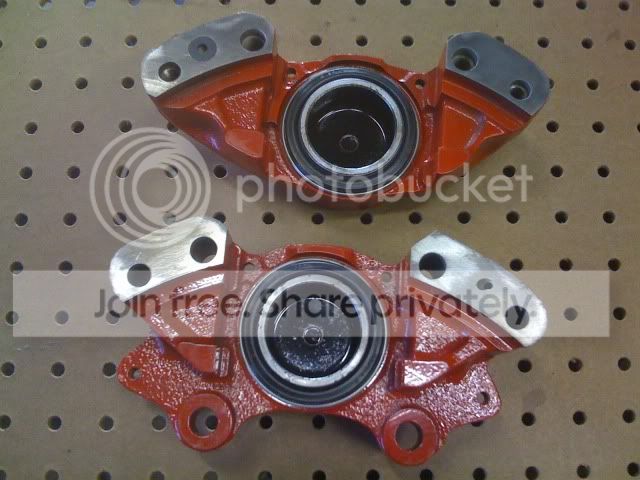
well, after seperating the two halves and forcing the pistons out with compressed air, I hope all works out.I didn't find a gasket between the two halves...don't know if ever one was there.as for the rebuild what about using "copper coat". The o ring around the bore indicates that you don't need a gasket, but just to be safe would an arosal gasket work?
Geo Hahn
Yoda
Offline
When its time to fit the piston in thru the boot you may find a couple of hooks made from bare 12ga solid copper wire (like stripped house wiring) will help. I flatten one, leave the other round... rounde the tips so they are smooth... and form into little hooks. Helps get the boot around the piston w/o scratching anything.
Actually my technique also uses compressed air but that won't help if the halves are split when you do this.
Actually my technique also uses compressed air but that won't help if the halves are split when you do this.
Trevor Triumph
Jedi Knight
Offline
when I was working on the Austin Healy forty years ago the former school bus mechanic said, "If they didn't want you to take them apart- the caliper halves- they would have used rivets" I've taken calipers apart for the repair- using compressed air and one time I used a short piece of line from a master cylinder. Big mess, plenty of brake fluid- not the best way. T.T.
Offline
Trev said:when I was working on the Austin Healy forty years ago the former school bus mechanic said, "If they didn't want you to take them apart- the caliper halves- they would have used rivets"
Most honorably CORRECT, Trev!! :laugh:
No way would I use a paper gasket between the halves, not even sure about any spray on type. You don't want to increase the distance between the two halves.
This could cause a problem with the o-ring sealing. Just get the correct o-ring and put them back together.
This could cause a problem with the o-ring sealing. Just get the correct o-ring and put them back together.
TR3driver
Great Pumpkin - R.I.P
Offline
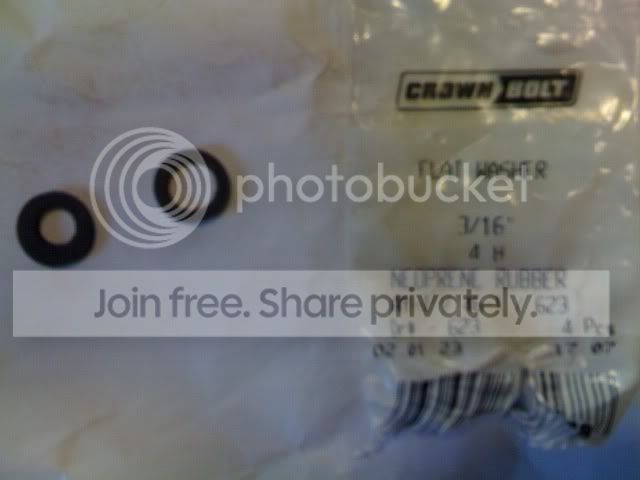
Wow. Remind me to never let you behind me in traffic!Tr4dude said:I used a gasket from Lowes in between the halves.
Any idea what temperature neoprene starts to melt at? Or how compatible it is with brake fluid?
https://www.efunda.com/designstandards/oring/oring_chemical.cfm?SC=none&SM=Neoprene
Offline
I would not use neoprene either, but hey, maybe that is what Jimmy Johnson uses on his banger racer?

martx-5
Yoda
Offline
TR3driver said:
Great info at this site. I will bookmark it for use at work when these questions of compatibility pop up.
Thanks.

Tr4dude
Senior Member
Offline
Any idea what temperature neoprene starts to melt at? Or how compatible it is with brake fluid?
I should have stated that the system was completely rebuilt and is using DOT5 in a TR6, when Girling updated there seals from natural rubber they went to Neoprene so the use of DOT3 could be used and would not break down the natural rubber seals, if using the old seals with DOT3, DOT4, or DOT5.1 they will deteriorate hence the use of Castrol/Girling LMA, a vegetable-based fluid. Silicone DOT5 is compatible with Neoprene.
Chemical Composition: Polydimethylsiloxane Fluid (PDMS)
Use: DOT 5 Silicone Brake Fluid is a silicone-based (Polydimethysiloxane CAS# 63148-62-9) fluid that is formulated specifically for used in hydraulic brake systems to provide corrosioin protection and lubrication. DOT 5 Silicone Brake Fluid is recognizable by its bluish-purplish color. In comparison to DOT 3 & DOT 4 Brake Fluids, DOT 5 provides higher thermal stability and higher dry and wet boiling points. In addition, being silicone-based, DOT 5 is hydrophobic and will not absorb water.
DOT 5 has a service temperature range of -55°C to 55°C. Its dry boiling point (no water present) is 260°C and its wet boiling point (contains 3% water) is 180°C Due to these properties, DOT 5 Silicone Brake Fluid is widely used by the military. It meets Mil-PRF-46176 & Mil-PRF-46176B. DOT 5 Brake Fluid also meets SAE J 1705 Society of Engineers.
DOT 5 Silicone Brake Fluid is compatible with a wide range of brake materials including <span style="font-weight: bold"><span style="color: #3333FF">SBR, EP, Neoprene and Natural Ruber</span></span>.
Meets the requirements of the following specifications:
•Mil PRF-46176
•Mil PRF-46176B
•SAE J 1705 Society of Engineers
•Meets NSN 9150-01-0728379
Features:
•Silicone-based fluid
•Hydrophobic…will not absorb water
•Appearance: Bluish-purplish fluid
•Wide service temperature range
•High Dry Boiling Point
•High Wet Boiling Point
•Long service life
•Compatible with a wide range of brake system materials
•Will not damage paint
Availability: 5 & 55-gallon containers
View Product Specs
View MSDS
View Mil-PRF-46176B
View Guide for Military Specifications
View Use Only Silicone Brake Fluid from U.S. Army
I should have stated that the system was completely rebuilt and is using DOT5 in a TR6, when Girling updated there seals from natural rubber they went to Neoprene so the use of DOT3 could be used and would not break down the natural rubber seals, if using the old seals with DOT3, DOT4, or DOT5.1 they will deteriorate hence the use of Castrol/Girling LMA, a vegetable-based fluid. Silicone DOT5 is compatible with Neoprene.
Chemical Composition: Polydimethylsiloxane Fluid (PDMS)
Use: DOT 5 Silicone Brake Fluid is a silicone-based (Polydimethysiloxane CAS# 63148-62-9) fluid that is formulated specifically for used in hydraulic brake systems to provide corrosioin protection and lubrication. DOT 5 Silicone Brake Fluid is recognizable by its bluish-purplish color. In comparison to DOT 3 & DOT 4 Brake Fluids, DOT 5 provides higher thermal stability and higher dry and wet boiling points. In addition, being silicone-based, DOT 5 is hydrophobic and will not absorb water.
DOT 5 has a service temperature range of -55°C to 55°C. Its dry boiling point (no water present) is 260°C and its wet boiling point (contains 3% water) is 180°C Due to these properties, DOT 5 Silicone Brake Fluid is widely used by the military. It meets Mil-PRF-46176 & Mil-PRF-46176B. DOT 5 Brake Fluid also meets SAE J 1705 Society of Engineers.
DOT 5 Silicone Brake Fluid is compatible with a wide range of brake materials including <span style="font-weight: bold"><span style="color: #3333FF">SBR, EP, Neoprene and Natural Ruber</span></span>.
Meets the requirements of the following specifications:
•Mil PRF-46176
•Mil PRF-46176B
•SAE J 1705 Society of Engineers
•Meets NSN 9150-01-0728379
Features:
•Silicone-based fluid
•Hydrophobic…will not absorb water
•Appearance: Bluish-purplish fluid
•Wide service temperature range
•High Dry Boiling Point
•High Wet Boiling Point
•Long service life
•Compatible with a wide range of brake system materials
•Will not damage paint
Availability: 5 & 55-gallon containers
View Product Specs
View MSDS
View Mil-PRF-46176B
View Guide for Military Specifications
View Use Only Silicone Brake Fluid from U.S. Army