• Hey Guest!
    British Car Forum has been supporting enthusiasts for over 25 years by providing a great place to share our love for British cars. You can support our efforts by upgrading your membership for less than the dues of most car clubs. There are some perks with a member upgrade!

    **Upgrade Now**
    (PS: Upgraded members don't see this banner, nor will you see the Google ads that appear on the site.)
Tips
Tips

TR2/3/3A Caliper/Hose - persisten leak in TR3A

lbcs_r_fun

Jedi Hopeful
Offline
HELP!!!

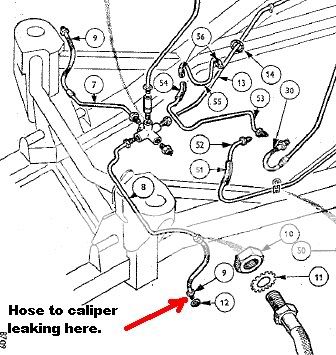
We are pulling our hair out over a very small BUT persistent leak at the front brake hose/caliper junction. The calipers are the later cast iron split-type and have been rebuilt by a reputable, well-known service company. Both cylinder seals are fine - dry as a bone under the dust boot. Fluid type is Dot 5. All other brake system components are new.

Under pressure test (brakes applied with temporary clamp on brake pedal, over 2 - 3 day period), a small drop appears every couple of days - enough to wet the end of your finger. Sounds minor, but of course this is unacceptable.

So far, we have tried several sets of new hoses (TRW from TRF), and copper and aluminum crush washers. We even honed the surface of the crush washers using crocus cloth/plate glass, until both sides were perfectly flat. We have examined the "pad" on the calipers, using a 10x jewelers's loupe, where the hose/crush washer seats and both are free of scratches or other damage that might prevent the hose/crush washer to seal. Also tried a special Permatex aviation grade hydraulic sealant - no effect!

Any suggestions would be appreciated. Right now this is a game stopper!

Thanks,

T
 
What about the banjo bolt? How does that look? Any chance of having a metric caliper and a standard banjo bolt? I know nothing about the 3, but I do know the 6 had a metric and standard thread calipers @ the hose.

Maybe the wrong bolt causing it to cock a bit when tightened.

YOu sure it's just not residual fluid from putting the hose on?

Seems to me if you have a brake leak it should be worse than that.
 
I currently have the same problem with one of two new hoses. My leak rate was a lot higher than yours, though. However, the root cause was not so obvious: It turned out that the thread on the hose fitting was cut at an angle. As a result, the washer was crushed unevenly: More than the desired amount in one area and not enough opposite that area. An unexpected failure mode, you would think that process control for stuff like that is well established.
I'm still waiting for a new hose, it's on backorder.
 
Are you sure the leak is at the hose/caliper joint, and not, say, a casting pore nearby?

I might be tempted to repeat the test with the hose & bleed screw reversed, so you can see the leak better (with a loupe).
 
Bremer said:
I currently have the same problem with one of two new hoses. My leak rate was a lot higher than yours, though. However, the root cause was not so obvious: It turned out that the thread on the hose fitting was cut at an angle. As a result, the washer was crushed unevenly: More than the desired amount in one area and not enough opposite that area. An unexpected failure mode, you would think that process control for stuff like that is well established.
I'm still waiting for a new hose, it's on backorder.

Bremer: You mean that the threads were not cut square to the longitudinal axis of the hose fitting? Amazing! How did you eventually determine that? Did you use a crush washer between the hose and caliper?

Thanks,

T
 
kellysguy said:
What about the banjo bolt? How does that look? Any chance of having a metric caliper and a standard banjo bolt? I know nothing about the 3, but I do know the 6 had a metric and standard thread calipers @ the hose.

Maybe the wrong bolt causing it to cock a bit when tightened.

YOu sure it's just not residual fluid from putting the hose on?

Seems to me if you have a brake leak it should be worse than that.

This is a Triumph TR3A,with the later split caliper design. It does not have banjo fittings, but has rigid line to hose and hose to caliper connections.

TR3A_brake_hose.jpg
 
TR3driver said:
Are you sure the leak is at the hose/caliper joint, and not, say, a casting pore nearby?

I might be tempted to repeat the test with the hose & bleed screw reversed, so you can see the leak better (with a loupe).

We don't suspect porosity is the problem but you never know.

Thanks,

T
 
lbcs_r_fun said:
Bremer said:
I currently have the same problem with one of two new hoses. My leak rate was a lot higher than yours, though. However, the root cause was not so obvious: It turned out that the thread on the hose fitting was cut at an angle. As a result, the washer was crushed unevenly: More than the desired amount in one area and not enough opposite that area. An unexpected failure mode, you would think that process control for stuff like that is well established.
I'm still waiting for a new hose, it's on backorder.

Bremer: You mean that the threads were not cut square to the longitudinal axis of the hose fitting? Amazing! How did you eventually determine that? Did you use a crush washer between the hose and caliper?

Thanks,

T

That's right, the axis of the threads was not parallel with the axis of the fitting. How did I notice? Well, the fitting/hose was making a spiral-shaped motion when threading it into the caliper, and it got fairly tight before the washer made contact with the caliper's sealing surface. Later I spun a nut onto the fitting (3/8 UNF I believe), and it did not sit square to the fitting axis. I did use a copper washer, and it almost sealed, but a small leak remained.
 
Maybe there is an imperfection or slight damage to the threads in the caliper casting.
 
Back
Top