• Hey Guest!
    British Car Forum has been supporting enthusiasts for over 25 years by providing a great place to share our love for British cars. You can support our efforts by upgrading your membership for less than the dues of most car clubs. There are some perks with a member upgrade!

    **Upgrade Now**
    (PS: Upgraded members don't see this banner, nor will you see the Google ads that appear on the site.)
Tips
Tips

Brake and Clutch Master Cylinders

mountainman

Jedi Trainee
Offline
First I would like to wish everyone a Merry Chirstmas and Happy New Year. This forum has been a great help to me. My question is how do you take the clutch and brake master cylinders apart? Mine are sticking and not fully returning and I can't see how the plunger comes out. They are both off the car.
Could it be the spring has weakened over the years?
Thanks
Greg
 
I'm in the process of rebuilding both the clutch and slave cylinders on my 59 TR3, so I'm a couple steps ahead of you.

Removing the circlip will let you remove the pushrod and the washer. To remove the piston, you might try rapping it sharply on a piece of wood to see if it will dislodge. If not, what I've found works best is low-pressure compressed air: using a blow-gun with a rubber tip, blow into one of the inlets while holding your finger over the other. Push the piston to the bottom of the bore so it has a "running start" at getting past the lip that's probably formed in the MC bore. Make sure you have a rag over the end of the cylinder so the piston doesn't fly across the room, and don't forget the safety glasses in case old fluid or parts start flying around. Start with a quick blast of low pressure and work up from there.

I've also had good luck mounting the cylinders in a vice with the open end facing up, squirting a good amount of penetrating oil in and letting it sit overnight. Still had to use the air compressor, but it popped right out.
 
You didn't mention which model car these are for, but I'm going to guess from your sig that you mean '59 TR3...

At the front of the M.C., under the rubber dust cover, is a spring clip in a groove in the cylinder. Remove this with needle-nose pliers -- then you can tap out all the internals.
 
All good suggestions. If the pistons move at all, most likely the air will work.
But if not, the extreme approach is to squirt some brake cleaner or Gumout (any volatile solvent) into the cylinder, then block both ports with bolts & nuts, and heat the body of the cylinder. The aluminum cylinder expands with heat faster than the steel piston, so this creates clearance for the piston to move. And the solvent will boil, creating pressure to move it. Be sure to have the open end aimed where it won't do any damage, since you are in effect creating a mortar. Eye protection is a must. You may also get a small ball of flame as the solvent burns, but just keep cool and it will go out in a moment.

I've done this many times on cylinders that are too badly corroded to disassemble with shop air. Although there is still a piston up in the rafters somewhere, it's worked well for me. And I feel it actually does less damage to the cylinder than forcing the piston out cold (with grease, for example), due to the increased clearance.

 
Aloha Randall,

I'll have to file that method away in case I ever need it. That sounds real manly with fire, explosions and flying objects. I bet it gets the blood pumping the first time you try it.
 
It's really not as bad as it sounds. Usually just kind of a pop, about like a champagne cork; certainly not what I'd call an explosion. And only rarely any flame at all.

But I'd rather caution people about the worst case than have them unpleasantly surprised.
 
Just curious, Randall --
What are the odds that a master cylinder, so gummed-up that it requires that sort of dismantling, is actually salvageable?
 
Moseso said:
What are the odds that a master cylinder, so gummed-up that it requires that sort of dismantling, is actually salvageable?
Fair to middlin, in my experience. I used that technique on both of the original MCs on TS13571L, and they are both back on the car. But the clutch slave was too far gone (and unfortunately is the only one I took pictures of).
 
YEEUUUUCCCCHHHHHHHH!
 
Fairly typical in my experience, for long-term exposure to DOT 3/4 brake fluid. Just one of the reasons I'm such a DOT 5 fan.

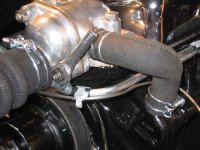
The thermostat housing was even more entertaining :
 
When I did the restoration of my 1958 TR3A, starting in 1987, my thermostat housing looked just like yours inside. I scraped out all of this stuff and cleaned it up. It's been back on the engine for 18 years and 100,000 miles without this happening again. Maybe it's because I use a mix of water and antifreeze. But I have a brass plug threaded into the bypass pipe with a 3/16" diameter hole to allow air bubbles to vent out. Well about 5 years ago, I took off the 13 year old hose for a new one and found similar beige looking "crud" blocking that little hole in the bypass plug. Check out yours next time.
 

Attachments

  • 14714.jpg
    14714.jpg
    64.2 KB · Views: 166
Back
Top