• Hey Guest!
    British Car Forum has been supporting enthusiasts for over 25 years by providing a great place to share our love for British cars. You can support our efforts by upgrading your membership for less than the dues of most car clubs. There are some perks with a member upgrade!

    **Upgrade Now**
    (PS: Upgraded members don't see this banner, nor will you see the Google ads that appear on the site.)
Tips
Tips

Body work resources

I did all the work on my 71TR6 myself, but applying new paint was not necessary with the exception of some minor touch-up. The paint job on the car was done in '83. It was a decent emamel job but faded. All that was needed to do was wet sand a couple of times with 1500 & 2000 grit, use a little rubbing compound and the the three step MacG system. It turned out pretty good for a weekend driver. I will do a complete body-off after I finish the Spit.

I chemically stripped the Spit bonnet, and the residual phosphate left has kept the metal from rusting any further. I was wondering if you used a chemical stripper?
 
[ QUOTE ]
I chemically stripped the Spit bonnet, and the residual phosphate left has kept the metal from rusting any further. I was wondering if you used a chemical stripper?

[/ QUOTE ]

Hi again,

The surface may not appear to be rusted, but might need more prep before any paint can be applied. Talk to a good paint shop about this.

Stripping is a possibility. But,the problem with it is you have to be incredibly careful to remove *all* traces of stripper before applying any paint. The stripper chemicals have a very nasty habit of hiding in nooks and crannies and later seeping out to ruin a bright, shiney new paint job.

I've only used strippers on large, flat panels that I don't want media blasted (hard blasting can cause ripples in hoods, fenders, decklids, any large smooth area).

I'd keep stripper away from intricate detail unless that area will be getting somehow neutralized and/or media blasted later.

Plus, media blasting, done right, gives a good "tooth" for new paint to adhere to. Chemical stripping generally doesn't, so further surface prep will be needed.

There are different types of media blasting, too. Soda, walnut shells, plastic pellets are all relatively "kind" to sheet metal. A small quantity of more abrassive might be mixed in, to deal with rust, for example.

Alan Myers
San Jose, Calif.
'62 TR4 CT17602L
 
Alan,

Where I live, there are little to no restrictions on what you attempt on your own property, unless, of course, you are foolish enough to run noisy equipment in the wee hours of the morning or kill the fish in the neighbors pond then you might just get shot, or worse!

The scenario about allowing someone else to do the painting was/is my original plan/idea. I was just wondering how far I should go with the body work. Should I even apply any of the plastic or should I just straighten, patch where necessary, use a compatable primer and deliver the individual pieces to the painter for the plastic filler -to- final coat process. I can assure you that he will get it back for touch-up after she is assembled. It will get scratched somewhere, I know this, and expect it.

Yet, I have this urge to do all the work myself. I suppose you could call it vainty, pride, or some other sin but I really would like to learn the entire process. However, I am well aware of my amateur status. Therefore, I am not setting my goals on the Boyd Coddington scale by no means. However, I would like a straight, well painted/protected car that is mechanically sound and I truly feel that I can get there from here.

As far as your comments as the many diciplines required to do a complete (meaning all facets of) restoration - I totally agree with you. American Hotrod always farms many things out because they can afford to charge what it costs to do just that. [Plus, it appears they are always concerned about sufficient time to complete a job?m or is that just TV *drama*?] As much as I agree with your thinking, I have to deal with the reality that I just cannot afford to farm very much of this work out. It never has occurred to me to have a "Coddington" caliper car. I never intended on this being one of the *concours* cars that stays in a trailer/garage, and never see the light of day except when its *showtime* - not that there is anything wrong with that. I thoroughly respect an individual that can actually have a really decent example of a rare car and resist the urge to take her for a spin. That is something I could not do - it would require herculean power to keep me from behind the wheel on a cool evenings drive to the Sonic for icecream or anywhere else for that matter, regardless of whether the car was Spitfire or a RR Phantom II.

Personally, I intend on driving this puppy and enjoying the twisty's around here. But it really needs to look good too.
That is my goal in a nutshell.
 
Hi again Mike,

Personally, I'd *like* to do it all, start to finish, too. That's just the way I've always felt about everything on my cars.

*But" that's really not practical, since a wide variety of skills are involved in a restoration.

I'd say go ahead and do the body work up through the sanding of the final body filler skim coat. The reason is simple... make a mistake and you can just do an area over. So long as you aren't rushed for time, you can fool around with it until it's just the way you like it. Materials aren't terribly expensive and a little waste is not a big issue since you aren't paying for the labor!

A final paint job can be touched up a little. However, it's not very forgiving. Use the wrong thinner, or paint at the wrong temperature, forget to use a tack cloth, or fail to control overspray adequately, etc., and a complete "do over" might be a big, expensive proposition, possibly even re-stripping the car. That's why I would opt to have the final paint done by a pro.

It's very important to work closely with the person who will be doing the final painting to insure all the work you do is fully compatible with the materials they'll be using.

Coddington or Foose may send cars out for premium level work and ultra-fast turn-around at a high cost. Your cost should actually be a lot less than it might seem at first, since it will mean you can avoid buying a lot of specialized equipment that you'll rarely use. You still might want the compressor, but needn't buy the spray gun, painter's suits, respirator, sophisticated air/oil seperators, etc. *And* you won't have the "learning curve do-overs"!

Talk to the body shops to find out what they would charge. Or, maybe there is a skilled painter in your area who does spray jobs on the side, since you don't need all the services of a body shop.

Heck, if you are getting into welding, too, you might even build a "rotisserie" to make the painter's job easier, if he doesn't already have one. That sort of thing makes great welding practice, must be strong but doesn't need to be particularly pretty!

I'd love to re-learn painting some day, but meanwhile I think I'll just leave it in the hands of a pro.

Alan Myers
San Jose, Calif.
'62 TR4 CT17602L

 
> Or, maybe there is a skilled painter in your area who
> does spray jobs on the side, since you don't need all the > services of a body shop.

That is a good idea...unless your just commited to DIY (which I greatly admire BTW). The first car I had painted the painter came to my house and shot the car (circa 1982). I learned real quick that the prep work is where the 'work' is. I really stunk the place up on that job..:smile:

If you decide to do the body work yourself (I hope you do) use the biggest (longest) block possible and block from different directions. DO NOT paint before you have 'guide' coated using flat back rattle can (if your primer is grey). This really highlights your lows. Remember, block, block, and block some more then when your done...block again...be patient...you can really make it look good...IMHO

Tim
 
There's alot of good info at https://www.jalopyjournal.com/forum/

I ran across it just last week. They have tons of "how to do it stuff" archived. Everything from metal fabrication to welding to the proper use of bondo. /ubbthreads/images/graemlins/cheers.gif
 
[ QUOTE ]
> DO NOT paint before you have 'guide' coated using flat back rattle can (if your primer is grey). This really highlights your lows. Tim

[/ QUOTE ]

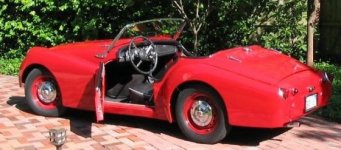
Tim-- I used different colors of primer to highlight highs/lows but never had heard of flat black.... Maybe it would have had fewer "lows" after preping my TR3. I did the prep on mine and had a commercial garage do the paint. The idea was good but they added so much dust/dirt that I was far more disappointed with their work than mine. Choose the painter carefully! Pete
 

Attachments

  • 127970-mytr35_05.JPG
    127970-mytr35_05.JPG
    44.1 KB · Views: 79
[quote Choose the painter carefully! Pete

[/ QUOTE ]

*Very* good advice! Ask to see recent examples of their work. Check out their shop. It should be scrupulously neat and clean.

Alan Myers
San Jose, Calif.
'62 TR4 CT17602L
 
Back
Top