
• Hey Guest!
    British Car Forum has been supporting enthusiasts for over 25 years by providing a great place to share our love for British cars. You can support our efforts by upgrading your membership for less than the dues of most car clubs. There are some perks with a member upgrade!

    **Upgrade Now**
    (PS: Upgraded members don't see this banner, nor will you see the Google ads that appear on the site.)
Tips
Tips

Blown headgasket??!!

markctr3

Senior Member
Offline
I've got about 200 miles on the new engine (TR3), and I now have coolant that is leaking out of, and/or around, the head bolt on the intake/exhaust side between #1 and #2 (see attached photo). I'm assuming that it's a blown head gasket, but before I do anything stupid (it may be too late for that) I would like to ask if anyone has encountered this before.

I used a new copper head gasket (sprayed with copper sealant) and new ARP head bolts with their assembly lube on the threads, washers and bolts. I torqued them in the proper sequence in 3 steps...30, 60, and finally 90 ft. lbs. The Haynes manual (it's the only one I have) lists the head torque at 100 to 105, but ARP recommends 90 -- someone said torqueing with assembly lube at 90 is equivalent to a "dry" torque at 100 ft. lbs. And someone else who works with me at RENNtech said don't do a 3 step torque -- go straight to 90 (went through 3 head gaskets on the Sentra before ARP told him to torque it in one step).

Now here's the problem. I am NOT a mechanic, so all I know is what people tell me. And so far 5 people have told me 5 different things! If I looked up 100 more opinions, I would have 105 different ways to do it -- can you feel the frustration?

That being said, I'm still open to advice...thanks for letting me vent.
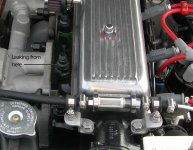
 

Attachments

  • 152596-Headboltleak.jpg
    152596-Headboltleak.jpg
    138.9 KB · Views: 133
Do you have a "factory" workshop manual? I never quite trust the Haynes series of manuals for accuracy.
I always think you should follow the manual's torquing procedure which usualy calls for step torquing in specific sequences.
I've never heard of going to full torque in one step, I would think the stresses in the head and the uneven squishing of the gasket would guarantee a leak that way.
I would put the (calibrated) torque wrench back on and take the bolts up to 105 in the right sequence and see if that seals the leak. After all, what have you got to lose trying that?
 
suggest talking to british frame & engine or greg solow.
rob
 
You didn't say if you retorqued the head after running it for a while, maybe a couple hours. If you didn't and are lucky, a retorquing could solve the problem. If not, a new gasket may be necessary. Always retorque with copper or fiber/steel gaskets.
 
Hi,

If you talk to Ken at British Frame & Engine, I think he'll tell you what he told me... the solid copper head gaskets can be hard to get to seal. Last time I talked with him about it, he recommended the shim steel or an original style "copper sandwich" type gasket be used instead.

Also, some solid copper head gaskets need to be annealed (and that often needs to be redone if one is re-used). There are some online pages showing how, do a Google search.

Another thing, when the head was off, were the holes that the head studs screw into checked? Often these pull up at the threads to form a little dome right around the base of the stud, and that can hold the head off from a tight seal. Some of the "tuners" chamfer or slightly counter-drill the threaded hole in the top of the block, to be sure there is no interference there and the head is pulled down quite evenly .

Racetorations is taking it a step farther by machining the block so that all the studs are the same, long length. The reason for this is that the shorter front and rear pairs are only threaded into the block an inch or so and there have been cases where threads stripped.

The ARP studs you are using should rule it out, but I've heard of the original short studs being put in upside down, and preventing full torque on the cylinder head.

Has the head been milled? If so, on TR2/3 sometimes the casting under the thermostat housing comes in contact with the water pump housing. If so, that can hold the head up slightly in the front.

Keep us posted please, about what you find.
 
Yes, I did retorque the head after about 2 hours of easy break-in. But, there's more to the story...

Xtreme Cylinder Heads in Jupiter, Florida did the head work, but for some reason, they forgot, or didn't do, a pressure check. When I first got the engine in the car and poured in the coolant, I noticed a BIG stream o' green leaking from under the car. When they "boiled" out the head it opened up a hole in the casting plug in the back of the head. I had to remove the head and change the plug, and of course, I used the same gasket. It came in the Payen kit -- again from Moss Motors -- and is a copper clad sandwiched gasket. I was told, and again I only know what people tell me, that as long as it wasn't heat cycled, I should be okay. I cleaned off the gasket with acetone and reapplied the copper gasket sealer.

The other possible issue is, two of the head studs broke off upon removal and had to be Helicoiled. Those two studs have a bigger diameter hole where the stud comes out of the head (I can't say for certain if the stud that is leaking is one of the repaired studs, but I have a sinking feeling that it is -- it was the two long studs that broke).

I'm not sure where the stud in question encounters the cooling passage. Could it be as simple as putting sealant on the threads at the bottom of the stud? No. That sounds too easy. Maybe I only need a new block!!??
 
I thnk it is EXTREAMLY bad to have the head done over and not have the freeze plugs repaced or an other little details over looked, much less areas prone to fail.


I hope your problem is with the studs in the water jacket leaking if it is not simply fixed with a retorque as advised earlier in the responses.
 
Hi, what I would do in your situation is take out the bolt and put some permatex (heat rated) sealant on the bolt put it back in and see what happens. First, drain the water then I would clean the bolt and hole the best I could before I reinstalled the bolt. Then pop the bolt in with plenty of permatex and torque it down. After that I would let it sit for a couple of days before I stated it. Hopefully, it is not too cold where you at and the permatex will cure. Anyways at this stage of the game, you do not have much to recuperate from just keep an eye on the engine temp. Make sure there is no water getting in the oil or oil in the water and it just might be ok. Later do a compression check and check that again in a month.

If the water is just tricking out, it is possibly that the water is only under the same pressure as in the radiator (4psi) and might even stop on its own. However, if the water problem is somehow connected to the head gasket it will be under much more pressure and you will not be able to stop it with a miracle in a can.

When I torque the head on a tr3 I use the torque pattern found in the books. I torque the head in stages usually three 30-60 -90. I only final toque it once to 105lbs because by the time I get to 105lbs I defy that thing to loosen up. Moreover, and in the beginning I do make sure that all the threads are very clean and are not damaged (studs and nuts ) I lightly oiled them run them down to make sure they are smooth in kinda dry run.

George
 
[ QUOTE ]
I think it is EXTREMELY bad to have the head done over and not have the freeze plugs replaced or an other little details over looked, much less areas prone to fail.

[/ QUOTE ]
It's not good to boil out a head or a block without first removing ALL of the plugs. Much easier to flush out the accumulated rust & junk after boiling it, probably impossible, without doing this. I really can't believe that a shop would do that. What other shortcuts do they take?
D
 
Back
Top