• Hi Guest!
    If you appreciate British Car Forum and our 25 years of supporting British car enthusiasts with technical and anicdotal information, collected from our thousands of great members, please support us with a low-cost subscription. You can become a supporting member for less than the dues of most car clubs.

    There are some perks with a member upgrade!
    **Upgrade Now**
    (PS: Subscribers don't see this gawd-aweful banner
Tips
Tips

BJ8 spark plug reach

Are we just assuming there's an advantage to having the plug tip flush with the combustion chamber? What is the problem we're trying to solve? Do the aftermarket heads--e.g. Denis Welch alloy heads--have the plug flush? Most properly-tuned BJ8s run pretty good--are there dyno numbers or any other objective data that prove flush is better?
 
I've ordered the LFR6C11 plugs per Chris' list above. Also ordered the indexing washers and a 14X1.25 spark plug tap to chase out the threads.
A friend has a spare AEC960 head. Will do a test install in that head and will follow up with pix in a week or so.
 
Are we just assuming there's an advantage to having the plug tip flush with the combustion chamber? What is the problem we're trying to solve? Do the aftermarket heads--e.g. Denis Welch alloy heads--have the plug flush? Most properly-tuned BJ8s run pretty good--are there dyno numbers or any other objective data that prove flush is better?
I have to assume that the factory knew about the plug reach and maybe it was for a reason? I think if anything was to be gained(horsepower), the factory would have speced out the longer reach plugs especially on their race cars. And then there's the "721" Head that is being reproduced fror vintage racing. Maybe it's for more than the 3 carb advantages it offered for vintage rules.
 
I have to assume that the factory knew about the plug reach and maybe it was for a reason? I think if anything was to be gained(horsepower), the factory would have speced out the longer reach plugs especially on their race cars. And then there's the "721" Head that is being reproduced fror vintage racing. Maybe it's for more than the 3 carb advantages it offered for vintage rules.


The whole idea they'd produce tens of thousands of heads with a 1" threaded hole containing a 3/4" sparkplug is fascinating.

I suppose the people who knew the scoop on this are all dead.

PS - they probably discovered it made little if any difference powerwise and some union guy's job depended somehow on the hole being kept as-is.
 
I've ordered the LFR6C11 plugs per Chris' list above. Also ordered the indexing washers and a 14X1.25 spark plug tap to chase out the threads.
A friend has a spare AEC960 head. Will do a test install in that head and will follow up with pix in a week or so.
Hi Steve
Very good solution, more easy than mine-BUT remember that also the distributor advance and static advance must be changed -probably near the early 3000
Cheers:encouragement:
 
Here's a thought <WARNING: Pure Speculation Follows>: Along with the intake, carburettor and camshaft changes for the BJ8 Geoff Healey and the factory realized they could achieve additional power by significantly advancing spark timing over the early 6-cyl engines. However, they discovered that the additional advance reduced detonation margin, so they compensated by recessing the spark plug in the head, achieving additional HP while retaining sufficient detonation margin for a reliable street car on pump gas.
 
Bob - that's the most plausible guess yet. If I'm not mistaken, though, the 960 head and spark-plug-in-a-hole was used on all the 3000s. Also - why bother threading all the way through?

I see from the manual the maximum advance for all 3000s except for the MkIII is 35 degrees; the MkIII is 34-38 degrees. The 100-6 is 36 degrees. As I've always understood it, the maximum advance is the only one that matters in terms of detonation.

This is my fault - but the whole thing is turning into a how-many-angels-on-the-head-of-a-pin discussion. :wink-new:
 
Hi Guys,
Just to clarify
I see from the manual the maximum advance for all 3000s except for the MkIII is 35 degrees; the MkIII is 34-38 degrees. The 100-6 is 36 degrees. As I've always understood it, the maximum advance is the only one that matters in terms of detonation.
The problem is actually that the earlier Pre BJ8 cars have 5 degrees (crank) static plus a 15 degree cam in the distributor (cam degrees need to be doubled to be crankshaft degrees) = 35 crankshaft degrees total maximum advance.
The BJ8 spec says 10 degrees (crank) static plus an 18 degree cam in the distributor (cam degrees need to be doubled to be crankshaft degrees) = 46 crankshaft degrees total maximum advance

As I said on https://www.myaustinhealey.com/aec960-healey-cylinder-head.html
I incorrectly assumed the AEC960 casting was unique to the BJ8. Apparently, it isn't. So I still don't know why the factory advance specification is so high on a BJ8 compared to a BJ7 or earlier Healey 3000. But one thing is for certain - having the spark plug that far away from the centre of the combustion chamber/ piston means more advance is required - i.e. the plug has to be fired earlier so that spark gets there in time....
So I don't know why a standard BJ8 needs 46 degrees total maximum advance. But I know all the AEC960 heads I have seen have been machined incorrectly. And I don't believe Geoff Healey had anything to do with it - the DHMCo didn't use AEC960 heads on their racing 3000's, they used the alloy head, which is based on the AEC721 earlier 12 port 100/6 casting (which was correctly machined - I've seen Joe Armors ex Sebring 1965 3000).
I have 35 degrees maximum advance at around 3,300 rpm, using a non vacuum advance distributor, with a 12 degree cam, and 11 degrees static, which was set up on a dyno - results are here: https://www.myaustinhealey.com/dyno_sheet.html
If the head is off the car, its reasonably simple to machine the plug seats. Or don't. No one else seemed to notice till I brought up the topic..... :smile:
Best
Chris
 
Every high performance head I have seen, and custom porting work I have had done, has the plug flush with the combustion chamber. Come to think of it I have never seem a modern head with a recessed plug

Having the plug protruding into the CC is just asking for a detonation problem, never mind the flow and flame travel issues. I think that this is as bad if not worse than the recessed plug
 
I think that the theory that the spark needs to be advanced to compensate for the recessed plug is not valid.

Spark advance has to do with increasing cylinder pressures and the amount of time it take to completely burn through the dense air/fuel mixture. There may be a variance of a micro-second or so, but not worth taking into consideration.
If you unshroud the spark plug it can burn cleaner and ping less, but won't affect timing
 
Last edited:
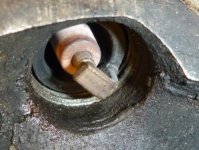
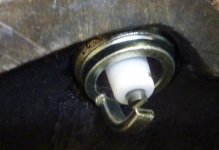
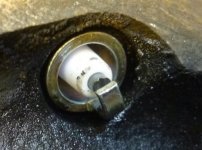
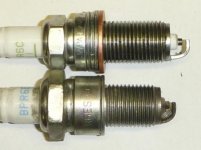
Results of spark plug reach tests in AEC960 head:
NormalPlug.jpgNormal 19mm plug. Note hole is not threaded all the way down.
NoExtraWashers.JPG26.5mm plug with no extra washers
WithWashers.jpg26.5mm plug with 3 gaskets and copper indexing washer.

PlugComparison.jpgComparison of plugs. Difference is only 3.5mm

Am not going to run the plug shimmed as above. Due to the lack of threads in the lower part of the hole I wonder if the plug would overheat even if the outer head surface were milled down 1/10" as previously discussed.

The other thing is there was a tremendous amount of carboniferous crud that came out of the plug hole when I cleaned it with the tap.
 
... the DHMCo didn't use AEC960 heads on their racing 3000's, they used the alloy head, which is based on the AEC721 earlier 12 port 100/6 casting (which was correctly machined - I've seen Joe Armors ex Sebring 1965 3000).
If the head is off the car, its reasonably simple to machine the plug seats. Or don't. No one else seemed to notice till I brought up the topic..... :smile:
Best
Chris

I looked yesterday, and the Denis Welch alloy head had the AEC721 cast into it.
 
Back
Top