

 Hey Guest!

 Hey - did you know if you click on the title of a thread it will take you to the first unread post since you last visited that thread?
 but were afraid to ask:
  STOP!! Never post your email address in open forums. Bots can "harvest" your email! If you must share your email use a Private Message or use the
  smilie in place of the real @
 Pretty Please - add it to our Events forum(s) and add to the calendar! >>
5
57_BN4
Guest
Guest
Offline
Hi Jerry,
I think it is fair to say that if you can stay under 185 when going up a long hill then your cam timing is good enough. A tooth out is approx 17deg and it'll run flat and gutless. I only ever saw an A-series engine put back together a tooth out and it still ran but pretty obvious that something wasn't right.
This method was good enough to get my money refunded a few months back when the BJ8 cam grind I requested ended up having a heap more overlap duration.
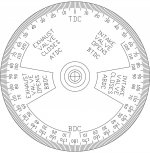
Print out two copies of the attached degree wheel and mount one on some cardboard, then cut and glue it to the front pulley so when the engine is at TDC the corresponding mark is at the bottom and visible from underneath the front bumper. Make a pointer out of some wire and duct tape it onto the chassis to point at the TDC mark and check that it aligns with the timing mark pointer and (hopefully) #1 piston at the top of its travel.
If you have a DTI with a magnetic base then you can directly read the cam lift by snapping a tiny pair of visegrip pliers onto #1 inlet pushrod and reading the lift off them with the DTI. If not, set the #1 inlet valve lash so it closes up at a lifter rise of 16 thou which is the checking clearance for BMC cams. Set the valve lash to 34 thou (16 thou * 1.4 rocker ratio + 12 thou normal clearance) and use the 12 thou feeler blade in the rocker gap to determine when the clearance is zero as you'll feel it change from free to gripped when turning the crank. Whichever method you use, take out the plugs and turn it over on the fan in the forward direction until 16 thou lift is registered, then look underneath at the pointer and read off the crank position. Mark the readings on the second degree wheel so they are easy to compare. Do the same for the closing side and for the exhaust if you want a double check.
Results should match approximately with the original cam, give or take maybe 1-2 deg for inaccuracy of the method, timing chain stretch etc. The optimum is about 2deg advanced and they usually end up about 3-5 degrees retarded in my experience which doesn't really matter on a stock engine. If all your readings are about 17 degrees out then it is pretty obvious what the problem is. This method will only work for original BMC cams, reground ones will use a different checking lift.
Andy.
I think it is fair to say that if you can stay under 185 when going up a long hill then your cam timing is good enough. A tooth out is approx 17deg and it'll run flat and gutless. I only ever saw an A-series engine put back together a tooth out and it still ran but pretty obvious that something wasn't right.
This method was good enough to get my money refunded a few months back when the BJ8 cam grind I requested ended up having a heap more overlap duration.
Print out two copies of the attached degree wheel and mount one on some cardboard, then cut and glue it to the front pulley so when the engine is at TDC the corresponding mark is at the bottom and visible from underneath the front bumper. Make a pointer out of some wire and duct tape it onto the chassis to point at the TDC mark and check that it aligns with the timing mark pointer and (hopefully) #1 piston at the top of its travel.
If you have a DTI with a magnetic base then you can directly read the cam lift by snapping a tiny pair of visegrip pliers onto #1 inlet pushrod and reading the lift off them with the DTI. If not, set the #1 inlet valve lash so it closes up at a lifter rise of 16 thou which is the checking clearance for BMC cams. Set the valve lash to 34 thou (16 thou * 1.4 rocker ratio + 12 thou normal clearance) and use the 12 thou feeler blade in the rocker gap to determine when the clearance is zero as you'll feel it change from free to gripped when turning the crank. Whichever method you use, take out the plugs and turn it over on the fan in the forward direction until 16 thou lift is registered, then look underneath at the pointer and read off the crank position. Mark the readings on the second degree wheel so they are easy to compare. Do the same for the closing side and for the exhaust if you want a double check.
Results should match approximately with the original cam, give or take maybe 1-2 deg for inaccuracy of the method, timing chain stretch etc. The optimum is about 2deg advanced and they usually end up about 3-5 degrees retarded in my experience which doesn't really matter on a stock engine. If all your readings are about 17 degrees out then it is pretty obvious what the problem is. This method will only work for original BMC cams, reground ones will use a different checking lift.
| MAKE | REF | LIFT | DURATION | INLET | EXHAUST | ||||
| mm | ins | btdc | abdc | bbdc | atdc | ||||
| AH MKI | 8.054 | 0.3145 | 230 | 5 | 45 | 40 | 10 | ||
| AH MKII | 9.35 | 0.368 | 230 | 5 | 45 | 51 | 21 | ||
| AH MKIIA | 9.35 | 0.368 | 240 | 10 | 50 | 45 | 15 | ||
| AH MKIII | AEC865 | 9.35 | 0.368 | 252 | 16 | 56 | 51 | 21 |
Andy.
Attachments
Last edited:


