• Hi Guest!
    If you appreciate British Car Forum and our 25 years of supporting British car enthusiasts with technical and anicdotal information, collected from our thousands of great members, please support us with a low-cost subscription. You can become a supporting member for less than the dues of most car clubs.

    There are some perks with a member upgrade!
    **Upgrade Now**
    (PS: Subscribers don't see this gawd-aweful banner
Tips
Tips

BJ8 Overheating - Need dimension

Did this car have a history of overheating before you had the radiator re-cored? Could be that the re-cored radiator is not functioning properly. Do you have the correct radiator cap? Is the belt OK? Just grasping at straws here.
 
Hi Richard,

From the condition of the original radiator, I would assume the car had issues with heat. Rust stains all over the top of it, no clogged tubes that I could tell but the radiator guy said it couldn't be saved. Other than that, no distinct tell tales of extreme heat though. The head was straight, as was the block, and no issues with the pistons or cylinders. Engine seems to run well. Radiator cap is new from BCS, and it hasn't burped yet on me, but I can tell its close and temps here haven't gotten excessive yet (max has been 85 or so), so I'm worried it won't survive an excursion in 105 degree days.

I've been researching fans again too. The initial fan I had was from BCS, and its a flexilite SS fan that fits the shroud he sold me well, 15 3/8 inch diameter but only 1 inch depth. The texas cooler has a smaller diameter, roughly 14 inches, so it doesn't fit the shroud as well and it has a 1.5 inch depth. It was an improvement over the first fan, but apparently I can do better. Drale makes a flex fan that is 14.75 diameter and 2.75 deep with 6 blades. That may be the ticket to get more air flow through the compartment. Flexilite also makes a 2 inch deep fan, 15.375 diameter but 5 blades. Not sure if it will pull as much as the 6 blade Drale? I will probably call to see which will pull the most. I'm not sure if there is a standard CFM test for these belt driven fans?
 
i would try to do the cheapest things first ,try a new thermostate ,flush out the system maybe the waterways have crud in them and could be blocked
 
Hi all,

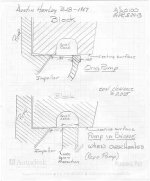
Back at it again as its raining here and I'm anxious to do something to cure this thing. So I pulled the radiator and water pump. The pump/impeller clearance was at the high side, .030 or so. I could tighten that up, but after checking the fit within the block of the pump and impeller I found something very interesting:

Water Pump.jpg

This is in pencil, so a little faded. The finding is that the pump (second in the drawing) outlet is cut in half because the impeller outlet area is smaller than the groove (I labeled it the scroll case since I worked in Hydro for so long) in the block, and the pump body doesn't place the impeller into the block far enough. Its an early repop evidently since I bought a spare pump off ebay which is apparently an original manufacture pump (its a thinner casting, and the cross section of the impeller matches what is printed in the manual). So major restriction in output of the pump. In addition I found that the output of the pump goes directly into a gallery along the side of the block, which has holes to feed the cooler water to each cylinder, very similar to a 6 cylinder flathead in a 38 oldsmobile I once owned. All the passages and block are very clean still, no blockages or contamination.

Anyways, I plan to cut the gasket face of the repop down so the impeller will set in further since the casting is thicker, then use the original impeller so the pump impeller output transition will match the block dimensions.

Then we'll try it out and see if it works.......if not then I have a trick planned for the radiator that may help also.
 
removed duplicate
 
Last edited:
Interesting find. Won't your fanbelt run off line if you machine the mounting face? Andy.
 
Good point Andy, yes I'll have to move the pulley fwd about .100 or so. I guess I will just not press it on the shaft as far as normal. Thanks, I hadn't thought of that. Funny how we have to fiddle with almost everything on these British cars, but I do enjoy the challenge. It also appears the block casting might have been off a bit, as well as the repop castings of the impeller and pump body both adding up to quite a miss match. Something to be aware of when buying and installing a new water pump. Not what you'd expect on say, a small block chevy.
 
Hi all,

Well, I'm still on my quest for a cooler Healey. I cut the face down on the water pump about 0.100 inches, moving the pump into the block further to align the impeller with the groove in the block. Then I swapped the repop impeller for an original impeller so the discharge of the pump impeller is the same width as the groove in the block. Its all back together now and running. It seems better in that the water in the radiator seems to be moving much faster and the temperature seems to move around faster in that when cruizing it comes down sooner, and the car takes longer to get hot, but it still will heat up to and above the 190F when sitting and idling for a while. An improvement but I think it still needs work. I will bench mark the delta T across the radiator again (originally I had 10F degrees) at idle for a comparison then take on the next change.

What I plan on trying is making the radiator a 3 pass unit by installing a top and bottom baffle to direct the flow down then up then down to the outlet. I ran across this idea at one radiator maker's website who stated it should give an additional 15 degree drop across the radiator. I've done some math on it as follows:

Assumptions: Coolant flow at idle is approximately 7 gpm and 35 gpm at maximum flow (limited by thermostat and pump inlet openings). Optimum flow in radiator tubes is 7 to 8 feet per second, per a radiator manufacturer website.

The recored radiator I have has 3 rows of 33 tubes, 0.430 tube spacing, .080 x .450 tube dimensions. This yields a flow in the tubes of 0.63/3.15 fps respectively for idle/full flow.
In a 3 pass modified radiator this changes to 1.89/9.85 fps in the tubes. Much better flow.

I also did some additional engineering calculations to evaluate the changes, but I won't go into that right now since it can get fairly detailed, but the bottom line is the change should bring the flow in the tubes from the laminar region into the turbulant region, moving the molecules around inside the tubes so heat transfer is enhanced. I've checked pressure drops (calculated) also to see if will have much effect on the flow. It should be less than 1 psi increase across the radiator.

So, hopefully in a month or so I should be able to tell you if this change will enhance the cooling ability of the radiator, or if its back to square one......
 
View attachment ign timing overheating.pdf

Hi all,

So I have to apologize to Andy an others that suggested I reset my initial timeing to 15 degrees. I was truely skeptical, since other engines I've worked on had much less initial advance with no heating issues. So I did this test with the car in the garage just warming it up until it got hot at idle. With the 15 degree advance over the 10 degree I had originally, it made a significant improvement. It actually reached equilibrium at about 196F with a 70F ambient. So I'm on the right track, but still have a ways to go.

Next step, before I alter the radiator, is to seal the Kilmartin shroud around its periphery so no air is circulating around the shround, and install a Flexfan, the plastic one. The rep at Flexalite said it pulls more air than the steel or the flex fans. The reasons behind this are that, using the calibrated german carb syncronizer, I measured a maximun/average flow in Kg/hr of 3.5/2.1 at the front of the radiator. Taping around the edges of the shroud improved it to 5.0/3.5 Kg/hr flow rate. My 06 P/U flows 7.0 Kg/hr max, and the wife's Jag flows 6.0 max with an electric fan.
 
Maybe you will have better luck than me. I installed a flex a lite fan a few years ago. It made my overheating problems worse. It seemed like a great idea, but I'm not an engineer. Last month I replaced the flex a lite fan with a Texas Cooler fan and shroud. Instant improvement. I plan to add a pusher fan for stop a go traffic.
 
Jerry,

Have you confirmed you are not running too lean? This will cause overheating problems. Also, have you checked out your distributor? If it is not advancing properly, that is, if you are running retarded it will overheat. The weights, springs and lubrication need to be attended to after 50 years of service. I did not see any mention by you that you rebuilt your dizzy.

As for the water pump. I have been racing 3000s for over 30 years using stock water pumps. I don't think that is your problem.

One helpful hint for everyone. Using synthetic oil will help any engine run cooler.
 
Hi dcarlg,

I initially had a steel flexalite fan with the Kilmartin shroud, but it was the light duty one, which only had an inch blade depth. The Texas Cooler made a difference over this flexalite fan in that I could rev the motor and the temp would actually start to decrease, at about 200F that is. The Texas Cooler has a depth of 1 1/2 inches. The flexalite plastic fan has a 2 inch depth and a more radical blade pitch so I'm hoping that it will maximize the flow through the radiator compared to the other fans, including the electrics.....but we will see by comparing it to the Jag's electric fan. The down side may be noise.....
 
Hi Richard,

Yup, I've messed with the carbs for quite a while, and the burn is a choclate brown under power, and at idle when pushing up the pistons with the little pin, the idle will rise ever so slightly. It idles smooth too at 850 rpm. The dizzy was restored, sorry for not posting, with new bush and springs such that the advance starts at about 1200 and is full in at 3500 rpm (I have an old distributor machine). Once I fiddled with the water pump, the car seemed more responsive to changes in air flow. That is once at speed the temps came down quicker once the pump was restored with an OEM impeller and that impeller aligned with the diffuser cast into the block (see my earlier post with the drawing).
 
Hi all,

I'm still busy on the cooling issue. I built a shroud out of 1/16 inch sheet metal, 1 3/8 deep to match the centerline of the fans plane, and installed it on Saturday. The results on testing the fan flow with my little German syncrometer are:

Texas Cooler w/stock Kilmartin shroud 3.5 Kg/hr max 2.1 Kg/hr estimated Median flow
Texas Cooler w/taped & full circle Kilmartin shroud 5.0 Kg/hr max 3.5 Kg/hr estimated Median flow
2003 Jaguar 3.0 liter S type electric fan 6.0 Kg/hr max flow
2006 Dakota 4.7 liter P/U mechanical fan w/clutch 7.0 Kg/hr max flow
Flexalite 415 nylon fan w/full circle sealed shroud 7.0 Kg/hr max flow 5.0 Kg/hr estimated Median flow

So I did the idling warm up test again, and with an ambient of 72F the equilibrium temperature went down to about 190F, a gain of only 6 degrees after all the work on the shroud. I have a few pictures I can post if anyone is still interested on what it looks like?

So my wife and I went for a drive yesterday, and on the road, at about 55 mph max temp reached was 180F up a small hill, outside ambient was 90F or so according to the weather folks. However, in town it still heated to 190F on slow speed and idling. I'm tempted to just re-install the A/C condenser and have it charged to see if it will make much of a difference in the engine temps on warm days.

Can anyone watching comment on how their A/C system affects their engine temps, say on the road at 55mph vs ambient temps, and in slow traffic?

thanks so much,
 
If only I had an airconditioner, maybe I'd be driving my Healey more often. I have no issues with engine temp since I re-cored the radiator, but then again I don't have AC!
 
Please post cooling improvements after changing the impeller. My mechanical engineer friends tell me that cooling is significantly more related to air than water flow. I still have problems with temps at idle even after replacing the radiator core and water pump and installing the texas cooler fan.
 
Hi Stretch,

I'll post the impeller change results for sure, if it comes to that. I hope to do the triple bypass (sounds like heart surgery?) before swapping the pump out, but I did purchase a BMW pump just for that reason, so its in the que.
As for air versus coolant flow improvements, I too thought air would give the most bang for the investment. However, since the doubling of the air flow at idle had such little effect, and the velocities are matching what a modern vehicle would have, what else is there to do BUT increase the pump output or reconfigure the radiator to increase the velocity in the tubes. I've researched what I can find on the web without spending $$ in joining SAE and purchasing research papers on the subject. One paper I found suggests that improvements in the air or water sides have equal effect in the heat transfer rate when the Reynolds number is between 600 and 1200. My calculations show the reynolds number between 425 and 2125 for my system currently. With the triple mod, it increases to 1275 and 6375, roughly as I'm guessing on the flow rates for idle and full chat to be 7 and 35 gpm respectively. I can email you the spreadsheet if you're interested.

Thanks for the interest, I'm glad to hear I'm not the only one with this problem.

Jerry
 
Hi Jerry,

If the airflow is ok or at least as good as standard then what is the dT across the radiator? A high dT (~10deg) at cruising rpm/overheating conditions would show that the radiator is getting rid of the heat but the water isn't moving through fast enough. A low (2-3deg) difference in temp when running would indicate the water is flowing fast enough and that the radiator is not rejecting enough heat compared to what the engine is producing. Those cheapy HF multimeters come with a thermocouple probe that can be stuck in under the radiator hose clamp using a dob of silicone to seal them. I promise not to laugh if you post a pic of driving down the highway with two multimeters duct taped to the hood.

Can't remember if it has been discussed but have you checked that the cam timing is ok? If it is out a tooth the engine will produce a lot more heat than it should for the power output. I have a very simple method of checking cam timing if you need one.

Andy.
 
Hi Jerry. I'm not an engineer, but I think those flex a lite fans flatten out at speed. This may contribute to blocking the flow of air thru the radiator. I removed my flex a lite fan after overheating (at speed) on the freeway. I had already re-cored the radiator, placed a proper thermostat, replaced hoses, etc. I then installed the Texas Cooler and BCS shroud. Big improvement. I just added a 13" Spal pusher fan to the front of the radiator to use when I'm stuck in traffic; like the Woodward Dream Cruise. It's been too cold to test this week. Good luck with your quest.
 
Hi Andy,

I hadn't thought of cam timing being an issue, and am interested in your method of checking it. I did replace the chain and gears when I had the engine apart, and installed it per the manual, but a quick check would make sure its right.

The delta T across the radiator, at idle and at 190 degrees is now about 9 degrees F. It was about 7F before doing the shroud and new fan. Like you say, its a little tough to measure it at speed but I like your idea of taping the meters to the hood...8^). I don't have any thermocouple meters, but then at speed the car runs now at 175F with 90F ambient, and will go to 180 to 185F if I go up a long hill. I think the car is now at a stage where its cooling system performance is equal to an original build. I need to do better though if I'm to get the A/C working. I would like it to get down to 170F at idle so it can manage the 15 to 20F additional heat load that will be placed on the cooling system.

I'm also going to run a test with an external fan blowing into the radiator to simulate an additional electric fan. It's easy, and cheap to try and see what the results are. I didn't think I could install an electric but in reviewing Bob Boyer's web site, he installed his electric between the grill and X member in front of the radiator. Its only a 12 inch one, but moves 1560 cfm. I don't think it will be enough, but it seems this quest is a alot of small improvements. Another thing the electric fan will do is push air over the top of the radiator at idle. I fear that air is recirculating at idle over the top of the radiator, back into the radiator. Most cars have a seal between the top of the radiator to the hood, preventing this flow. My pickup also has sheet rubber sealing the sides of the radiator to keep air from recirculating, I haven't figured that one out yet, but have been thinking about it....

If you get a chance, post the cam timing check? thanks so much.

 
Back
Top