but were afraid to ask:
 Dave, I agree with all you said, What about cases where the parts are incorrect OR poorly made....causing the piston to have to go much further to make the shoes touch the drum. The springs will draw back the shoes all the way as far as the wheel cylinder will allow, each time you get off the brakes...then if it has to travel a much longer distance you would have a long throw on the brake pedal, Yes? and if this is the case with all 4 (even 2) wheels that's a lot of extra travel and pedal movement. Example would be if the shoes are undersize, or the incorrect or poorly made wheel cylinder is installed., Thanks, Lee


-
 Hey Guest!
British Car Forum has been supporting enthusiasts for over 25 years by providing a great place to share our love for British cars. You can support our efforts by upgrading your membership for less than the dues of most car clubs. There are some perks with a member upgrade!**Upgrade Now**
(PS: Upgraded members don't see this banner, nor will you see the Google ads that appear on the site.)

Tips
- We have a special forum called "Member Articles" where you can submit actual articles for consideration for publication. Learn More
- Don't have an Avatar? If not, your avatar will default to the 1st character in your username. Go into "Account Details" to change your Avatar.
- Some basic forum navigation info: click
 Hey - did you know if you click on the title of a thread it will take you to the first unread post since you last visited that thread?
- Hey Guest - Is your British Car Club in our Clubs database? If not, send me a PM - Basil

- Looking for a local club? Click the "Clubs" tab above and browse hundreds of clubs world-wide.
- Add Android or iPhone APP: click
- Did you know - any picture or video you add in your posts in any marque-specific forum will also get added to the Media Gallery automatically.
- A few more tips about posting and replying: click
- Hey there Guest - be sure to keep your profile page up to date with interesting info about yourself: learn more
- More tips and tricks on Posting and Replying: click
 STOP!! Never post your email address in open forums. Bots can "harvest" your email! If you must share your email use a Private Message or use the
  smilie in place of the real @
- Want to mention another member in a post & get their attention? WATCH THIS

- So, you created a "Group" here at BCF and would like to invite other members to join? Watch this!
- Hey Guest - A post a day keeps Basil from visiting you in the small hours and putting a bat up your nightdress!
- Hey Guest - do you know of an upcoming British car event?
 Pretty Please - add it to our Events forum(s) and add to the calendar! >> Here's How <<
- Hey Guest - you be stylin' Change the look and feel of the forum to fit your taste. Check it out
- If you run across an inappropriate post, for example a post that breaks our rules or looks like it might be spam, you can report the post to the moderators: Learn More
- If you would like to try some different "looks" or styles for the site, scroll to the very bottom, on the left and click the Style Selector.
You are using an out of date browser. It may not display this or other websites correctly.
You should upgrade or use an alternative browser.
You should upgrade or use an alternative browser.
Big trouble with BN4 brakes
- Thread starter longbridgehealey
- Start date

Brinkerhoff
Jedi Knight
Offline
I had the same problem with a bugeye Sprite and a BN4. Its the four drums and the shoe movement thing. Try tightening up the brake adjusters till they lock all four wheels and take shoe movement out of the equation. What does the pedal do now? If it isn't hard then re bleed with the wheels locked up. If the shoes need two or three clicks to lock the wheels x four wheels can add up to a full pedal stroke.
On my BJ8...If I lock the brakes by the adjuster..then put in the EM brake that would as you say eliminate shoe movement and then once you press the pedal once the pistons should stay out as there is no spring to bring them back (EM brake is holding the shoes tight. Then if the movement of the pedal is still a lot...I agree it would eliminate the amount of shoe movement as the reason for it. Maybe on the fron (BN4 etc...you could just adj all the adjusters full tight to do the same, makes sense...even though I'm not lucky enough to have a BN4 !, Thanks for the suggestion.....Lee
D
Deleted member 8987
Guest
Guest
Offline
Well....if the issue is inside the drums...I'd like to see poor parts that cause the wheel cylinders to retract sitting in the driveway all by themselves.
Like I said, it ain't rocket science.
The shoe return springs are what retract the cylinder pistons. One stroke pushes the shoes and pistons out, it's designed to not immediately dump back into the reservoir..so, second stroke, you have brakes!
If the shoes are very thin (not just the lining), not braced (welds broken), and not even close to the drum size, yes, theoretically you could be flexing the shoe to meet the diameter of the face of the drum.
Sort of like all the cheap manuals, when you look for "overheating", one thing they always say is "loose impeller on water pump".
In almost 50 years, I've seen one loose impeller. Found changing a leaking pump..not overheating.
So, to eliminate adjustment, crank the adjuster down hard and see what it does. If the problem goes away, look in the drums. If it doesn't, look in hydraulics.
Often you find springs inside wheel cylinders...to A) hold the cup tight to the piston (if loose solid cups), and B) hold the piston against the shoe/peg.
I suppose if someone put the spring between the dust boot and piston you could have a problem.
Never seen it done.
Dave
Like I said, it ain't rocket science.
The shoe return springs are what retract the cylinder pistons. One stroke pushes the shoes and pistons out, it's designed to not immediately dump back into the reservoir..so, second stroke, you have brakes!
If the shoes are very thin (not just the lining), not braced (welds broken), and not even close to the drum size, yes, theoretically you could be flexing the shoe to meet the diameter of the face of the drum.
Sort of like all the cheap manuals, when you look for "overheating", one thing they always say is "loose impeller on water pump".
In almost 50 years, I've seen one loose impeller. Found changing a leaking pump..not overheating.
So, to eliminate adjustment, crank the adjuster down hard and see what it does. If the problem goes away, look in the drums. If it doesn't, look in hydraulics.
Often you find springs inside wheel cylinders...to A) hold the cup tight to the piston (if loose solid cups), and B) hold the piston against the shoe/peg.
I suppose if someone put the spring between the dust boot and piston you could have a problem.
Never seen it done.
Dave
OP

longbridgehealey
Obi Wan

Offline
Wow, problem solved!
go back and read Frameman's post. Bruce drained the system, filled with dot 5, and we have brakes that lock on the first pump. There has probably been a couple gallons of brake fluid pumped thru the system during the various bleeding attempts, but not dot 5. Never would have thought of it. Thanks to everybody for all their help, and a great big thank you to frameman, aka Marty in Canada!
Larry
go back and read Frameman's post. Bruce drained the system, filled with dot 5, and we have brakes that lock on the first pump. There has probably been a couple gallons of brake fluid pumped thru the system during the various bleeding attempts, but not dot 5. Never would have thought of it. Thanks to everybody for all their help, and a great big thank you to frameman, aka Marty in Canada!
Larry
Brinkerhoff
Jedi Knight
Offline
That's great Larry ! It must be like giving birth , thank God that's over.
D
Deleted member 8987
Guest
Guest
Offline
Wow, problem solved!
go back and read Frameman's post. Bruce drained the system, filled with dot 5, and we have brakes that lock on the first pump. There has probably been a couple gallons of brake fluid pumped thru the system during the various bleeding attempts, but not dot 5. Never would have thought of it. Thanks to everybody for all their help, and a great big thank you to frameman, aka Marty in Canada!
Larry
Please tell me you didn't literally do that.
You didn't just drain the DOT 3 and add DOT 5.
Please tell me you replaced every cylinder with new, or fully cleaned with new rubbers, new hoses, flushed steel lines.....
Dave

drambuie
Jedi Warrior
Offline
Something sounds fishy here... Your Austin Healey was designed to use dot 3 from the start, and that's what most of us use to this day. Just by converting to dot 5 and Low and behold your problem is gone does not wash with me! Did they end up installing that new brake master cylinder like you said they would? And then use Dot5 ? In my first post I strongly suspected the master cylinder was the problem and recommended changing it out and converting to Dot 5, but by just using dot 5 and the problem is gone just makes no sense to me. In any case, I'm really glad you have a firm peddle now on the first mash! Ok enough....I'm taking my Healey out for a long drive in the country and lunch. Take Care, Michael.
Last edited:


5
57_BN4
Guest
Guest
Offline
Please tell me you didn't literally do that.
You didn't just drain the DOT 3 and add DOT 5.
Please tell me you replaced every cylinder with new, or fully cleaned with new rubbers, new hoses, flushed steel lines.....
Dave
Yes, this. A whole bottle of meths or brake-clean down the system is a fairly good minimum along with disassembling as much as possible and manually cleaning it out with an air compressor.
Although it may appear that the new fluid cured the low pedal problem, it is no more logical than leaving it to sit for a while and coming back to find it is cured. Both work but neither are logical. All cars I have had the problem on are with DOT5 fluid so it isn't a solution by any means. Not all cars I have had the problem on are Healeys.
Beware the sleeping dragon that is mixed brake fluid types.
D
Deleted member 8987
Guest
Guest
Offline
Yes, this. A whole bottle of meths or brake-clean down the system is a fairly good minimum along with disassembling as much as possible and manually cleaning it out with an air compressor.
Although it may appear that the new fluid cured the low pedal problem, it is no more logical than leaving it to sit for a while and coming back to find it is cured. Both work but neither are logical. All cars I have had the problem on are with DOT5 fluid so it isn't a solution by any means. Not all cars I have had the problem on are Healeys.
Beware the sleeping dragon that is mixed brake fluid types.
I recall when DOT 5 came out, and the "wisdom" that just flushing the lines with alcohol was "good enough".
I was the guy who had to replace boosters, masters, hoses and cylinders afterwards.
Yeah, take it all apart. Wipe each rubber part down with a rag soaked in cleaner of your choice. Wipe out the cylinders. Pull the booster clear down.
Clean the master. Clean the reservoir. Flush the steel lines out.
Then, if there are any miles on the parts, you will find the cups seated to any bore irregularities, and when you try to run it.....you find it leaks like a sieve....and you replace all the parts again.
DOT 5 when you do a full replacement of the parts...and you check with the supplier/manufacturer for compatibility (my Jag...no way. They are quite specific).
Any of that 3 or 4 in corners, you'll end up with black mud........as it mixes with the 5.
Wow, problem solved!
go back and read Frameman's post. Bruce drained the system, filled with dot 5, and we have brakes that lock on the first pump. There has probably been a couple gallons of brake fluid pumped thru the system during the various bleeding attempts, but not dot 5. Never would have thought of it. Thanks to everybody for all their help, and a great big thank you to frameman, aka Marty in Canada!
Larry
I'm glad it worked out for you. The viscosity rating of the brake fluid is very important. I suspect the Dot 5 had a higher viscosity rating. There are Dot 3 brake fluid that have higher viscosity rating as well. I think the fellow with the spongy brake pedal on another thread is also experiencing this problem.
Marty
OP
longbridgehealey
Obi Wan
Offline
Yep, I know it sounds crazy, but never the less, it worked. The car has the original master, we took the new one back out when there was no apparent gain from using it. I strongly suspect part of the issue was a mixing of various brake fluids. But when Bruce (Healey Surgeons) had the car they purged and filled the system a couple of times, so the same fluid would have been used consistently. Regardless, the end result is that I have brakes, and boy does that make me happy!
Last edited:
drambuie
Jedi Warrior
Offline
One last comment....Do yourself a favor and keep a eye on the color of your dot5 brake fluid as you use the car. It should stay red in color and clean. if it starts looking dirty........ Your in for a major hydraulic system rebuild. Hopefully they purged the system clean enough as to not mix any amount of old fluid with your dot5.
OP
longbridgehealey
Obi Wan
Offline
Hi Dave, yeah, we did all the things you mentioned, but none of them solved the problem. Then the switch to 5, and that was the end of it.
D
Deleted member 8987
Guest
Guest
Offline
Hi Dave, yeah, we did all the things you mentioned, but none of them solved the problem. Then the switch to 5, and that was the end of it.
As I and others have said...that may not be the end of it.
Watch the fluid. Any colour changes, be prepared for doing it all again.
OP
longbridgehealey
Obi Wan
Offline
Sounds like a plan. I was just about to the point of pulling the entire system out and starting over.
Marty, If I am the other guy on the other thread then to repeat I don't have spongy pedal, my issue is with travel distance. I think I have most of it fixed. 1) The rear lower shoes were installed by PO wrong, 2) The EM brake had bolts instead of the clevis's where the EM brake link goes to the transverse rods..and the EM brake had too much slop in it....HOWEVER I now discover that my BJ8 has a 5/8 Master Cylinder in it instead of the 7/8 (it has a servo and is 1965 Mark III). I just got a 7/8 from Moss and am about to install it. Thanks, Lee
OP
longbridgehealey
Obi Wan
Offline
OK, one final comment on this subject. Much of the following info is from Bruce and Inan at Healey Surgeons. Here's what was done to the brakes on the 100-6.
it has a NOS girdling brake master cylinder with new brake master cylinder kit fitted in case the rubber seals had deteriorated with age from sitting on the shelf. It has all 6 new wheel cylinders, and all three new brake hoses. All four brake drums were turned, and both front and rear shoes were replaced. It also has new bridge pipes on the front wheels. The brakes were bled with both conventional Castrol LMA brake fluid (many times) and silicon brake fluid (twice, to be sure all of the old fluid had been drained). The brakes were bled under pressure and the conventional method with EZ bleed system and with someone pumping the pedal.
In addition, Healey Surgeons would like to point out this problem is unique to the brake system with the integral reservoir master cylinder, I.e. The Longbridge 100/6. They have never seen this on the later 100/6 models or the 3000 Healeys with the separate brake reservoir. Maybe the factory realized, "hey, this is not a good set up" and changed the hydraulic system.
so, that's our story, and we're sticking to it
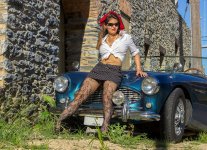
the Healey when everything was working!
it has a NOS girdling brake master cylinder with new brake master cylinder kit fitted in case the rubber seals had deteriorated with age from sitting on the shelf. It has all 6 new wheel cylinders, and all three new brake hoses. All four brake drums were turned, and both front and rear shoes were replaced. It also has new bridge pipes on the front wheels. The brakes were bled with both conventional Castrol LMA brake fluid (many times) and silicon brake fluid (twice, to be sure all of the old fluid had been drained). The brakes were bled under pressure and the conventional method with EZ bleed system and with someone pumping the pedal.
In addition, Healey Surgeons would like to point out this problem is unique to the brake system with the integral reservoir master cylinder, I.e. The Longbridge 100/6. They have never seen this on the later 100/6 models or the 3000 Healeys with the separate brake reservoir. Maybe the factory realized, "hey, this is not a good set up" and changed the hydraulic system.
so, that's our story, and we're sticking to it
the Healey when everything was working!