• Hi Guest!
    If you appreciate British Car Forum and our 25 years of supporting British car enthusiasts with technical and anicdotal information, collected from our thousands of great members, please support us with a low-cost subscription. You can become a supporting member for less than the dues of most car clubs.

    There are some perks with a member upgrade!
    **Upgrade Now**
    (PS: Subscribers don't see this gawd-aweful banner
Tips
Tips

Big trouble with BN4 brakes

Country flag
Offline
I don't even know where to start with this. Here's the short version. Last summer our 100-6 starting jerking hard to the right when the brakes were applied. Upon investigation, various leaks were discovered. The front wheel cylinders we're rebuilt, the master was rebuilt, new front brake shoes, and new lines between the front wheel cylinders.

After various redo's and tightenings, all the leaks were corrected and it no longer jerked when the brakes were applied. Now for the problem...

First, heres what we are working with. This car is a true Longbridge built 100-6, built in 1957. After fixing the leaks, we could not get first pump pressure on the brake pedal. It would go to the floor on the first pump, then get good locking pressure on the second pump. After messing around with this issue for weeks, I finally gave up and called my good friend Doug Reid, who many of you know as being a pretty good Austin Healey mechanic. His advice was to keep bleeding the car and the problem would probably be solved. Well, after bleeding it so much that I felt like a vampire, I decided that I just wan't going to fix this issue. So off the car went to Bruce and Inan at Healey Surgeons. It's been two weeks, and Bruce is pulling his hair out. After duplicating what I had done, and replacing the master cylinder, here what else he has done:
replaced all three brake hoses
replaced all six wheel cylinders
replaced all brake shoes
bled the car three different ways
changed the front wheel cylinders to 7/8 from 1 inch at the suggestion of Tom Kovacs at Fourintune
replaced my master with a nos one, didn't do any good so replaced mine

where are we? The brake pedal still goes to the floor on the first pump, then gets good locking pressure on the second pump.

Bruce knows I'm posting this, he said forward him all ideas we get, he's at his wits end over this. Inan said it's the first time in 40 years that they could not figure a problem out.

any ideas?????

Larry
 
Mine did exactly this, so have various other cars I have done. Although I don't completely understand how or why, just leaving them to sit for some time has cured all of them. Yeah I know, not very convincing is it.

Have you tried pulling up the e-brake firm then giving the pedal a couple of presses to 'set' the rear cylinders into the brakes-on position, then wait a few seconds and try the pedal. If it is much improved then you have some adjustment issue in the rear mechanism. I'm still working on a solution to this fairly common (in my experience) problem.

Questions:
Are your shoes re-lined originals or replacement ones? There are some replacement ones going around with very thin linings that are dangerous.

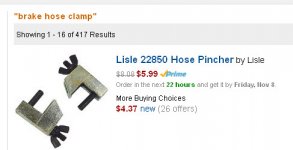
Have you tried isolating each section by clamping off each rubber hose? Any improvement after clamping off a hose means the problem is on the far side of the clamp. Parts stores sell special brake line clamps which are two hinged parallel round rods and a thumbscrew thing to squash them together on the hose.

Have you tried bleeding using air pressure on the reservoir? This is the only way to get all the air out that I have found. Use a shop air compressor set at 20psi and pressurise the reservoir using a 1" length of fuel hose onto the cap, then have somebody take a nip out of each wheel. If you have a third person give the pedal a couple of quick jabs at the same time to dislodge any air bubbles. The Longbridge reservoir is very small and runs out quickly so stop often and refill it.

Suddenly it will come right as if there was no problem in the first place and you'll be left wondering what the heck that was all about.

Andy.
 
Could it be the reservoir cap?
You've replaced everything else, what about the MC? If it's the one with the integral reservoir, they're only $50 from Moss.
Maybe there's some scuzz in the passage between the reservoir and piston that's acting as a check valve.
The clamps mentioned above by Andy are very cheap on Amazon.
BrakeHosePinchers.jpg
 
Hi Andy, and thanks for the info. I'm forwarding your response on to Bruce at Healey Surgeons. We tried the E brake test, no luck. The brake shoes were replacements from one of the usual suspects, so Bruce took those off and replaced them with a pair of relined ones he had at Healey Surgeons. I'm not sure if he isolated each section, like I said I'm forwarding your suggestions on to him. It's funny, since this happened we've been hearing about similar problems from other Longbridge owners. It seems to alway happen after rebuilds or other brake work. We'll let you know how we make out,

Thanks!!
Larry
 
Hi Steve, yep, rebuilt the master, and also tried a new master and cap :(
 
I had something similar to this and it turned out to be a weak pedal return spring. The pedal wasn't returning enough to connect the cylinder with the reservoir on the first pump. Something about pumping it once made it return far enough and then I got good pressure. Try pulling up on the brake pedal before pushing down...
 
I had a similar problem on my BN6 and like Bruce for over 40 years I have never experienced this problem. After contacting my supplier and asking if they had changed brake fluids and was informed they hadn't, I asked for the number to the brake fluid manufacturer. We contacted Dow Chemical and explained the situation to one of their technicians. I was only under the impression that hydraulic brake fluid was not compressible and was quickly informed it was compressible. The technician explained there are 37 different formulas for dot 3 brake fluid. Further in the conversation we discussed what would change the compression rate in brake fluid. I realized that viscosity would change the compression rate of the fluid. The higher the viscosity it compresses less. I was doubtful about this information so I made a viscosity cup. I filled it with different types of brake fluids, most drained out of the cup very quickly except for one. We removed all the current brake fluid from the car and put the higher viscosity brake fluid in it. We proceeded to do normal brake bleeding procedure and got a firm pedal almost immediately. My assistant and I looked at each other and said I would never have believed that unless I was here doing this. The technician from Dow explained the reason for so many formulas was depended on what the automotive manufacturer required for their particular system . Please bear in mind I am only repeating what I was told and the difference in formulas is to reduce weight in the automobile. go figure!
The higher viscosity formula was used on earlier automobiles because the principles used were different than today's cars.
We discussed silicon brake fluid and the problem it has with air. He reminded me that Healeys are a vented brake system and this is why you have a sponging pedal on these types of systems. In Canada he recommended Certified brake fluid sold at Canadian Tire and some GM brake fluids.
I hope this helps. We spent a whole summer trying to get brakes and after changing the brake fluid had brakes in 20 minutes. I guess he was right.
Marty
 
Larry, Interesting...I talked with Bruce for 30 minutes on Monday. I have a BJ8 (with servo) and have a similar issue going on. He was very helpful and also wanted my opinion on what could be going on... on your car!. I could tell he was about as frustrated as me ! He was saying...this is just simple system why can't we figure it out?? I am concentrating on the rear brakes...I ordered new shoes and return springs (I'll check the fit before putting them on) from Healy Surgeons and various other parts from Moss Including a new TRW Master in case I need it). I was thinking the initial long pedal movement was caused by air, but now I don't think so, I thought the wheel cylinders in the rear were moving too far so I removed the shoes and used a couple c clamps to hold the wheel cylinders from moving...still have the first stroke going down a little more than the second but not all that much (1/2 inch). Maybe after I replace the shoes, springs in the rear I may bleed again just to be sure I got all the air out (I have run 3 cans of brake fluid already. One thing that worries me is (I know it was not silicon in there to start) is I have use 2 different brands dot 3 fluid for bleeding . I think I have run all the old stuff out by now (how much does the whole system take???) I might also get some Castrol GT/LMA and re-bleed plenty of it through to replace all with the Castrol. What does everyone think??. Lee
 
To me, this sounds like you still have a problem with your master cylinder. I have had the same problem with some new brake master cylinders and bad rebuild kits as well. Only after rebuilding my Nos master cylinder with a new rebuild kit or returning the new master cylinder for a replacement did the problem get solved. Sometimes that rubber O ring in the master cylinder bore is not installed correctly or not sealing and expanding enough. You may want to pre bleed the master cylinder on the bench before installing it as well. Another thing you may want to check is the bleeder screws for sealing problems and leakage. Also re check brake line connections at the master cylinder for leakage. I highly recommend dot 5 brake fluid as well! Hope your problem gets finally solved soon!
 
It could be...I did order TRW MC from MOSS. The TRW I put in my MGA 1600 worked out great, so I hope this will too. Well, If I was going to switch to Silicon (I did use Silicon on the MG) I would now have to take the calipers apart & clean them out, install new wheel cylinders and then try to get the dot 3 out of the lines, servo ect...On the MG I did replace absolutely everything in the brake system and did use silicon based on recommendation by MG Guru Barney Gaylord (great guy, great site) Just not sure I want to do all that right now. I did replace the 3 rubber brake lines, but not the metal lines. I think they are original too. I'll keep you posted as the issue progresses. I should know a lot by tomorrow evening. Thanks,Lee
 
It sounds as if you have excess travel somewhere, If the brake linings have been checked, how about the flexible hoses, I recently had a problem with the rear flexible as I could not bleed the back brakes properly using the 'Ezeebleed' system, Changed the rear hose and that sorted it. Can the MC be bench tested? it obviously pumps up but worth a check for the pressure on first pump.

:cheers:

Bob
 
All 3 rubber brake hoses were replaced last week...also, If I pull the master, I'll just replace it. It is a Girling (casting 625), but it looks the same size as the clutch...I'm told that may not be correct as it should be a 7/8??, Lee
 
Thanks everybody for the replies, keep them coming. I'm forwarding these ideas on to Bruce. We seem to have drifted from the BN4 issue, but that's OK because Healey Surgeons seems to be involved with both cars:smile: Also, any more ideas on the BN4 would be welcome. Thanks again! Larry
 
Larry, I have been thinking about this...It seems if there is no fluid leaks...you have to just have too much mechanical movement somewhere. Maybe put a C clamp on each wheel cylinder (6) then try the pedal. If it still fails (too much movement) then the problem has to be in Master or an air pocket somewhere?? Lee
 
I went through a similar issue with my BN6 after replacing front wheel cylinders, flex hoses and crossover pipes. Bled the brakes many times both manually and with EZ Bleed. Funny thing, after driving the car a few times, the brakes improved to the point where the pedal no longer goes to the floor, though it does pump up. I intend to bleed again soon. I'm thinking there was air in the line somewhere and driving the car shook it loose and/or that is has somehow self-vented (through the reservoir cap?).
 
Just received the shoes from Healey Surgeons...the linings are LESS thick that what came off the car. The ones from the car are 3/16 from the steel to the outside of the shoe material...the new ones are slightly over 1/8 inch. Are these the dreaded thin linings??? Are they OK to use? ALSO, Larry I wander if on your BN4 if ALL the shoes are under size...would that not make for more pedal movement (8 shoes x 1/16 = 1/2 inch!)? Lee
 
Lee- yes, send those shoes back. To the resellers who I know read these forums- c'mon guys get this stuff off the market before somebody destroys their car due to brake failure

Larry- I got a very good pedal on a BN2 (same wheel cylinder arrangement) after pressurising the reservoir with an air compressor and then sharply jabbing the pedal when the bleeder was open which presumably dislodged the trapped air bubbles. I wonder what would happen if the backing plate was removed from the upright and rotated so the bleeder was at the top for bleeding. This would determine if the upside down piping arrangement on the front is the cause of so much wasted brake fluid.

Have you tried winding the front adjusters out until the shoes are firmly locked onto the drums then trying the pedal much the same as doing the e-brake pull test? Also, is the master cylinder 3/4"?

Andy.
 
Andy, Here is what I was told....The NEW wheel cylinders they (HS) are getting...require the thinner linings (must be they are too far between piston and opposite end? in other words not made correctly). Healey Surgeons have 3 different thickness's of linings they can supply (Thanks to them!). I was told it is because on the different wheel cylinders etc. I also called Moss....a really nice guy looked up details on the BJ8 shoes. He sent me two photo's, one of the OE shoe showing a 4.5mm thickness of the lining...and the other showing what they stock and it is 3.5mm lining. The ones that were on my car are about 5mm, and the ones I just got are 3.5mm. Next comment...while I am new to Healeys I am not new to doing brakes...people are talking about this thin linings being dangerous. So are you saying that let's say we have 1/4 inch linings and when they wear to 1/16 we are in danger? If so it is the wheel cylinders that are the problem. The cylinders should never be close to popping when the linings are worn to the point of making a little warning noise. If that is happening the wheel cylinders are too darn short, meaning the piston has to go too far to engage the linings onto the drum. If I am all wet here tell me why. Meanwhile I have no idea what to do to get these brakes correct based on all the info I now have., So lets see here, if you have the original spec wheel cylinders AND run the thin linings I could see a possible problem, OR if you have the new cylinders and use the thin ones your OK, but if you use the thick ones there is not enough clearance???? Either way I can't see where the cylinder would pop?? Thanks, Lee
 
in other words not made correctly

This is the crux of the matter- people are selling stuff that appears to be the same as original but has fatal flaws which can lead to complete system failure as has happened to at least two owners so far. As you say, it should not be possible under any conditions to have the wheel cylinder pop out, even if the shoes are completely worn out and the adjusters aren't tight. That would be a real situation for an old car that hasn't been regularly maintained and it just isn't heard of up until recently (that I know of).

I don't know how or why failure can happen with some shoe/wheel cylinder combinations but it definitely can and the onus should be on the suppliers to provide sufficient information with the parts to avoid the dangerous combinations. All the more reason to refurbish the original known-quality parts which can be done at less cost than replacing them with unknown quality stuff.

Andy.
 
This is a generic brake response, based upon decades and decades of doing brakes....Italian, Japanese, British, Korean...and US.
Three things will cause the symptoms you are experiencing. One is a ballooning hose...and since you replaced them, you need to ask if this did it before the hoses were replaced. Might be helpful to get a good pedal, wedge the pedal down with a brace to the seat frame, get out and look at the hoses.
Second is air.
We used to have specific cars with that issue.
Open a bleeder, have an assistant standing by near the bleeder, pull your knee to your chest, and nail the pedal, holding it down while the assistant closes the bleeder. We used to call that "turbulence bleeding"....forces air out of upper traps.

Last is brake shoe adjustment.
Install, bleed, get a good hard pedal, then re-adjust, do the pedal bit again, and recheck.
Seen shoes wedge and not center...had to adjust with drum off, kicking shoes up or down to get the drum to just slide on, then adjust.

In some cars, we'd adjust so there was no way to turn the wheel..all of them...check pedal, then back off each adjuster exactly the same.

Yeah, not BN4 specific, but usually brakes aren't rocket science.
Unless you have an old Jag with a vertical mount master, remote reservoir, and a foot valve...

Dave
 
Back
Top