• Hey Guest!
    British Car Forum has been supporting enthusiasts for over 25 years by providing a great place to share our love for British cars. You can support our efforts by upgrading your membership for less than the dues of most car clubs. There are some perks with a member upgrade!

    **Upgrade Now**
    (PS: Upgraded members don't see this banner, nor will you see the Google ads that appear on the site.)
Tips
Tips

TR4/4A Beginning Cyl Head Removal - Questions

RJS

Jedi Warrior
Country flag
Offline
Hi

I discovered I have a broken cylinder head stud. So, even though I have never done this before, the head is coming off. I'll plan to take it slowly and hope to lean on you guys and gals for my questions. Started today and here today's questions:
  1. When I removed one of the pushrods, one of the tappets flipped and is lying on its side. How big of a deal is this? Can I correct it after the head is off the block? For future reference, is there a way to correct this with the head still on - any tricks?
  2. I drained the anti-freeze from the lower radiator hose. Will that be sufficient to keep anti-freeze from pouring all over when I remove the head? If not, any other suggestions?
  3. Should I attempt to remove the intake and exhaust manifolds together as a unit, or separate them and remove the intake manifold first?
  4. Is it OK to remove the head nuts with an impact wrench? I've been soaking them for two weeks and lightly tested them with a breaker bar today and they're really on there.
  5. Is it preferred to remove the cylinder head studs before or after removing the cylinder head (I do plan on upgrading to ARP studs and nuts)? The one reason I would consider doing them after is so I can soak them with penetrating oil first - can't do that with the head still on.

Thanks

Bob
 
1. Once the head is off you should be able to relocate it no problem. I have done this - possibly used a magnetic probe to fish it out. You may be able to do this with the head still on though I would just wait as it will be easier after. BTW - twirling the pushrod as you lift it help it break free of the suction that may want to hold the lifter.

2. I would also open the drain on the (passenger) side of the block. If nothing comes out (often gets clogged) you can simply remove the drain and twiddle a bamboo skewer or wire or drill (whatever it takes) to free up the clog.

3. I leave the manifold connected and just pull them back out of the way. If you have SUs you may need to remove the choke linkage to be able to pull them back far enough to clear the manifold studs. I stick a piece or two of 2x4 down between the downpipe and the block to hold them back.

4. The torque (as I recall) is north of 100 ft lbs so 'lightly' testing them is not likely to move anything. I have not removed them with an impact but I do not see a reason why it would be an unsound approach.

5. I have always removed the head with the studs in place. Of course if you find that one of them is stuck to the head that may alter your plan.

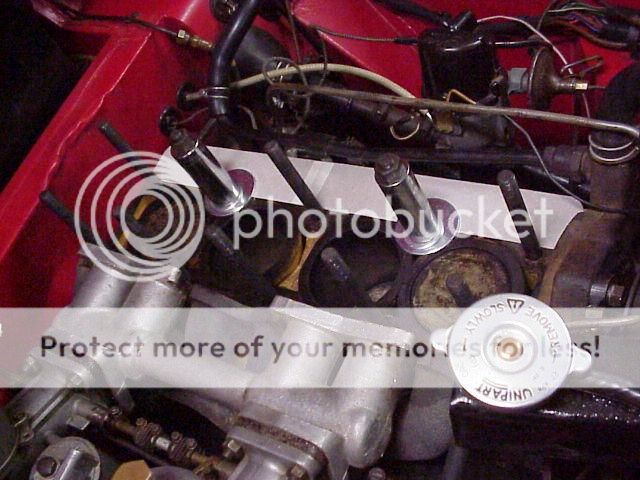
Once the head is off you will want to use something to clamp down the liners so they do not get disturbed - supposedly they can lift if the engine is turned. Seems unlikely to me but I always clamp them down anyway. Photo to follow.

Sockets and big washers used to clamp down the liners. I also put some cardboard pieces over the open area for the lifters to prevent anything from falling in:

head1_zpswsciuhzi.jpg
 
I can't add anything to what Geo has said but I must say that if you have ever had back problems lifting that quite heavy head will strain the muscles since you will be lifting at an odd angle. Straining jobs like that will teach you a new language if you don't already know it.

Lou Metelko
Auburn, Indiana
 
Ditto on all of the above. When lifting the head off, you also have to be careful to lift it straight. If it tips, it will catch the studs and bind. Might be a good time to find a helper, if you can.

Since you're going to replace the studs anyway, I wouldn't bother with trying to clamp the liners. Just don't turn the crankshaft, and you'll be fine. (Like Geo, I seriously doubt it would be a problem on an older engine, but no sense taking a chance.)
 
Thanks Gents,

All really useful info and a big "Whew" on the tappet. That allowed me to sleep last night. I'm coming up on my 53rd birthday next month so when it comes to lifting the head off I will solicit the services of my 16 year old son who hits the weight room at school everyday.

Just coming back to the manifolds - I like your tip of simply pulling them clear of the head studs. But, I am using this opportunity to clean them up and possibly rebuild the carbs. So, it's all coming off. Again, better with the intake and exhaust together or to separate them? Or, does it really not matter?

Bob
 
Just coming back to the manifolds - I like your tip of simply pulling them clear of the head studs. But, I am using this opportunity to clean them up and possibly rebuild the carbs. So, it's all coming off. Again, better with the intake and exhaust together or to separate them? Or, does it really not matter?
If they still have the studs that connect them together, I would go ahead and remove them as a pair. Those studs will probably be corroded and difficult to remove; might as well have them out where you can see them when you snap them off.
 
Hello Bob

You should be careful to lift the head straight up if the studs are still in place. It may require some or a lot of persuasion to get it to move. I ended up using wooden wedges to get mine off. Being mindfully of the edges of block and the water passages.

David
 
If the head comes up and off straight consider yourself lucky. There are those ten long studs and to get a good straight up pull after years of being on the car is doubtful, but try that first plus the 16 year old is probably going to be your best tool. If you do have trouble, look at a book and see which ones of the head bolts are shorty’s and try and double nut a couple of those out to get rid of some of the binding resistance from the studs off. I usually juice stuff up with WD40, but try and avoid getting that down on the figure 8 gaskets at the bottom of the lines; it probably will not hurt anything, but that stuff will dissolve rust and sealant and remotely possible break the sleeve seal. The wooden wedges are a good idea and you should clamp the liners down with a bolt and big washer or something. Good luck and patients and do not be afraid to take a break to get a fresh look.
 
I used an impact wrench to remove the cylinder head nuts and it worked ok just go easy on the trigger and in short spurts at first. I figured that was better than putting constant heavy torque on the bolts using a regular socket wrench to loosen in case some were weak and prone to snap off. Not saying that's what you should do, just saying it worked in my case and made the process a little easier.
 
I used an impact wrench to remove the cylinder head nuts and it worked ok just go easy on the trigger and in short spurts at first. I figured that was better than putting constant heavy torque on the bolts using a regular socket wrench to loosen in case some were weak and prone to snap off. Not saying that's what you should do, just saying it worked in my case and made the process a little easier.

I've never owned an impact wrench that will free 100+ torqued nuts. I have to free them with a breaker bar, and then spin them off with the impact wrench.
 
When I was taking my car apart I bought an electric impact wrench from HF that puts out 230 ft lbs of torque..it's a little bulky for tight spaces but otherwise works like a champ. Didn't have any problem with the head nuts and they had been torqued previously to at least 105 lbs..
 
Not all impact wrenches are created equal. I've not tried it, but I would guess that my IR "TiMax" impact would be able to twist off a TR head stud with no problem. It's rated something like 900 ftlb.

But I've also got a "tire changer" impact that like you say, won't develop nearly as much torque. ISTR it was rated at 200 ftlb. I got frustrated with it not being able to remove the lug nuts on my motorhome, so I've also got a cheap "Central Pneumatic" rated at 450 ftlb (or something like that), that will reliably remove a nut that was torqued to 125 (and got a bit rusty afterwards).
 
Hey,

Thanks gents. Appreciate all the input. I realized I have easy access to an engine hoist. I was considering using this to pull the head off. Any thoughts? I imagine I should pull the studs out first to avoid binding on the way up. My main question is what do I connect to for the pull?

Bob
 
The hoist probably won't work with the studs in; I picked the entire car up that way once (then set it down and lifted the head off by hand). But it would probably work fine if you can get the studs out.

The rocker pedestal bolt holes should be plenty strong enough.
 
I've never had much trouble removing the TR heads, but if you do, there are a lot of "old school" techniques.

If you haven't taken it apart yet, loosen the nuts and start the motor for a second. If you have taken the manifolds apart, feed cotton rope into the front and rear plug holes and hand turn the crank until the head lifts. I've always found places to lever with a crow or large chisel, using caution to avoid marring the block and head faces.

I realized I do have an impact wrench that would work...but it's 3/4" inch drive and weighs 60 lbs! Like you Randall, I got it to remove RV wheels. Works good for that, but too ungainly to handle for anything else.
 
Hi All,

Update. Everything is off and cylinder head comes off next weekend. I had been soaking all the manifold fasteners for a couple of weeks with a 50/50 mix of Acetone and Dextron-Mercon ATF. Everything backed right out, nothing broke...not even the fasteners from the exhaust manifold to the downpipe which were heavily rusted. I did end up removing the carbs from the intake first. Then separated the intake and exhaust manifolds to remove them. Electric impact wrench handled the cyl head nuts. I was paranoid of snapping a head studs on removal. I double nutted them and with a firm tug, they all came right out...no drama. Big whew on my part.

Next weekend I'll pull the cyl head with the help of the engine hoist. Then everything goes back together with new fasteners (lots of hi-temp copper anti-seize), new gaskets and new ARP head studs.

What are people's preferences for cylinder head gaskets? My car has 87mm pistons and liners. The PO who had the engine rebuilt in circa 1998 used "Upper Engine Gasket Set from TRF. Part No. GEG178 T34 Gasket Set, Head, 86mm”. I understand that set uses a standard copper sandwich gasket. Does any one have any experience with this composite gasket with silicone sealing strips?
https://www.bpnorthwest.com/triumph.../head-gasket-big-bore-87mm-to-90mm-lucas.html

Thanks

Bob
 
Regarding the head gasket....not all gaskets are well made. Be careful that there is no intrusion into the combustion chamber.
 
That was the plan. Bolts into the rocker pdestal stud holes. Unless someone can suggest a better idea.

Bob
 
Back
Top