Hey Guest!
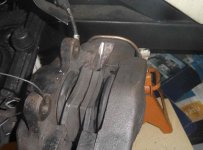
That's a good point; the brake rotor was very likely rubbing the inside of the caliper. Might have been the source of the rhythmic squeak.
A few other things that I thought were in the book, but I'm not seeing at the moment:
Front wheel bearings are consumables, but their lifetime varies widely with conditions. For example, splashing a hot hub through water can suck water into the bearing housing, which can carry dirt with it and greatly reduce bearing life. And if the water is not promptly dispelled by the hub getting hot again, it will eventually degrade the grease (again shortening life), and even possibly leading to corrosion issues (in cars that are stored for long periods). So it's important to inspect the bearing surfaces every time you regrease the bearings (as well as actually doing the regreasing). ANY visible wear on the rollers or outer race is grounds to replace the bearing, as it was almost certainly caused by dirt contamination. I don't have the link handy, but there is a document on the web (written by Timken IIRC) that talks about this.
I think I've already mentioned this, but I'll hit it again : the clearance given in the TR2/3 workshop manual is wrong. IMO the .003" to .005" value that Berry mentioned is correct.
But, you can only lock the nut in 1/2 flat increments, which is over twice the .002" range allowed! In theory, dimensions of replacement parts are controlled so that backing off to the available position will result in .003" to .005", but we all know that replacement parts aren't always exactly right. So it's a good idea after replacing the spindle or D washer to do a dry fit and check the clearance using a dial indicator (as shown in the TR4 manual, but inexplicably not explained). If the resulting clearance is out of range, thin the D washer until it comes out right.
Obviously, that makes the vertical link, spindle and D washer a matched set; so it's important not to switch D washers from side to side when servicing the bearings. It's also important to replace the D washer if there is any wear or damage to it from the bearing race spinning as that will have changed the clearance.
Last (for now), some of us were taught to let the bearing cage spin while cleaning the inner race with compressed air. Although the race certainly has to turn some, letting it spin at high speed is a very bad idea. Without proper loading, the rollers will bang around and potentially produce microscopic momentary overloads that produce invisible damage to the surface and shorten service life. This applies to all roller/ball bearings, not just wheel bearings. This is also mentioned in that Timken document.
I had to take a a few thou cut off the nuts to get the feel I wanted.
For a precise setting , as you said ,the range between flats is to big
Tom