• Hey Guest!
    British Car Forum has been supporting enthusiasts for over 25 years by providing a great place to share our love for British cars. You can support our efforts by upgrading your membership for less than the dues of most car clubs. There are some perks with a member upgrade!

    **Upgrade Now**
    (PS: Upgraded members don't see this banner, nor will you see the Google ads that appear on the site.)
Tips
Tips

TR2/3/3A Bearing failure

That's a good point; the brake rotor was very likely rubbing the inside of the caliper. Might have been the source of the rhythmic squeak.

A few other things that I thought were in the book, but I'm not seeing at the moment:

Front wheel bearings are consumables, but their lifetime varies widely with conditions. For example, splashing a hot hub through water can suck water into the bearing housing, which can carry dirt with it and greatly reduce bearing life. And if the water is not promptly dispelled by the hub getting hot again, it will eventually degrade the grease (again shortening life), and even possibly leading to corrosion issues (in cars that are stored for long periods). So it's important to inspect the bearing surfaces every time you regrease the bearings (as well as actually doing the regreasing). ANY visible wear on the rollers or outer race is grounds to replace the bearing, as it was almost certainly caused by dirt contamination. I don't have the link handy, but there is a document on the web (written by Timken IIRC) that talks about this.

I think I've already mentioned this, but I'll hit it again : the clearance given in the TR2/3 workshop manual is wrong. IMO the .003" to .005" value that Berry mentioned is correct.

But, you can only lock the nut in 1/2 flat increments, which is over twice the .002" range allowed! In theory, dimensions of replacement parts are controlled so that backing off to the available position will result in .003" to .005", but we all know that replacement parts aren't always exactly right. So it's a good idea after replacing the spindle or D washer to do a dry fit and check the clearance using a dial indicator (as shown in the TR4 manual, but inexplicably not explained). If the resulting clearance is out of range, thin the D washer until it comes out right.

Obviously, that makes the vertical link, spindle and D washer a matched set; so it's important not to switch D washers from side to side when servicing the bearings. It's also important to replace the D washer if there is any wear or damage to it from the bearing race spinning as that will have changed the clearance.

Last (for now), some of us were taught to let the bearing cage spin while cleaning the inner race with compressed air. Although the race certainly has to turn some, letting it spin at high speed is a very bad idea. Without proper loading, the rollers will bang around and potentially produce microscopic momentary overloads that produce invisible damage to the surface and shorten service life. This applies to all roller/ball bearings, not just wheel bearings. This is also mentioned in that Timken document.

I had to take a a few thou cut off the nuts to get the feel I wanted.
For a precise setting , as you said ,the range between flats is to big
Tom
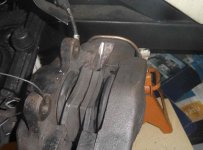
 
Wow. I suppose you have to look for somethings, before you can see them. The only procedure I have for setting the front bearings, is to tighten to 10'# and then slacken to fit the pin, so I need to find what you-all are talking about. But I went out this morning and examined the caliper and rotor. The rotor shows no significant signs, but the caliper is as pictured. I'm sure that could be heard as well as the race riding in the hub.

The more I know I know, the more I know I don't know. Thanks all.
 

Attachments

  • rotor_dig.jpg
    rotor_dig.jpg
    60.8 KB · Views: 106
When you were talking drums I thought you were referring to the bad wheel. Now I'm up to speed...you have front rotors. It does look like the rotor may have contactcted the top of the caliper. It looks shiny in the pic.

In my shop class the teacher was adamant "not to spin those d@$n bearings with the air hose"! Always been a big no-no.

But again, roller bearings never die instantly. You have to learn to detect a bearing rumble. That still gives you a decent amount of time before it disentigrates.
 
To me, the shiny spot on the caliper might just be a reflection. Even if the rotor was contacting the caliper, it would probably not produce a squeal, but more of a rubbing sound.
I think the bottom line is that the bearing failure was probably caused by high temps that reduced the end float to zilch. Since you live in a hot climate and actually drive the car on long trips, it might help to adjust the wheel bearings to the higher limit of end play-.005". The downside being possibly some "looseness" in the steering.
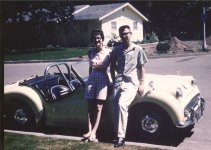
Jerry-You are my hero for not only rescuing and restoring the car, but actually driving it on long trips. My longest venture in a TR3 was in 1964 from just South of Portland, OR to Phoenix, AZ. In August, no less. Here is a pic, shortly after returning. I only had the car for about another year before wrecking it, the girl friend became a wife, still here after 51 years.
Berry1964 001.jpg
 
Last edited:
Hmm... I just lost another post in the middle of typing.

Berry, the two of you make for a sporty looking couple. I like the roll bar and grill as well. I hope the bar helped in the accident.

Clearly the bearing failed before the rotor dug into the caliper. The shiny mark is not a reflection, but did not photograph well. The matching inner edge of the rotor also did not photograph well. I'm sure the rotor is much harder than the casting of the caliper. If I were so inclined, I could probably put the wheel back on, held in place by the D washer, and record the sound. -but I am not so inclined. I think all kinds of bad sounds were being made, but not all can be heard at 75mph inside a TR3. I also think the hub was often finding itself resting against the good inner bearing and making no noise at all. On a straight, flat, smooth road, -like many interstates, the noise was intermittent, but I heard a high pitched squeak often enough for me to know that something terrible was going to happen if I didn't make that noise stop. I like to think I am fairly easy going, but some things make me anxious -especially with my wife in the car.

I failed to mention a peculiar incident that I'm now sure is somehow involved. When I returned from the April Pa trip, I could hear a slight clunk when I turned right. I could wiggle the top of the left front wheel and feel play in the wheel bearing. I pulled the wheel and made sure the bearing had grease in it. I pulled the cotter pin and tightened the nut a couple flats until the clunk went away. At the time I thought it was odd but assumed that somehow I either didn't mark the nut properly when I cleaned/re-packed the bearings, or didn't put it on properly when I cleaned/re-packed the bearings before the trip. I drove the car around Houston a few hundred miles, the clunk was gone and everything seemed normal.

I suppose it makes me happy to know that someone can consider me a hero. From the time I first saw my TR3, I knew it was going to be a lot of work, but would reward me with as much pleasure. Long trips in it are always an adventure. I never know where, who or why, but it seems to make people happy just to see us cruising down the road.

On the first part of my April Pa trip I stopped for a quick burger at a fast food place in a little town on the edge of Texas. I saw a man pull in next to my TR3 in the parking lot and walk around it a few times. Then he walked into the restaurant, looked around at all the tables and people real slow. Then he walked across the room and sat down across from me and asked 'Is that your TR3 out there?'. I was a little stunned that he somehow knew I was the driver. I'll never understand why, but sometimes we stand out in a crowd.
 
FWIW, I've done a lot of high speed miles in TRs, in temps over 100F and never seen that kind of failure. Hottest I recall was 118F; and my tach was reading 4500 rpm in 4th OD. But I do replace the front bearings rather more often than I would like, because I often see the dull matte finish under rollers, showing the results of contamination.

On the GM car where I did have repeated bearing failures, generally the first thing I would notice was the rotor contacting the caliper, which sounded exactly like brake squeal at first, but quickly turned into the typical grinding noise of worn-out pads.

I know why I sometimes get the same restaurant experience : I'm the only one in the room whose hair turns upwards from where it sticks out under my cap. Almost no one in CA even wears a hat/cap; and the wind in a TR3 does strange things to otherwise straight hair. Of course the leather driving cap probably helps too, but I normally take it off in a restaurant, leaving just the funny hair.
 
Of course the leather driving cap probably helps too

I remember being in a restaurant in Ca with my wife when a man walked in while removing his leather cap. We both immediately knew it was the TR3driver. I also remember telling him he didn't look at all like I expected. -but we were expecting him.
 
Over the years I have made some of children car noise neurotic always looking/hearing for noises since I had a tr3 before they were born, and I was always saying you hear that. My oldest now always drives a new car, so he can relax and not listen so much; besides these new Lexus SUV you cannot even hear the road. Driving a tr3 or for that matter anything from the 60ites the noises are there and real. I still know people who cannot believe that the noises even in newer cars can be translated into real information until you hand them the part.
steve
 
Back
Top