• Hey Guest!
    British Car Forum has been supporting enthusiasts for over 25 years by providing a great place to share our love for British cars. You can support our efforts by upgrading your membership for less than the dues of most car clubs. There are some perks with a member upgrade!

    **Upgrade Now**
    (PS: Upgraded members don't see this banner, nor will you see the Google ads that appear on the site.)
Tips
Tips

TR2/3/3A Basic TR3 Operator's Manual

M

Member 10617

Guest
Guest
Offline
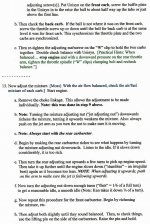
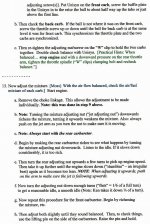
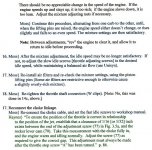
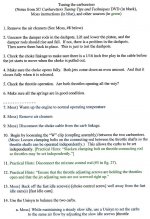
With the help of Forum participants, I have been trying to put together a very basic operator's manual for my TR3.

Here is the section on tuning carburetors and setting the mixture.

If you are inclined, please take a look at the following three documents (posted separately) and let me know if you find any problems with them or if there is a need to add something.

I know that tuning carburetors is useless unless everything else in the engine is working well, but let's assume that is the case.

Your help will be greatly appreciated.
 

Attachments

  • 24690.jpg
    24690.jpg
    129.7 KB · Views: 496
Here is the second page:
 

Attachments

  • 24691.jpg
    24691.jpg
    146.8 KB · Views: 162
  • 24693.jpg
    24693.jpg
    146.8 KB · Views: 146
Here is the third page:
 

Attachments

  • 24692.jpg
    24692.jpg
    124.3 KB · Views: 444
Hi, Mickey,

I'm not sure how to post it on the Wiki Project, but I will give it a try after I get some feedback from Forum participants.

Thanks.
 
FWIW -- I never bother to warm up the engine to sync the carbs (step 7), just jump right in. Then, by the time I have them synced, the engine is warm for the mixture adjustment.

AFAIK the carbs can be synced fine on a cold engine. Indeed, if you had a means to just spin the engine with a big electric motor you could sync the carbs without actually running the engine as all you're measuring is the vacuum created.

I also skip step 9 (disconnect choke linkage) -- don't see why that is needed.

For mixture adjustment I find it helps to visualize the direction I am turning the nut as viewed from above... then: <span style="font-weight: bold">R</span>ight=<span style="font-weight: bold">R</span>icher and <span style="font-weight: bold">L</span>eft=<span style="font-weight: bold">L</span>eaner.

Interesting they say to do the rear carb first. Any guesses why?
 
Hi, George,

Good points... very helpful.

As for warming up the engine, here in Virginia, especially when the weather is cool, the car is rather lumpy until it has warmed up. Perhaps they want you to warm up the engine so it runs smoothly while you are doing this work. (??)

As for disconnecting the choke cable (step 9), I don't know why Moss recommends this. The SU technician in the SU video doesn't mention disconnecting the choke cable, but he does emphasize the need to disconnect the choke linkage (jet connecting rod assembly). It is the one portion of these instructions that I am very confused about, in part because Moss and the SU guy tend to use the same nomenclature for two different things: choke cable vs choke linkage.

Perhaps Moss call for disconnecting the choke cable because it might interfere with something or because it might hinder setting the fast idle screws at the end of this procedure, which Haynes says is absolutely necessary.

The SU guy emphasizes starting with the rear carburetor, but gives no explanation.

I like your aide de memoire: right = richer, left = leaner. I'll use it.
 
Might be worth noting that the "SU tool kit" contains a tool for synchronizing that is cheaper, easier to use, and more accurate (IMO) than the Unisyn. Also stores much easier in your on-board tool kit, since it comes in a small, flat pouch. It also includes a gauge for float height, and a tiny wrench for the mixture nuts. (The jet centering tool is useless IMO, but maybe others will have better luck with it than I have.) Here's the best image I could find on short notice:
https://www.mgaroadster.co.uk/su_carburettor_tool.htm

On the TR3, the SU Tool kit also allows you to do something that the Unisyn can't (at least not easily), which is to check the synchronization after the throttle opens slightly instead of just at idle. This shows how much the coupling between the carbs is deflecting (and not slipping).

However, you can do a remarkably good job just by listening to the hiss through a length of tubing.

If you are going to include testing the dashpots, then I would suggest also including another test, which is to lift the pistons and let them drop freely, observe that they drop smoothly and land with a distinct 'click'. If any binding is observed (lack of a click indicates binding just as they reach bottom, which usually indicates the jet is not centered properly), then proper mixture adjustment will be impossible until the problem is addressed.
 
Randall,

Many thanks.

I have the SU tool kit -- mainly just use the small nut adjusting wrench -- but I don't believe it included a tool for synchronizing the carburetors. All I have is what is in the little pouch. I must have missed something....

I don't trust myself listening to the hiss. Fifty years ago that is how I did it, and I wasn't very good at it back then...

You have solved a mystery for me. The procedure that you describe for testing the dashpots is exactly what the SU DVD showed, but I didn't understand what I was seeing because the narrator didn't explain it as well as you have. I will add that information to my little "manual."

Again... many thanks.

Eventually, this car will go to some youngsters who know even less about engines than I do, and I want them to be able to do the basic work themselves. It is not only cheaper... but I find that shops that work on these cars are keen on doing big restorations... but don't pay enough attention to the small stuff. As a result, things don't always get done thoroughly. Time, for them, is money. Time for me... well... is money saved.
 
LexTR3 said:
I have the SU tool kit -- mainly just use the small nut adjusting wrench -- but I don't believe it included a tool for synchronizing the carburetors.
You didn't get at least two of the rods & wires shown in this photo?
SU%20Tool_2.jpg


To use it, you insert the rods & wires as shown in this photo (apologies for the octagonal content)
SU%20Tool_3.jpg


With the engine off, bend the wires slightly until they line up with each other. Then start the engine. If the wires remain lined up, the throttles are synchronized.
 
LexTR3 said:
I tried your procedure with the pistons and here is what I found. I raised the pistons and let them drop. Neither one dropped much. They remained raised. The only way I can get them down is to put a little pressure on them. When they reach the bottom, there is no "click." There is 30W motor oil in the dashpots.

What do you think?
I think you have a serious problem that must be addressed. First step, remove the damper rods entirely and try again. If they still bind, it's time to remove the domes and check out what's inside. Remove the three screws that hold the dome to the carb, and lift it straight up. Usually the piston will remain behind, but if not be sure to put your hand under the dome, so it can't fall out. Hopefully it's just carbon/varnish/gum buildup on the machined outer surface of the piston, or perhaps the inside of the dome. If so, a careful cleaning with some solvent is likely all it needs.

Note that the piston and dome are quite soft, and the surfaces are a precision match to each other. Don't use any kind of abrasive to clean them, or drop them on a hard surface. If the dome is dented (causing a high spot in the bore where the piston hangs up) but not cracked, you can try rubbing out the high spot with a bit of fine crocus cloth.

Also don't swap the pistons between domes. Swapping domes & pistons as a set between carbs is usually OK, but may upset the jet centering.
 
Randall,

False alarm... perhaps...

When you spoke of "pistons," I thought you were speaking about the damper rods. They did not fall freely or make a click.

I took off the air cleaners and lifted the actual pistons. They rose and fell freely, and made a kind of click or clunk sound when they fell to the bottom.

Sound OK to you?

I received all those parts in the SU kit, but I didn't know that they could subsititute for the Unisyn. I will go back to the drawing board on that right now.

The problem, other than my ignorance of these things, is that the SU video only showed the damper rods being raised and lowered. There was nothing to show that the pistons were being raised or lowered, and no mention of a click.
 
LexTR3 said:
When you spoke of "pistons," I thought you were speaking about the damper rods. They did not fall freely or make a click.

I took off the air cleaners and lifted the actual pistons. They rose and fell freely, and made a kind of click or clunk sound when they fell to the bottom.

Sound OK to you?
Yup, that's just as it should be. Except that with the dampers installed, you will feel firm (but smooth) resistance to lifting.

The thing with the damper rods is only to verify that there is enough oil in the dashpot for proper operation. It is important for proper operation, but as there is nowhere for the oil to go (on these carbs) it is very rarely a problem. Adding a little extra oil every year or two is probably beneficial though, as the excess will seep down between the chamber and the piston rod to lubricate them.
 
A great relief! Sounds like my carbs are doing what they should do. I learn something every day (and forget something every day also!).

So here is what I have included in my little manual:

1. Remove the air cleaners.

2. Unscrew the damper rods in the dashpots. Lift the damper rods and leave them up or out for the moment. Lift the pistons and let them drop freely. They should drop smoothly and land with a distinct "click" or "clunk" sound. If they don't fall or are binding, this usually indicates that the jet is not centered properly. The jet needs to be centered. The proper mixture adjustment will be impossible until the problem is addressed. If the pistons fall freely and "clunk," then replace or lower the damper rods in the dashpots and tighten.
 
BTW, one advantage of using the SU tools that Randall shows for syncing the carbs is that you don't have to remove the air cleaners, and you avoid any issues with the flowmeter disturbing the engine.

You can also use them to perform the piston drop test with the air cleaners in place.
 
Darrell,

Sounds like a good tool to use. I have the tool, but didn't realize it could be used to synch the carbs.


One other question. I am assuming that "mixture control rod," "jet connecting rod assembly," and "choke linkage" all refer to the same rod. One problem for us new guys is that there is no standard nomenclature.
 
TR3driver said:
Also don't swap the pistons between domes.
Yes, 99/44%, one should not mix these parts up. UNLESS, of course, some dreaded previous -- or current -- owner accidentally did that in the past. There are those times when one discovers that it's exactly what was done in the past.

If you can't find any other reason (i.e., damage, varnish and dirt, etc.) for a piston sticking, there's always the slim chance that the bits were mixed by mistake!
 
Hopefully, no previous owner or mechanic swapped the pistons. At present, they seem to be doing what they are supposed to do. I need to check the air flow balance, however, and will do that as soon. Glad to have the warning as I will make certain no one from here on out switches the pistons.

As for me, I doubt that I will ever know enough to take the carbs apart and inadvertently switch the pistons. I leave that kind of work to the experts.
 
LexTR3 said:
If they don't fall or are binding, this usually indicates that the jet is not centered properly.
"Don't fall" is usually something else; I would say that only absence of the landing click probably indicates the jet centering being off. The only times I've seen binding higher up, it's been because the pistons were rubbing on the domes for some reason (as noted above).

But if you aren't going to service them yourself, I suppose it really doesn't matter
grin.gif


BTW, there is a simple test for mis-matched domes & pistons, but it does require removing them from the car.
 
Randall,

Good. I'll write, "if they bind and especially if they don't "click," this usually indicates...."

Can you shed some light on my confusion over "mixture control rod," "jet connecting rod assembly," and "choke linkage." Are the all names for the same thing?
 
Back
Top