• Hey Guest!
    British Car Forum has been supporting enthusiasts for over 25 years by providing a great place to share our love for British cars. You can support our efforts by upgrading your membership for less than the dues of most car clubs. There are some perks with a member upgrade!

    **Upgrade Now**
    (PS: Upgraded members don't see this banner, nor will you see the Google ads that appear on the site.)
Tips
Tips

ARP studs too short

Basil

Administrator
Staff member
Boss
Offline
Now what! I had ordered a set of ARP head studs for my Spitfire (1500) some time ago and just got my head back from the machine shop today so went to install the head tonight. I now discover that the ARP studs are too short! My original studs had 6 studs of a certain length plus two studs that are about 1/8 inch longer to go where the engine lift bracket goes. All of these ARP studs are about 1/8 inch shorter than the regular studs and 1/4 inch shorter than the longer studs.

When I screw the studs all the way into the block and put the head on, there isn't enough thread sticking above the head to allow the ARP head nuts to screw all the way onto the studs! I'm assuming that I need to have the studs screwed all the way into the block? Has anyone had experience with ARP studs on the Spitfire 1500 engine? Is this common, or do I have the wrong studs?
 
Sounds like wrong studs to me but I'm the last guy you want to get info about ARP at the moment
 
Basil I used the ARP set on my engine with a 1500 head. They don't supply longer studs but that isn't a big deal, you just wont have the lifting hook.
I didn't measure the length of the studs but I found that Triumph had drilled and tapped one of the stud holes significantly deeper than the others. I just threaded it in to the same height as its neighbors and all is well. An 1/8" shouldn't make much of a difference since there will be a bit left above the nut anyway.

By the way, they lifting hook cleverly fits onto the back of the engine block instead of on the head to put the engine back into the car.
 
70herald said:
Basil I used the ARP set on my engine with a 1500 head. They don't supply longer studs but that isn't a big deal, you just wont have the lifting hook.
I didn't measure the length of the studs but I found that Triumph had drilled and tapped one of the stud holes significantly deeper than the others. I just threaded it in to the same height as its neighbors and all is well. An 1/8" shouldn't make much of a difference since there will be a bit left above the nut anyway.

By the way, they lifting hook cleverly fits onto the back of the engine block instead of on the head to put the engine back into the car.

I thought I have to screw the studs all the way into the holes in the block...are you suggesting that I don't necessarily have to screw the studs all the way in? I was wondering about that being a possible solution, but intuitively it seems dangerous?
 
The ARP studs I bought for my TR6 were too short too. Spent a lot of time on the phone with the TEch department at ARP. Measured the head, measured the studs, compared to the studs that I had removed from the engine during teardown. Ended up getting a big shrug from ARP and they said send back to Moss (that is where I bought them). I ended up using socket head cap screws instead of studs.
 
Basil, no the stud do not have to bottom in the block, in fact most beleive is is better to not have stud fully tightened so it can turn as final torque happens, and long as you have plenty of thread engagment on the block, you should be fine.
 
Hap Waldrop said:
Basil, no the stud do not have to bottom in the block, in fact most beleive is is better to have stud fully tightened so it can turn as final torque happens, ans long as you have plenty of thread engageent on the block, you should be fine.

Thanks Hap - So I guess I don't really have an issue after all - that's great!
 
I agree with Hap and was taught not to bottom out the studs......the grip of the studs is the threads in them & the block....as you're tightening/torqueing the head, there's a small possibility that the studs might move downward in their holes...if they're bottomed out that could be trouble.

'course I'm not the best mechanic on the BCF!
 
Yes, studs do not have to bottom out.

If you like, you can think of the threaded holes in the block as being "extra deep" (because, in fact, that's what they are).

Technically, minimum thread engagement must be equal to the thread diameter of the stud.
I like to have at least two diameters of thread engagement in situtations like this. Assuming the threaded holes in the block are in good condition, any more than that could be considered gravy.
 
Thanks for all the replies. I spoke with Tony this morning also and you all seem to be in violent agreement. I fell a lot better now and will thus have my newly rebuilt head installed tonight!
 
BobbyD said:
Does this whole threaded stud theory apply to all studs in threaded holes, like the Trailing Arm studs that hold the rear hubs on?

Yes, Bob.
General rule of the thumb is at least one diameter of thread engagement is acceptable (in reliable materials like low carbon steel or good quality iron).
More is better, of course (which is why I like to have two diameters).
Softer metals (like grey iron) are generally required to have two diameters of engagement at a minimum.

None of this talks about the quality of the bolt. For suspension and safety parts, Grade 5 (or equivelant) should be used. Grade 8 is better. And Lock-Tite, lock washers and/or safety wire may be needed. The length of the unthreaded section of the shank of the bolt can be important too, depending on the application (fully threaded bolts are usually avoided).

~More info here~
 
aeronca65t said:
General rule of the thumb is at least one diameter of thread engagement is acceptable (in reliable materials like low carbon steel or good quality iron).
Which is the fly in Bob's ointment; those trailing arms are made of something approximating hard cheese!
 
Didn't have the studs bottomed out in my Wedge. Didn't help me a bit. $65 worth of repair tools and parts and the original bolts are going back in instead of the studs.
 
Hey Boss,

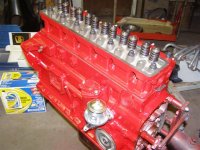
Here's a picture of mine, prior to torquing head down.
 

Attachments

  • 15652.jpg
    15652.jpg
    67.7 KB · Views: 336
I have ARP studs in my 1500 motor and I do not remember running into this problem? Is it only because of the engine lift bracket? Does the engine lift bracket serve any other purpose. Im sure My front bracket was a part of the alt mount and dont have a rear one. Never have. Perhaps thats the difference?
 
Well, I have installed and torqued all the studs. I basically screwed the studs in far enough so that when putting the nuts on, the top of the studs are flush with the top of the nuts. I can tell you that some of the studs are less than 2 thread diameters into the block. However, all the stud nuts did torque to the proper value. I torqued them to 60 ft/lbs per the ARP directions. I hope this works!

Basil
 
Basil: I was working on the 3A today so I had a chance to speak to Brian about your problem. He said that the rule of thumb is 2.5 x's the stud diameter for adequate thread engagement into the block. If you follow this rule you may have enough stud length. The other issue, even if the studs were long enough to bottom out in the block this would cause a stress point in the casting which is NO GOOD.
 
angelfj said:
Basil: I was working on the 3A today so I had a chance to speak to Brian about your problem. He said that the rule of thumb is 2.5 x's the stud diameter for adequate thread engagement into the block. If you follow this rule you may have enough stud length. The other issue, even if the studs were long enough to bottom out in the block this would cause a stress point in the casting which is NO GOOD.

I have no idea how much thread is actually in the block, I can only tell you that there is as much as possible assuming these studs are the correct studs for this motor.
 
Back
Top