• Hi Guest!
    If you appreciate British Car Forum and our 25 years of supporting British car enthusiasts with technical and anicdotal information, collected from our thousands of great members, please support us with a low-cost subscription. You can become a supporting member for less than the dues of most car clubs.

    There are some perks with a member upgrade!
    **Upgrade Now**
    (PS: Subscribers don't see this gawd-aweful banner
Tips
Tips

Any Lagonda owners ?

rich644

Freshman Member
Offline
Greetings,

Great forum. I know its a long shot but I'm trying to hook-up with any North American (pre war) Lagonda owners.

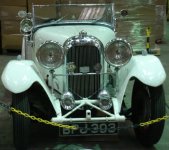
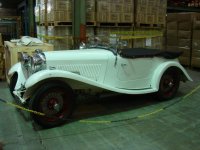
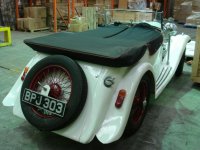
I recently imported a 1934 Lagonda Rapier from Wales and am having lots of fun mastering the intracacies of a Pre-selector gearbox. (and scaring myself in traffic)

The Rapier registry does carry parts and it's membership is (obviously) 98% british

I understand (per the registry)there are at least 3 Rapiers in the US and as many as 20 other Lagondas in the states.

I'd love to hear from other owners and even from those with familiarity with the marque.

I'm glad to find a place with others who share my enthisiasm for old British cars

Best regards
Richard
 
[ QUOTE ]
I recently imported a 1934 Lagonda Rapier from Wales

[/ QUOTE ]

I wonder if it's the one I remember? Newport area?
Welcome BTW, would love to see a pic or two.
 
Welcome indeed! It's great to have owners of rare and/or oddball cars become members, it gives great variety to the forum...........

I agree with Baz, I too would love to see a picture or two!
 
There is a nice aluminum Lagonda that races at Buttonwillow every year during the Moss / VARA event. Neat car!
 
greetings I purchased it from a very nice older gentleman in Tonna Neath West Glam. Wales.(The British are such nice people to work with)

As I understand about 380 Rapiers were manufactured, between 1934 and 1938 and about 175 are currently in running condition accounted for in the registry (with a few dozen others broken up for parts over the years)

Enclosed are pics from the bonded wharehouse in the UK just prior to shipment.
 
let me try this again with a smaller file
 

Attachments

  • 262305-lagondacompressedfront2.JPG
    262305-lagondacompressedfront2.JPG
    85.2 KB · Views: 136
That is one elegant looking car.I do trust you'll be driving it around now and then.

Stuart. /ubbthreads/images/graemlins/cheers.gif
 
/ubbthreads/images/graemlins/iagree.gif
 
Its refined, fast, and more fun than a bathtub full of otters.

It's a surprisingly drivable car. I would stop short of saying it would be practical daily driver. The good news is its all original. The bad news is its all original. So you need to plan your stops a little ahead of time.

Although the 13" Girling brakes on this car were considered state of the art in 1934, so compared to other cars of its era, it really does have pretty good stopping power.

As soon as I master the mysteries of the Wilson pre-selector gearbox. (you shift first, and then depress the clutch)I expect to be spending more time on the road.
 
The pre-select gearbox is a joy to drive! I've had a Daimler and now an Armstrong Siddeley thusly fitted. If you like I can send you a scan of the owner's manual for the Daimler explaining in detail how to use the transmission. Once you get used to thinking a shift ahead it becomes very easy to use.
Absolutely beautiful car! Lagonda is a great marque.
 
Thanks for the offer of assistance. Armstrong Siddeley had some cool touring cars in the 30's. I read that they (siddeley)offered an "automatic clutch" with their preselector gear boxes. I'm wondering if this is the same set up as my car, or if there were variances in the way the gear box was engaged from manufacturer to manufacturer. I have been going through some of the old documentation and it indicates that my car was recalled back to the factory in the 30's and fitted with a clutch.

I am spending some time diving in less traveled areas learning how to think a shift ahead (it does require a little concentration)

I think most of my problem may be that the shift pattern is kinda vague so I leave a stop in 3rd gear thinking i'm in 1st and kill the engine or burn the clutch.

It has been suggested that I may need to fit a stronger spring to the selector detent which hopefully would give me a better feel of what gear i'm actually in. Once I'm in forward motion its fairly easy to shift. but the stop and go driving I'm finding a challenge.

I hope I master it before I burn out the clutch.
 
Interesting set up. The Daimler was fitted with a fluid drive - a turbine-like torque converter. The gear selection is done with a mechanically linked paddle on the steering column. The Sapphire has a centrifugal clutch with electric actuation of the gear selection. It has a miniature shift pattern and a tiny joystick on a stalk extending from the column. I think most Wilson gearbox cars post war were fitted with an autoclutch of some sort, but now I remember reading that earlier cars had a foot actuated clutch. The procedure for the Armstrong and Daimler both for starting off is 1) engine at idle. 2) select the gear. 3) press and release the gear actuation pedal in one brisk motion - no slipping. 4) accelerate away. 5) select the next gear. I'm not sure I understand how the gearbox gearchange is actuated in a car with a clutch, unless there's an additional linkage to initiate the gear change in the box and disengage the clutch.
Both cars will sometime get caught in neutral is the gear actuation pedal is not depressed fully and released briskly.
You may be right about the detent spring being a cause of vagueness in the shift pattern.
 
A slight tangent. As a child I was fascinated to sit in London buses with pre-selector gear-boxes where I could watch the driver. As soon as he had got into a gear, he would push the lever to the next gear that he would want, ready to press the pedal. This included changing down to slow down, of course (proper driving!)

Ken G, 1925 Rover 16/50 (San Francisco)
 
Back
Top