• Hi Guest!
    If you appreciate British Car Forum and our 25 years of supporting British car enthusiasts with technical and anicdotal information, collected from our thousands of great members, please support us with a low-cost subscription. You can become a supporting member for less than the dues of most car clubs.

    There are some perks with a member upgrade!
    **Upgrade Now**
    (PS: Subscribers don't see this gawd-aweful banner
Tips
Tips

TR6 Ammeter revisited

crash21

Senior Member
Country flag
Offline
I found the original Lucas ammeter in my boxes of parts for my TR6.

I took it apart to clean it and check it out.
Yes the writing on the gauge face had pretty well turned to powder and nothing more then removing the glass sent most of it into the air. That will be dealt with soon enough but...
Once inside I have the pointer, a small magnet and a coil of wire that appears as though it used to be connected at some point. In the center of the coil the wire appears to have burned in two.
Just to be sure, is the wire supposed to be one length of wire (not two pieces) and will soldering it back together work? I was concerned that soldering it would change the resistance in the wire.
 
Should be one length of wire. I'm not certain that soldering it will work, but the exact resistance is not important (unless you're adding an external shunt to alter the calibration). It's the current flowing through that loop of wire that sets up a magnetic field and causes the needle to deflect.
 
Aloha David,

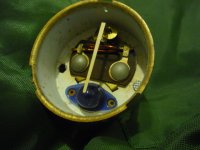
The inside on the ammeter is pretty simple. The current that flows in a single copper wire loop makes the needle deflect, depending on the direction and amount of the current flow. I have one that had a corroded face and a broken mounting post; here is what's inside. I suppose you could solder it, but I think it will end up acting as a fusible line and melt under high current flow. Something big must have shorted out to melt the wire. Better find it before you hook up another battery!

Jeff

TR6 Ammeter_inside.JPG
 
Thanks for the replies!
I don't know what caused the wire to melt but before anything goes back together there will be a new wiring harness and all the electrics will have been replaced or refurbished as necessary. Thanks for the pic..it is exactly what I needed.
Everything in the pic is present except for the bulb cover. The rivets are in place but the colored cover is missing.
In essence wouldn't the wire inside be a "shunt" and to change calibration you would add a second external one?
So I could use any gauge wire to repair the internals?
 
The blue cover is held in place with tiny rivets; I replaced one once that had burned through by gluing another one in. Leaving it out probably would make it brighter; they don't look all that blue and are pretty dim anyway. The oil gauge doesn't have a cover at all, and I don't recall it looking different. Yes, any wire that can carry the full load plus some would work I guess. I'll PM you.

Jeff
 
The wire inside wouldn't technically be called a shunt. It's just a series wire that carries the full current the gauge is trying to measure. In that capacity, its gauge or resistance don't matter, as long as the wire can carry the current without getting too hot. An external resistance in parallel with the wire would be called a shunt, and could be used to calibrate the gauge. In this case, the resistance of the internal wire becomes important.

Ed
 
Back
Top