• Hey Guest!
    British Car Forum has been supporting enthusiasts for over 25 years by providing a great place to share our love for British cars. You can support our efforts by upgrading your membership for less than the dues of most car clubs. There are some perks with a member upgrade!

    **Upgrade Now**
    (PS: Upgraded members don't see this banner, nor will you see the Google ads that appear on the site.)
Tips
Tips

Alternator trouble

SteveT

Jedi Hopeful
Offline
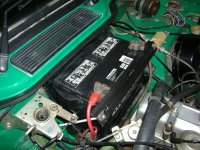
This is from a question back in May about my Volt meter running in the red for a while. Well it seemed to have stopped and ran usually at about 12.5 to 13, then recently it started going into the red just this weekend coming back from the Cincy show. Now there is acid in the battery tray and it appears to be coming from the top, see picture. This pretty much indicates the alternator is overcharging the battery and boiling the acid?

Thanks -- Steve
 

Attachments

  • 6188-07-17-2007___8.JPG
    6188-07-17-2007___8.JPG
    84.6 KB · Views: 257
Can the alternator be tested on the car? And is there an alternative alternator that can work other than a rebuilt Lucas?

Steve
 
Yes, it can, but you need to have a volt/amp meter and follow load test procedures.

1978-80 Ford Fiesta (Bosch style) is a bolt on 55Amp replacement.
 
Hmm, thot I posted this from work but it's not here.

Between the battery acid and the voltmeter, it seems pretty clear that your alternator is overcharging. I've seen batteries fail that way, but that would not explain the voltmeter. To be absolutely certain, connect a different voltmeter across the battery terminals. If you see more than 14.4 volts with the engine at a fast idle, then the alternator is definitely overcharging.

Most likely an alternator problem, but there is a small chance it could be a wiring problem. If you have a small brown wire from the alternator to the hot battery cable, make sure it has full battery voltage on it at the back of the alternator.

There is an alternator made by Bosch that seems more reliable than the Lucas, and puts out more current to boot. Bolts right up (although you may need to swap your old pulley to it); and uses the same connector for wiring. Original application was a 78 Ford Fiesta with A/C. Last one I bought was $50 + $20 core, but they may have gone up.
 
Paul and Randell,

Thanks for the info; does that unit fit any TR6; I have a 1976. And, it has the internal regulator. Any wiring hints that you might have? Also, the unit goes from $60.00 to $105.00, depending where you shop.

Thanks -- Steve
 
Let us know how all this comes out, Steve. My 250 is still plagued by charging problems. It constantly charges while driving, and the charging varries with engine speed.

I've put in at least three alternators and a couple of voltage regulators (the 250 has an external regulator, and the replacements, though made in England, are junk in my opinion). The battery is relatively new, but I may try swaping it out with the new one I just put in my Tiger to see what happens. Next the ammeter is coming out for testing.

Tricksy Lucas, we hates him.
 
To the best of my knowledge, everything is a perfect match, including wiring. I just haven't gotten around to ordering one for my car yet, because mine was rebuilt locally by a great shop last year. But with the new tripods, I will be ordering one soon.
 
SteveT said:
does that unit fit any TR6;
I believe it will fit any TR6, however some of them may require some minor wiring changes at the alternator.
SteveT said:
Any wiring hints that you might have?
I'm not sure what you're asking here. Wiring the Bosch alternator is mostly just a matter of making sure the connectors match. If your car lacks the small brown wire to a separate 1/4" disconnect, you may need to add it (this is the same wire I mentioned checking above; what it does is feed battery voltage to the regulator so it can compensate for voltage drop through the charging circuit.)
 
MadRiver said:
(the 250 has an external regulator, and the replacements, though made in England, are junk in my opinion).
That's strange. My Stag uses a similar (tho not identical) regulator, and I've had no trouble with them. The one I dropped the power steering pump on (breaking it open and dumping PS fluid inside) did eventually fail, but I wouldn't call that the regulator's fault /bcforum/images/%%GRAEMLIN_URL%%/smile.gif

However, I have had several problems with the wiring to the alternator, and one incident wound up frying the control box (which is incorporated in the regulator on your TR250). So my suggestion would be to first give the wiring the "hairy eyeball", especially the ground at the regulator and the brown/red from the regulator to the starter solenoid. Also check carefully the brown/green to the alternator for any signs of a short to ground (which would cause the alternator to go full on).
Then get in there with a good voltmeter, and check the voltages right on the pins to the regulator. With the engine running, you should find exactly full battery voltage on the B+ terminal, and exactly ground on the "-" terminal. Any voltage drop between these terminals and the battery will result in overcharging.

Friend of mine fought a 'twitchy' ammeter on her TR250 for several months, and eventually discovered a bad ground where the battery cable joined the body. Paint on the body was preventing a good connection, as I recall.
MadRiver said:
The battery is relatively new, but I may try swaping it out with the new one I just put in my Tiger to see what happens.
I'd suggest some simple checks first. Check the voltage at the battery with the engine at a fast idle. If it's over 14.4, then there is definitely a problem with the charging system, and no sense changing the battery until it's fixed. Part of what makes these systems so hard to troubleshoot by changing components is that each component can cause the other to fail.
MadRiver said:
(Next the ammeter is coming out for testing.
It's almost impossible for an ammeter to fail, except to go open circuit. Obviously yours isn't open circuit, so this would be a last resort, IMO.

Likewise, if the alternator will put out full current, then it's probably OK. The only possible fault left would be a short to the field (rotor) winding, which you can easily check for with an ohmmeter. Disconnect both field wires and look for continuity from either field terminal to ground.

BTW, I'm not sure if the Bosch alternator will fit the TR250 without modification or not. The externally regulated Lucas 11AC on my early Stag is rather larger than the Lucas ACR models used on the TR6, so the mounts are different. You may need to find mounts from a TR6. Also, of course, the wiring will be different. You'll need that funky 3-terminal plug from the TR6 in order to connect to the Bosch unit.

 
Not to beat a dead horse, but I went to Advanced Auto and they tested the alternator on the car and the battery checked out good and he said the alternator seemed OK, but the regulator was wide open. When I asked what that meant he said it was faulty and he could not replace it.

Could he be correct? The regulator is available from the common British parts houses. Or should I just go with a new alternator and be done with it.

Thanks -- Steve
 
SteveT said:
I went to Advanced Auto and they tested the alternator on the car and the battery checked out good and he said the alternator seemed OK, but the regulator was wide open. When I asked what that meant he said it was faulty and he could not replace it.

Could he be correct?
Certainly sounds plausible to me.

SteveT said:
The regulator is available from the common British parts houses. Or should I just go with a new alternator and be done with it.
Guess it depends on how comfortable you feel with opening up the alternator to replace the internal regulator. It's no big deal really, but can be confusing if the wire colors don't match (as they sometimes don't). There is also a chance that the problem is not actually inside the regulator (but still inside the alternator somewhere); meaning it still might not work.

If I didn't care about originality and had the money, I'd probably just swap in the Bosch unit. But being an inverterate tinkerer, I'd probably try to get the old alternator to work first. Yeah, that's a bit crazy /bcforum/images/%%GRAEMLIN_URL%%/crazyeyes.gif

Car batteries basically start out at 100% functionality, and lose a little bit with every start and every month. There is no doubt your boiling episode cost something in terms of battery life, leaving it weaker than before, but it might still be usable. OTOH I once took a battery to the local equivalent of Advance Auto (Pep Boys) and they told me it was fine. 2 weeks later it wouldn't start the car even after being charged all night. When I took it back, their machine said it "needed charged".

But obviously, you should at least have it out, and wash down the area (including under and behind the battery) with a baking soda solution. Good time to touch up the damaged paint (if any), too.
 
Thanks Randall,

This is not the first time the battery caused problems; the PO had the area repainted a while back. I think I'll get the Bosch unit, $65.00 from PB. I'd hate to order the regulator to find out it was not the problem.

Steve
 
All,
My alternator was LUCAS 17ACR was not working so I went through the testing of the field winding, stator, and diode pack. The article by Charlie Brown: "Triumph Alternator Diagnosis and Repair" was a great help. The full field test shows that my alternator can put out current (ammeter goes to ~50% of FS @ engine 2000rpm). I decided to replace the internal regulator (Lucas Part Number: UCB100). It seems to work with a major drawback: a 3 amp drain! The black wire (see attached instruction sheet) causes a 3 amp drain when attached as shown at the brush housing to ground.
I'll try a link to the instruction sheet..:smile:

Any ideas of what I can play with here?

My next move is a Bosch. I just wanted to give the Lucas a good effort...:smile:

Tim
 
When my Lucas alternator did that it was because the diode was bad. I now have a Delco alternator.
 
Good Call! I pulled the unit and tested again today.

I have a bad diode as well, must have happened after I went through the 'test'. I had tested the battery drain as soon as I got the car and found the Glovebox light was on..:smile: I am afraid I must abandon the Lucas alternator.
Tim
 
Why the Lucas. The Bosch and the GM are far superior to the stock unit. If you have questions on how to hook these up just Google them . There are 100's of articles on the conversion!
 
Back
Top