• Hey Guest!
    British Car Forum has been supporting enthusiasts for over 25 years by providing a great place to share our love for British cars. You can support our efforts by upgrading your membership for less than the dues of most car clubs. There are some perks with a member upgrade!

    **Upgrade Now**
    (PS: Upgraded members don't see this banner, nor will you see the Google ads that appear on the site.)
  • When posting a classified ad, you MUST select a prefix from the drop-down next to the subject line. If you don't you will get an error and your ad will not be posted!
Tips
Tips

TR6 '76 TR6 pcv valve, etc

wangdango

Jedi Hopeful
Country flag
Offline
Working on a TR6 and the small valve on top where a vac line goes is capped off, the pcv valve on the head is still there and is not capped. The only vac line in use is from the distributer to the fitting on the intake (this is a 3 way fitting, one line goes to the brake booster, the 2nd to the dist, the 3 fitting is empty -no hoses attached). The car came to my shop not running, so not sure what was done and done right or wrong in the past. My feeling is if its not required, leave it off. Can someone point me in the right direction? IE: less is best,.... Car is fitted w/Strombergs.
thanks
Ed
 
Ed, that fitting on the intake is a banjo fitting. It's important to keep the brake servo connected. On that year car one nipple was for the attachment of an Anti Run-on Valve and the other went to a diverter/relief valve.
Neither of those last 2 are absolutly necessary for the engine to run good.
Any open nipples on the Banjo need to be capped or plugged.
It's not the usual location for the distributor's vacuum retard to be connected, however.
The vacuum line nipple for the Vac. Retard is located on the bottom of the front carb, close to the carb's mounting flange.
If it were me, I'd either hook the retard to that nipple or not use the retard at all. Regardless, all nipples not in use on the carbs and intake must be capped or plugged EXCEPT the nipples on the left side of the carbs that are about as close to the air filter housing as they could be. They point toward the cockpit.
Those are vent ports for the carb's float chamber when the engine is idling.If they are capped, the engine won't idle and possibly not even start.
There is a secondary purpose for those nipples/port, but without the Anti Rub-on valve in use, that purpose is no longer needed.
BTW there are good illustrations of the plumbing for all the TR6 models in the Moss catalog (among other places) in the "Emission Control" section.
Also, that valve that you mention is not a PCV, but an EGR.
 
Thanks,
can I remove the EGR valve? is it of any use? Would love to rid the car of any bits that are not needed. Charcoal can, etc. Can you tell me what is NEEDED, and what I do not need. There is a small metal can shaped thing below the charcoal canister, it has two elect. leads to it, whats it? Do I need it? Thanks Ed
 
Yeah you can remove the EGR. You'll have 2 holes to plug with threaded bolts or plugs. I don't recall the thread size, but I found what I needed at NAPA when I brought the pipe and the valve in to compare.
The thing under the CC is the Anti Run-on Valve. One of the missing hoses from the Banjo fitting used to go there.
Be careful with the electrical leads, when you remove them. One is "hot" whenever the ignition key is in the "ON" position. The other wire gets it's ground at the oil pressure sensor switch on the dizzy side of the block.
Just keep the hot wire in mind and don't let it touch ground while you're taping it off.
As far as what you can remove, well you'll need to keep the Valve cover vented to the carbs and you'll need to keep the nipples on the left side of the carbs that point towards the cockpit (the ones closest to the air filter's) open to the atmosphere or leave then connected to the Carbon Can by a hose.
Then there's the vent line from the gas tank that is supposed to go to the CC.
If you choose to remove the CC you can 1) leave it open to the atmosphere or 2) (my choice) stick the hose from the gas tank into the hose from the carbs/valve cover that used to go to the CC.
As for the air pump, diverter/relief valve and exhaust manifold air lines, I'd better let a 75-76 owner who's removed all that describe how they did it.
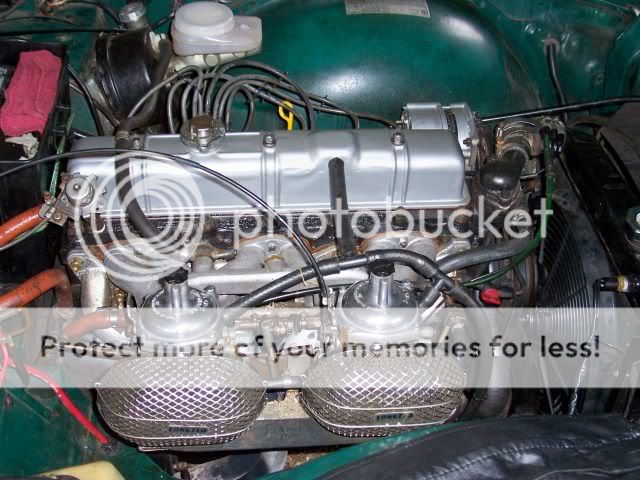
Here's a picture of how I dealt with the emission stuff that's common to both my 74 and the 75-76 engines.

100_0997.jpg
 
Back
Top