• Hey Guest!
    British Car Forum has been supporting enthusiasts for over 25 years by providing a great place to share our love for British cars. You can support our efforts by upgrading your membership for less than the dues of most car clubs. There are some perks with a member upgrade!

    **Upgrade Now**
    (PS: Upgraded members don't see this banner, nor will you see the Google ads that appear on the site.)
Tips
Tips

TR6 '74 TR6. Let's talk about disconnecting smog stuf

2wrench

Luke Skywalker
Country flag
Offline
So my car was very stock. Ran okay. Blew it up.
It sucks. Ready for change cause it's torn to pieces.

Fact or Fiction: If you disconnect your smog stuffs,
your car's engine will produce greater horsepower and
better gas mileage.

If answer is fact, then I wannnit.

What the dickens do I leave in; what to leave out?
Why wouldn't I want to do this....or is it just
a no brainer that I should do this?

Before you post, remember we already agree to
disagree, right; and I mean respectfully disagree,
please, because if you do this, we all win.

Actually, while I brace myself, you may all be in the
same camp, in which case the question falls into the
no brainer category.

Thanks,
 
You are in CA.
Do you have to have that stuff on to pass inspection? If so then it's moot, if not, get rid of it all...
 
2wrench,

The smog decision on my '74 was made by the DPO. The stuff to hook up the EGR valve was missing so I had to leave it off. I ran a vacuum line from the bottom connector on the rear carb to the distributor retard. I also hooked up everything that goes to the charcoal cannister, including the anti-run on valve. The stock engine is no powerhouse at 120K miles anyway, so I can't tell if it does anything for performance.

Jeff
 
I'm trying to keep my mods reversable by retaining
in good condition original parts changed out.

Sound like pie in the sky?

I will continue to monitor to see what others'
experiences/feelings/approaches are.

Though I can't recite them, the concepts for
improved performance sound logical/rational.
 
If you have an EGR valve, then most likely (tho not necessarily) disabling it will produce slightly better fuel mileage. But since it should close (not do anything) at WOT, disconnecting it won't net you any more power.

If you have a "smog pump", then almost certainly disconnecting it will net you a bit better fuel mileage and a tiny bit more power (but nothing dramatic unless there is something wrong with it).

Everything else external has basically no effect on either mileage or power. (The vapor recovery stuff might actually improve mileage, but not enough to measure IMO.)

The main reason 'smog' Triumphs make less power (and burn more fuel) than their non-smog counterparts is lower compression, milder camshaft, and lack of vacuum advance.

Current CA law says a 74 is not subject to smog inspection. However, that could easily change, especially if owners of early 70's cars get a reputation for disabling their smog equipment ...
 
Randall,

Didn't Triumph actually try to improve perfomance a bit by improving the cams on the smog engines? I'm not sure, just asking.

I kept the cannister, A/R valve and dumped the EGR.
 
2wrench, if the mill is to be rebuilt, do it from the standpoint of performance from the bearings, up. Pistons, cam, valves, the works. "Bolt-on" (or "bolt-off" in this case) horsepower is a sham. The engine is a system. Figure out just what you'll be using the car for and plan the output accordingly. I.E. "Daily driver", bump up the compression a bit (pistons & head work), mildly cam it... competitive running, like autocross or (heaven forbid!) training the RicerBois in the merits of old English iron, 10:1 comp and wilder bump-stick. "Driveability" kinda goes for a chop the more radically you tweak 'em, too.

Just some thoughts.
 
alana said:
You are in CA.
Do you have to have that stuff on to pass inspection? If so then it's moot, if not, get rid of it all...

No more inspections in CA....for now, anyway.
 
Dr: As an aside, I see you own not one, but two
Lotus vehicles. Got any pics? I'll bet they are
already on the net and I just look past every day.

How do these cars drive? I remember as a kid.
Wow! A Lotus!

Considerably more pricey to restore, I presume?
 
Re: '74 TR6. Let's talk about disconnecting smog

Hatefully $o. The Elans are both in need of frame repair ATM.

I've owned as many as three examples at one time. Lotus Cortina Mk-I was the third. This has been posted before, but:
 
Re: '74 TR6. Let's talk about disconnecting smog

Doc ... it must be hard parking that Cortina! /bcforum/images/%%GRAEMLIN_URL%%/grin.gif

To add my two cents, I'm in the same boat as Paul on my '74 TR6. I removed the EGR, advanced the timing, and kept the carbon canister and anti-runon solenoid. My engine hasn't been rebuilt.

Matt
 
Re: '74 TR6. Let's talk about disconnecting smog

A fair bit of to-and-fro to get it in or out, yup.
 
Re: '74 TR6. Let's talk about disconnecting smog

Yes, the later TR6 engines had lower compression but a 'wilder' (or less mild) cam. The result was higher peak horsepower (106 vs 103, I think) but less low-end torque so that the 0-60 time was a bit slower than the earlier cars. When picking the cam for your build, remember that you tend to trade low-end torque for peak power.

The anti-runon valve seems like a good enough idea to think about adding one if the car didn't come with one. I don't see a downside to the carbon canister either.

Bryan
 
Re: '74 TR6. Let's talk about disconnecting smog

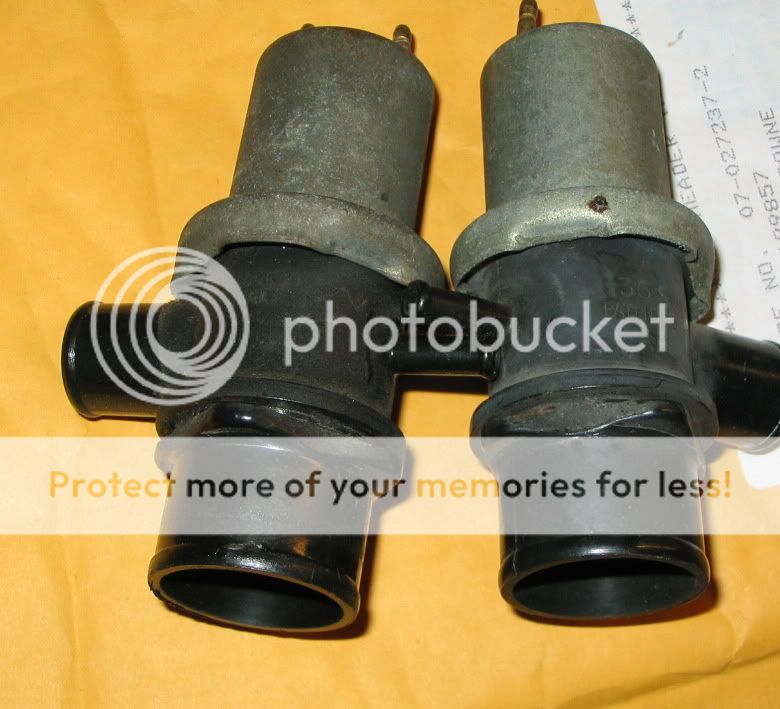
So can anybody post a pic of an anti-runon valve?
 
Re: '74 TR6. Let's talk about disconnecting smog

Here's a couple.....

IMG_0732.jpg
 
Re: '74 TR6. Let's talk about disconnecting smog

Making the ARS work requires a lot more than just bolting it on (to the bottom of the carbon canister) however. You'll need the modified ignition switch (to supply power only when the key is off); plus the 3-prong oil pressure switch (to ground it only when the engine has oil pressure) ... then you'll need the modified carbs (to connect the bowl vents to the carbon canister when the throttle is closed). Not to mention the wiring and plumbing to hook all that together.

Lot of hassle, IMO. Especially when it's easy to prevent runon by just letting out the clutch in gear when you turn the key off. I make it a habit, part of my shutdown sequence just like touching the headlight switch to make sure they are off.
 
Re: '74 TR6. Let's talk about disconnecting smog

Well Doc, I've not seen that depressing picture before. But I guess it's par for the course... that Lotus' sit in a garage not used and needing major work.

Sorry to hijack the thread.

Back to pollution equipment.
Smog pump - causes parasitic drag. doesn't do much for emissions reduction.
Vapor recovery and PCV - doesn't hurt anything. keeps fuel from evaporating out, this is good.
EGR - reduces speed of combustion. THIS IS GOOD - if it works right. It is also BAD if it works wrong. With poor quality fuel (low octane rating) the fuel burns too fast. Combustion pressures rise, maximum pressure increases, NOx is produced, more engine strength is needed. AND "firing stroke" (adiabatic decompression) pressure is not increased - ergo no more power. Better off with slower combustion -> higher octane rating, or EGR.
Making it work properly may be a challenge. Otherwise a knock sensor and timing retard system might be the way to go.

A restrictive exhaust allows a small amount of exhaust gas to remain in the cylinder, reducing the oxygen content of the charge. This is exactly what EGR does, except EGR is not linear with speed. EGR should only work when combustion pressures are potentially very high. A knock sensor ignites the charge a little later, mostly reducing the maximum pressure though also moving the combustion pressure rise to a little later in the expansion cycle, allowing a very slightly higher average pressure and very slightly more torque.

Making a rocket is expensive - go for mild power improvement. Definately a cam. Bigger carbs (or more carbs) are an option, and do work, but see the note about my Volvo Amazon below. Bigger exhaust works, but is partially defeated by EGR. Balancing is very good along with stronger pistons and rods because it allows higher rpm. But the breathing should also reflect this. RPM doesn't do anything unless a decent charge can come in at the higher speed.

Doc is partially right about engine is a system, as you can see from my rambling above, but I disagree about bolt-on HP being a scam. It does work... to an extent. The bottom end and rest of the drivetrain is built with a strength safety margin. This can be approached - but don't pass it, 'cause then you will end up like my Amazon - broken trans, drive shaft and differential... all at the same time. That was with <u>only</u> double Weber carbs.
 
Re: '74 TR6. Let's talk about disconnecting smog

My statement was in the context that the engine is apart now, now is the time to plan it so it is all in concert. Building it to standard spec's and THEN looking for added power (with "bolt on" parts) is a bass-ackwards method, IMO. Sure the DCOE's will give it more fuel, headers get the spent gasses out quicker... but volumetric efficiency is better achieved with a "whole-istic" approach.
 
Re: '74 TR6. Let's talk about disconnecting smog

Hey 2 !!

Someone stripped out ALL the pollution control stuff
from my 69TR6. The car runs pretty good after two years
of restoration and stops dead immediately when I switch
off the key. The Monza exhaust header makes a nice throaty
sound.

I have my gas tank fumes direct hose vented to outside
the car over the driver's rear shock.

d
 
Re: '74 TR6. Let's talk about disconnecting smog

Cretin! Environmental TERRORIST!!

...there, just thought I'd get that outta the way...

A vented cap could work, and you could then plug that hose, Dale.
 
Back
Top