• Hi Guest!
    If you appreciate British Car Forum and our 25 years of supporting British car enthusiasts with technical and anicdotal information, collected from our thousands of great members, please support us with a low-cost subscription. You can become a supporting member for less than the dues of most car clubs.

    There are some perks with a member upgrade!
    **Upgrade Now**
    (PS: Subscribers don't see this gawd-aweful banner
Tips
Tips

67 BJ8 Blow by question

ttrotter

Member
Country flag
Offline
RAC68's Oil Catch Can thread has prompted this inquiry from an admitted neophyte!

I always thought that excessive "blow-by" was an indication of worn pistons/rings which allowed to much oil into the valve area. Also thought that compression test indicate the condition (wear) of the pistons/rings. My compression numbers are 155/160 across all 6 cylinders, which sounds really strong to me. (My previously owned '65 was at about 135 across all cylinders.)

I seem to be getting more than normal blow-by and will try RAC68's Oil Catch Can to see if I can reduce it, but now I'm puzzled about what is causing this blow-by, given my compression #'s. Please enlighten me!

Thanks folks,
T
 
You pose a good question as your compression does seem strong to me also. Although there are many on the list that have extensive experience in Healey engine construction and can provide a good understanding of the issues that could be the cause of blow-by, for my part I agree that ring ware and piston deterioration seems to be causes high on my list. However, we are talking about oil-saturated vapor with blow-by being one component of this noxious mix. Although I would expect blow-by is a major cause in pressurizing the crankcase, it is not the only source of oily vapor reaching your carburetor or intake manifold.

My engine has 100K++ miles on its original rings and pistons with an over-shaved head (requested by mistake 3+ decades ago) raising compression pressure to 168.5lbs +/- 3%. Additionally, I further increase engine stress by commonly shifted at around 5K RPMs and have done so since the car was new.

Although I do not have any excessive smoke billowing out the exhaust, I do have the common oil drip from the slinger (no oil seal) and oil vapor reaching the air cleaner. This oil-vapor condition becomes obvious when disconnecting the tube from the crankcase/valve-cover during a major carburetor adjustment and stimulated my realization that it could be causing less than optimal carburetor and engine performance. Although I expect that ring/piston/cylinder ware is a substantial contributor to my blow-by, I also suspect that oil aeration resulting from high RPMs and normal summer engine heat may also be contributing to my vapor volume. Since my engine performs rather well and I presently have no interest in performing an expensive engine rebuild, I see the implementation of an Oil-Catch-Can as a remediation and not a repair or correction of the condition.

I can’t say what is causing the volume of oil vapor you are experiencing, however, I do expect that, by having an Oil-Catch-Can intercept and diminish the volume of oil from encumbering carburetor operation and you rear combustion cycle, you will be doing a good thing to reestablish proper engine performance.

Good luck,
Ray (64BJ8P1)
 
Two days ago I got rid of my spare engine and to make it easier to lift I pushed out the pistons/rods which had never been out since 1957. The engine had relatively even compressions and ran quietly with reasonable performance prior to me stealing the crankshaft out of it. It did however have smoke on a trailing throttle and rhythmic huffing from the breather at full throttle. At idle there was no more fuming than I'd expect.

Two pistons had the top ring broken, one in half and the other in about ten small pieces and the amount of polishing and hammering of the ring lands told me it had been like that for some time. The point I'm making is that compression testing doesn't necessarily give an absolute indicator of mechanical integrity as the second and third rings will compensate for the loss of the top one during the low speed/low pressure compression test. I'd guess that the reason for the damaged rings in that case is detonation as everything else about it was pretty much perfect for a low mileage original engine.

In saying that, how are you defining excessive blowby from excessive oil in a normal amount of blowby? The latter is caused by worn rocker bushings, a relatively easy fix.

Andy.
 
Ray and Andy, thanks very much. Thoughtful and very helpful replies.
Andy, I could very well have worn rocker bushings. Defining excessive blowby from excessive oil in a normal amount of blowby?--not sure I can do that at this point :smile:
I'm at exactly the same point as Ray, so the Catch Can sounds like a very reasonable thing for me to try first. While I do not have black smoke, the residue build up on my rear bumber is causing some aggravation as well as as some periodic, very small drops of oil appearing on my trunk lid after driving. Such is the "nature" of some Healeys, I know!
I'm hoping the Catch Can will alleviate some of this.
Thanks again,
Tom
 
It's easy enough to check for worn rocker bushings. Open up the oil filler cap while the car is idling and look at the oil coming through the oil holes on top of the rockers. Oil should just seep out of those oil holes. If it's squirting, you are getting way too much oil in the top end and that could easily be the cause of the oil in your rear carburetor. As was said earlier, fixing a worn rocker shaft is a relatively easy thing to do (compared to new rings, etc).

Keith
 
Keith, thanks for this! It is time for my car to get some excersize, so the next pretty day we have I'll be checking for that squirting oil. After I get my Catch Can rigged up, I'll report back on its performance also.
Regards,
Tom
 
Although I totally agree with Keith and would check and fix a valve train that is emitting too much oil, I suggest you consider removing the cover and check all rockers as well as the oil feed pipe. This effort is relatively easy and you will be more confident in your conclusion rather than relying upon a restricted view for your determination. I would, however, look through the oil filler for a quick preliminary indication.

Either way, installing the oil-catch-can is a very inexpensive way to help the engine from choking on oily vapor. The Healey engine was never that tight in the first place and will always have blow-by and produce oil-saturated vapor. Remember, there is a reason why it is common for a Healey to use 20W50 (or most engines of the era) as apposed to a modern engine’s use of 0W5 or even lighter oils.

All the best,
Ray (64BJ8P1)
 
I've never though of compression tests as useful except to indicate bent or burnt valves.

Healeys tend to have lower oil pressure than the book says and lower still if it's all escaping from the rocker arm bearings.

Blue smoke when accelerating after descending a hill or being on the overrun is always valve guide wear and Dennis Welch does some stem seals. There most be plenty that can be fitted without removing the head after you've made a tool to hold the valves shut. They can reduce oil consumption significantly.

I agree with Andy, you can get good compression reading and then remove pistons and see all sorts or disasters.

If the breather is blowing chances are rings and bores are past their best, but it doesn't do any harm to live with it until you feel like doing an engine rebuild.

Just my twopenneth. Ash
 
On my BJ7 I too found an excessive amount of blow by. Like you I figured that it was the rings, however, since I had to remove the cylinder head anyway to replace and reseat some exhaust valves I installed the rubber umbrellas over the valve stems. I just took a valve to a auto supply house and purchased the tightest fitting one's they had. They worked fine, no more blow by.
 
On my BJ7 I too found an excessive amount of blow by. Like you I figured that it was the rings, however, since I had to remove the cylinder head anyway to replace and reseat some exhaust valves I installed the rubber umbrellas over the valve stems. I just took a valve to a auto supply house and purchased the tightest fitting one's they had. They worked fine, no more blow by.

Gotta believe re-seating the valves helped a bit.
 
I had my BJ8 engine rebuilt a couple of years ago (where does the time go?) and had it 'warmed up a little'. Pistons replaced - a little oversized- lightened flywheel, DMD twin HD8 inlet manifold, extractors, re-profilied cam shaft etc.

The engine re-spec worked really well and she is a torquey strong motor now. However... it was breathing a little and the resulting oil in the hose to the rear carb air filter was at times dripping down onto the extractors... with the ensuing smoke haze rather alarming!

I fitted a catch can to save this from happening, and as there seemed to only be a little oil being spilt I thought we were set. Then we started out with some friends on a road trip to Tasmania to watch the Targa Tasmania, and to spend some time touring the state afterwards. We planned a 4 hr drive for the first day. About an hour in I was starting to get the odd wiff of warm oil... hoping it was the E-type in front of me we continued on. But when we stopped for a break we discovered otherwise. Skip ahead to the end of the days drive and the various temporary remedies tried, we stood around the engine bay looking at the mess. The oil smell started about the time the can filled and started overflowing, helped about with the highway speed air... Now it was everywhere. (no chance of any rusting...)

As the trip was a two week tour, consensus was that to continue was folly, and as we had an alternative car at home I would retrace my steps and catch up with the others the following day after some long hours behind the wheel... We fitted an extension to the breather hose to move the oil away from the engine bay - it exited just behind the left front wheel.

Here is a picture of the result about an hour from home when i stopped to check/top up the oil... Other than the mess, the car was running really well :-(
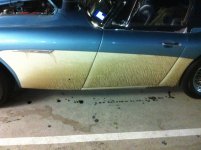
IMG_0139.jpg

This was a completely rebuild engine, only recently run in.

I left the car to the guy who did the rebuild while we were away and when we returned he said he'd checked it over and was a little mystified. He checked the cylinder pressures - ok, and checked the lower block wasn't pressurising either. In the end he made up a baffle to place beneath the breather hose outlet in the valve cover so that oil being thrashed about at speed couldn't directly enter the hose, and restricted the oilway to the rear section of the rockers. It seems to have stopped oil coming through the breather. I've taken it for some longer drives since - 3 hr drives at freeway speeds - and the most i can see now is a slight film on the white paint immediately rear of the hose exit (it is still fitted with the extended hose - might now be time to refit the catch can).

 
I could be wrong here (and if I am, I'm sure someone will let me know :D), but I don't think there should be that much oil "thrashing around" under the valve cover even at speed. This really sounds like excessive clearance between the rockers and the rocker shaft. This could be caused by a worn shaft or incorrectly bushed rockers.
Keith
 
Back
Top