
• Hey Guest!
    British Car Forum has been supporting enthusiasts for over 25 years by providing a great place to share our love for British cars. You can support our efforts by upgrading your membership for less than the dues of most car clubs. There are some perks with a member upgrade!

    **Upgrade Now**
    (PS: Upgraded members don't see this banner, nor will you see the Google ads that appear on the site.)
Tips
Tips

TR2/3/3A 59 TR3A dynamo problem

tj_tr3_tr6

Freshman Member
Country flag
Offline
We just bought this TR3A at Christmas time and stated restoring it after it has been in storage for 20 years. We were able to get it running really well for a couple of months and then the dynamo just stop charging. I took it out and apart and the brushes look long and new, cleaned it out and reinstalled it and all I get now is 1 or 2 volts coming from it. Is there anything else I can check to fix it? Or should I just buy a new one?

Thanks
Tim
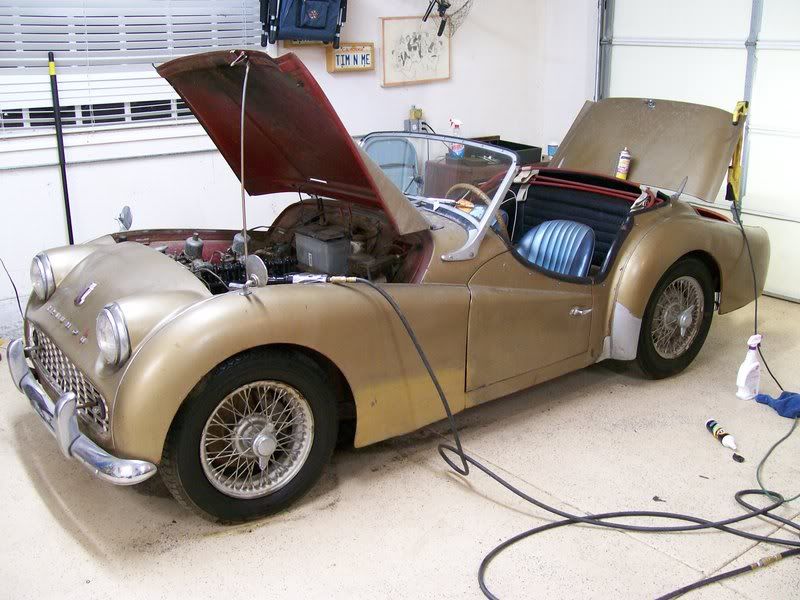


000_0015.jpg
 
Just replaced mine. Driving home from a short run the ignition light came on and I noticed the amps were pulling on the battery.
Took out the generator (dynamo) and replaced it with another old one. No charging light still on. Took both generators apart and found the original to have a broken wire and the other had a bad stator coil. Bought a new rebuilt from a local shop and now I'm back to charging again.
If you send me your email I'll send you a nice Lucas manual in PDF form for testing the system. It was sent to me by TR3driver (Randall).
 
You are getting 1 or 2 volts output because of residual magnetism in the field soft iron cores. This says to me that the dynamo itself is good, but that you are not getting any current through the fields. The problem is therefore in the control unit or wire/connection from the control unit to the field connection on the dynamo.
 
The aforementioned Lucas manual is the way to proceed. Takes you thru the tests step-by-step so you know exactly where the problem is. Very clear and easy to follow I think.

As for the picture of your TR3A... if that is the original bonnet prop perhaps you do not know that it is designed to go into an oblong hole in the bracket that has the safety catch, plunger and spring at the front edge of the engine compartment. The original prop has a bend at the end that goes into that slot... the advantage being if a breeze comes along (yes, unlikely in your garage) and lifts the bonnet it stays hooked rather than crashing down.
 
Twosheds said:
You are getting 1 or 2 volts output because of residual magnetism in the field soft iron cores. This says to me that the dynamo itself is good, but that you are not getting any current through the fields. The problem is therefore in the control unit or wire/connection from the control unit to the field connection on the dynamo.
I agree, except it could also be an open circuit in the field coils inside the dynamo.

There is also a scan of the Lucas document available on-line, at
https://www.sterlingbritishmotoringsociety.org/files/Lucas_Generator_and_Control_Box_Tests.pdf

Your TR3A should have either a C39 or C40 dynamo (the C40 is supplied as a replacement for the C39) and a RB106/2 control box.

I'll agree that following the book is the best course, but can't resist offering this advice : Connect the two terminals at the dynamo together temporarily, and a voltmeter (DMM will work fine) to ground. Start the engine, then watch the voltmeter as you bring the engine rpm up slowly to a fast idle (no more than 1500 rpm). If you still see only a few volts, the fault is inside the dynamo. If the voltage rises with rpm to over 12v (don't let it go over 20 as that can potentially damage a working dynamo), the dynamo is good and the fault lies outside, in either the wiring or the control box.
 
TR3driver said:
Twosheds said:
You are getting 1 or 2 volts output because of residual magnetism in the field soft iron cores. This says to me that the dynamo itself is good, but that you are not getting any current through the fields. The problem is therefore in the control unit or wire/connection from the control unit to the field connection on the dynamo.
I agree, except it could also be an open circuit in the field coils inside the dynamo.

Correct as usual, King Friday. I didn't think of that possibility.
 
Geo Hahn said:
The aforementioned Lucas manual is the way to proceed. Takes you thru the tests step-by-step so you know exactly where the problem is. Very clear and easy to follow I think.

As for the picture of your TR3A... if that is the original bonnet prop perhaps you do not know that it is designed to go into an oblong hole in the bracket that has the safety catch, plunger and spring at the front edge of the engine compartment. The original prop has a bend at the end that goes into that slot... the advantage being if a breeze comes along (yes, unlikely in your garage) and lifts the bonnet it stays hooked rather than crashing down.


That pic was just after we bought the TR and since then we figured out just as you said.
Thanks, I did test the two leads together and got the two volts, but did not raise the RPM's while testing. I will check into some of the ideas you all have offered. Thank you so much

Tim
 
startech47 said:
Was it ever charging? Maybe the generator needs to be re-polarized.

Yes it was charging fine for a month or so and then nothing. How do I re-polarize the generator?

TIm
 
tj_tr3_tr6 said:
Thanks, <span style="font-weight: bold">I did test the two leads together and got the two volts</span>, but did not raise the RPM's while testing. I will check into some of the ideas you all have offered. Thank you so much
Tim

Ah! That changes everything. You didn't say before that you got the 2 volts by jumping the output to the field dircuit. I retract my earlier diagnosis. The problem is in the dynamo itself.

To polarize it, jump a wire from "hot" (ungrounded, whichever that is on your car) to the field (smaller) terminal on the dynamo. Just hold it on there for a second. Do it a couple times. It's probably not the problem because dynamos don't just up and lose residual magnetism for no reason, but worth a try before pulling the dynamo.

Isn't it fun to say, "dynamo"?
 
<span style="font-weight: bold"><span style="font-style: italic">
Twosheds said:
tj_tr3_tr6 said:
Thanks, <span style="font-weight: bold">I did test the two leads together and got the two volts</span>, but did not raise the RPM's while testing. I will check into some of the ideas you all have offered. Thank you so much
Tim

Ah! That changes everything. You didn't say before that you got the 2 volts by jumping the output to the field dircuit. I retract my earlier diagnosis. The problem is in the dynamo itself.

To polarize it, jump a wire from "hot" (ungrounded, whichever that is on your car) to the field (smaller) terminal on the dynamo. Just hold it on there for a second. Do it a couple times. It's probably not the problem because dynamos don't just up and lose residual magnetism for no reason, but worth a try before pulling the dynamo.

Isn't it fun to say, "dynamo"?
</span></span>


Do I run the engine while jumping my hot to the small terminal to re-polarize?

I have taken the Dynamo apart twice now and replaced the bearing and bushing, I ohmm the field coils and armature
and they seem to check out fine with no open fields.

Thanks
Tim
 
Doesn't matter if it's running when you try to polarize.

But the 2v with the terminals connected together says to me it's not polarization. 2v should have been plenty of excitation to get started. My guess would be bad armature (assuming no mistakes in the above results).

You really cannot test the armature with an ohmmeter, since it has many different coils that are all connected together. There is a device commonly known as a growler that can check them by applying an alternating magnetic field and checking the induced voltage; but they aren't very common (except in old auto electric shops).
https://cgi.ebay.com/ws/eBayISAPI.dll?ViewItem&item=140227579482
 
Back
Top
