

-
 Hey Guest!
British Car Forum has been supporting enthusiasts for over 25 years by providing a great place to share our love for British cars. You can support our efforts by upgrading your membership for less than the dues of most car clubs. There are some perks with a member upgrade!**Upgrade Now**
(PS: Upgraded members don't see this banner, nor will you see the Google ads that appear on the site.)
You are using an out of date browser. It may not display this or other websites correctly.
You should upgrade or use an alternative browser.
You should upgrade or use an alternative browser.
TR2/3/3A Speedometer question.....
- Thread starter karls59tr
- Start date

Hi Karl there is an inner main spring that is very sensitive. If you can get the needle to bounce when you gentle flick your wrist, is a good way to tell at a swap met if the gauge is functional.
Your needle could have fallen off the shaft because they are a push on fit.
Steve
Your needle could have fallen off the shaft because they are a push on fit.
Steve
Hi Karl there is an inner main spring that is very sensitive. If you can get the needle to bounce when you gentle flick your wrist, is a good way to tell at a swap met if the gauge is functional.
Your needle could have fallen off the shaft because they are a push on fit.
Steve
Steve The needle is still on the shaft because it still operates the full range when accelerating it just wont drop all the way back to its starting point I think i need to detach the cable from the gauge and lubricate the inner wire of the cable with some sort of lubricant?? Karl
Some years back Geo and I were working on my speedo. He showed me where there is a small white dot right before 0 mph on the gauge face. This dot is where to put the needle when replacing the needle because the needle needs a little spring loading and calibration.
So with needle in hand, you set the needle on the dot push the needle down and then gently lift the needle from the white dot and move the needle to zero on speedo with the back of the needle resting on the perpendicular post and that is the basic calibration and preload.
Sounds like you need to calibrate the needle. They pull up and off.
Steve
So with needle in hand, you set the needle on the dot push the needle down and then gently lift the needle from the white dot and move the needle to zero on speedo with the back of the needle resting on the perpendicular post and that is the basic calibration and preload.
Sounds like you need to calibrate the needle. They pull up and off.
Steve


Offline
With the outer shell of the speedo removed, you put a finger on the escapement wheel and move the
needle to zero it out. It should fall back easily but not slam down when moved. It is an analogue gage and will never
be used in a court of law!!
A gentle touch is required here
Mad dog
needle to zero it out. It should fall back easily but not slam down when moved. It is an analogue gage and will never
be used in a court of law!!
A gentle touch is required here
Mad dog

Offline
Think about it this way: as the pointer approaches zero, the spring unwinds and there is less and less force on the pointer. As a result, even the slightest additional friction will cause the pointer to hang up. Before taking off the pointer and resetting it, be sure it is moving completely freely.

glemon
Yoda
Offline
One last, as mentioned it doesn't take much to hang up the needle at the lower part of the scale. Sometimes loosening or tightening the cable retaining nut on the speedo can help the alignment or pressure on the speedo and help the needle move more smoothly and freely. As also already mentioned, these are very analog cars, or fiddly as I like to call them.
Offline
Likely muck accumulated over the years. Google a document written by TR owner Anthony Rhodes on Smiths Speedometer repair. He goes into detail on how to service and repair these speedometers and odometers. It is the best doc out there for this task. It is free, lots of clubs reference it.Does anyone know why the speedometer needle would fail to return to zero and hang up at 8 mph?

DWP Industries I
Freshman Member
Offline
If you have recently replaced your speedo cable, remanufactured inner cables are sometimes a bit too long and can cause excessive pressure on the mechaniusm. Try loosening the cable a few turns and see if the pointer drops to zero. If it does, then remove 1/16" from the end of the inner cable at the speedo end and try it again. You can also test it by fitting it in the Rev Counter position and seeing if it returns to zero when the engine is switched off. The cables for the Speedo and the Rev Counter rotate at similar speeds, so you will not do any damage.
Offline
Lube in the head tends to dry over 30 or 60 years and form little hard clumps of dirt. If it really bothers you you can pull it apart and clean it.
Bob
Bob

DWP Industries I
Freshman Member
Offline
If you intend to take it apart, this video from Dr Michael Flannery will be useful:
And this one too for the later design speedometer mechanism:
And this one too for the later design speedometer mechanism:
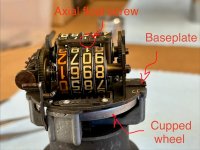
Karl, this may not be your issue, but that problem can be caused by incorrect adjustment of the axial float screw holding the cupped wheel. If you remove the speedometer assembly and take the needle and faceplate off, there is a small screw immediately next to where the cupped wheel shaft protrudes (see attached photo). That screw adjusts the end float of the cupped wheel and shaft it rides on; the bearing setup is similar to jewel bearings used in watches and old instruments (like the speedometer). Too much end float (screw is turned out too much) and the cupped wheel will rub against the baseplate (holding the odometers), and too little end float (screw is turned in too much) and there will be too much friction against the shaft (which is shouldered near the top just under where it protrudes). Either way, friction will be a problem (that instrument has no room for friction). That ended up being the problem with a speedometer that I rebuilt; correct adjustment of the screw fixed the problem.Does anyone know why the speedometer needle would fail to return to zero and hang up at 8 mph?
Also, you may already be aware, but before removing the needle, mark the cupped wheel with a Sharpie on the circumference where the needle pointed so you can preserve the calibration for reassembly. Also, I've found that holding the cupped wheel and twisting the needle is the way to remove it (rather than just prying axially). Also, if you forget to mark the cupped wheel with a Sharpie, you can let the spring return the cupped wheel to equilibrium, then mark the wheel where the white dot is on the faceplate just counterclockwise of 0 mph, then turn the cupped wheel clockwise past the needle stop and set the needle to that spot, which should be calibrated.
Michael
Attachments
DWP Industries I
Freshman Member
Offline
When adjusting the bend float using the small screw, fit a small screwdriver or punch inside the square hole where the cable fits and apply firm pressure.
This takes up any play in the main shaft. When tightening the screw make sure that the cupped wheel is still free to rotate. Too miuch adjustment and it will jam or become stiff.
This takes up any play in the main shaft. When tightening the screw make sure that the cupped wheel is still free to rotate. Too miuch adjustment and it will jam or become stiff.