• Hey Guest!
    British Car Forum has been supporting enthusiasts for over 25 years by providing a great place to share our love for British cars. You can support our efforts by upgrading your membership for less than the dues of most car clubs. There are some perks with a member upgrade!

    **Upgrade Now**
    (PS: Upgraded members don't see this banner, nor will you see the Google ads that appear on the site.)
Tips
Tips

TR2/3/3A Barn find details and restoration started, and progress - 1958 TR3 A

MrChuck55

Freshman Member
Offline
2.jpg
22.jpg


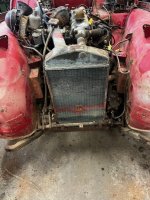
This is the start of my acquisition and restoration of my barn find 1958 TR3 A. I will post pics and update info on this thread as I go along.

A bit about me. Have always been a jack of all trades. Background includes construction, mechanical work, welding/fabrication, machine shop (in between hobby and semi-professional!) dirt track racing (built and maintained IMCA modified and late model for 7 years). A few hot rods and sports cars and motorcycles along the way- (69 Chevelle SS 375hp 396 98% original that I purchased in 1976...waiting for frame off, 55 Chevy long bed pickup...chassis and mechanical complete...bodywork and paint next...AFTER this TR3!!!) Have also restored or partially rebuilt a few heavy equipment items and tractors. Pilots license in 96, and owned and restored a couple of planes. (RV 4 in progress, flying a RV 7 currently). Mid life crisis started flying as a crop duster about 15years ago...and never looked back! Currently trying to semi retire and only fly a few months a season. I have done quite a bit of basic bodywork and a lot of painting, and a lot of aluminum skins/fabrication on the airplanes, but my sheetmetal bodywork has not required much for patch panels and welding. (Until now! LOL) So, learning a lot of new skills when it comes to welding sheetmetal! Lot's of good info here on this site! Enough of my background!

THE CAR
The TR3 A belonged to an older friend and neighbor of mine...he passed away and his wife later asked if I would want it. I have always loved the cut down doors and styling of the sidescreen TR's, and so I said yes and dove in!
My friend purchased the car in 1972 I believe, while they lived in Kansas City, but shortly thereafter moved to Omaha Nebraska. They then moved near the Springfield MO area and brought it with them in 1976. He parked it in a barn and it never moved again until I pulled it out this past December. (2025) While he was alive, I had helped him work on it and fixed a few things on it, but he never did anything with it, not even transferring title or licensing it here in MO. It appears that it was pretty much 99% original, and had all the original items like covers, sidescreens (and actually a second set slightly different) most tools/jack handcrank etc. No bondo or previously repaired damage (though I may still find some). Rear overider and left fender slightly damaged. And front bumper not great and no overiders on front. I believe it has had a fresh coat of paint over the original, but only the outer panels repainted as far as I can tell. Inside of boot and bonnet, and inside of doors and under dash areas all appear original paint. There is a problem with the VIN I am working on. The car title from Nebraska appears they used the engine number instead of the commission number! (and actually placed a K suffix on it for some reason?? Couldn't read clearly b/c dirt and grease???) I got the BMIHT heritage certificate, and according to them the Commission, engine and body number are correct.
5.jpg
26.jpg
25.jpg

I was able to get ID/OD and used the engine number as vin for Missouri title for now. At some point I will need to get a corrected title with the commission number as vin as it should be.

TIRES AND WHEELS
Started with wheels and tires so I could mount and move frame easily. It still had the original spare tire, and was holding air!!
1.jpg
2.jpg
4.jpg
5.jpg

Sandblasted, a few spokes replaced and trued, and epoxy coated and painted. Sorry, forgot to take a pic with new tires mounted. Maybe add later.


RUST AND BODY REPAIRS

Decided to start learning my new sheetmetal skills at the front. Passenger side was all done with MIG, and did the driver side with TIG. The areas with the body mount doublers weren't too bad. Tedious because I was trying to limit the future sandwich rust problem. I then moved to the doubled reinforcement plate area for the front overrider supports...this proved a little more difficult as I was dealing with domed surface and had to figure out how to shape the metal. First one was sandbag hammer form with shrinker...second I made a hammer form and was able to complete it without having the shrinker teeth marks to deal with. Extra steps here also to limit future sandwich rust. (coated with weldthru primer before spot welding doubler, then mixed and applied epoxy primer spraying thickly on edges and worked in excess with a paint brush to force it in seam...after body sandblasted I will go around all areas with seam sealer. Also, the hole where the bolt goes thru will need to have some seam sealer forced into the seam between panel and doubler plate!) Photos to follow later.
 

Attachments

  • 1.jpg
    1.jpg
    116 KB · Views: 25
Looking forward to following along with your work
 
Here are some pics of the repaired areas on the front of the inner fenders...the body mount and overider doublers. Didn't try to "metal finish" so will need a very slight
coat of filler. I think my research indicates maybe a fiber reinforced for the first coat to help waterproof any pinholes. I held a light behind and welded every one I could find, but I'm sure MIG or TIG might leave some tiny holes somewhere! As stated before, used the passenger side to practice my MIG skills and get it dialed in, then did the driver side all with TIG.

100.jpg
101.jpg

Passenger side rusty section cut out...


103.jpg
104.jpg

and repair stages...

163.jpg
170.jpg

and driver side. Rust before cutout and new repair panel welded in and prepunched for plug welding doubler.


175.jpg
177.jpg

Overider doubler area repair...


184.jpg
188.jpg

And doubler...was able to use HF modified spot welder. Worked very well.
 
185.jpg
187.jpg

Decided to try my first flexible shape pattern making on this one. Didn't really need to get that elaborate for this area, but when I get to the complicated curves of the rear panel repairs I feel I may need to use some there.

Next was starting to move on to the small area of the driver side lower firewall, and was going to repair the driver floor as only the front foot or so and some of the edge against the sill was rusted. The remainder of the floor seemed pretty solid, and the passenger side damage/rust was only a few areas against the inner sill. But since I need to replace the inner sills, I believe the floors will need to come out anyway so I decided just to get replacements. As I started on the driver side lower firewall (about 1" at bottom where it meets floor only rusted area) I had to separate the inner fender, and as I am prone to do, got a little sidetracked and decided to switch it up a bit and tackle what I thought was an easy fix of a dented area on the driver side inner fender...easy that is until I realized the dents were in the area where the boxed section was welded and therefore no access to the backside for a dolly. Pulled out the stud welder and went to work. What a rabbit hole! Messed around for days with that stud welder and a hammer, but I was just not getting to a point I was happy with for later filling...so...out came the holesaw! Well, I had a small access panel I could get some things to the backside with. BUT...hours and hours of working the area and still wasn't getting it right. So out came the torch for some heatshrinking. Still not happy. Decided I needed a swiveling head dolly. Hours of machining time later, torch and hammers and slappers I managed to get it to the proverbial "close enough" (I think!:smile:) I am not "happy" but short of cutting a section away, or cutting part of the boxed section away, then dealing with distortions and such welding back in I have done about all I can with it. Did I mention I am not a professional body man! Looking back now, time wise probably should have changed up and just removed and replaced a section, but oh well...live and learn!

299.jpg

Only pic I have so far when I had started with the pull studs...I will take some more pics today and try to get uploaded soon.

I am currently overthinking the boxed section repair of the access hole I created. Would like to do something to add some rust protection inside, but am in an analysis paralysis state as I research all my thoughts on how to go about that. Internet and forum research to support or nix my ideas only leads to confusion as there are so many limitations to each method, and no good consensus on the "best way"...
Some ideas I am entertaining...
1) Do nothing...not a lot of rust problem appearing except a few areas of mild surface rust currently, some 68 years after the leaving the factory! But I will have to weld in my hole patch, and the backside of the weld will be inaccessible and prone to rust I believe...Cavity wax maybe after paint is finished??
2) Clean up deep areas of loose paint/rust with a steel cable slighty frayed at end in a drill. Then I can go in with a body wax gun/tube and apply...??? Well, that's the fork in the decision tree I can't seem to decide on. Some options appear to be...
a) Use wax gun/tubes (or brushes on semi stiff wire on the side I holesawed the access hole) to try and apply epoxy primer...hard to prep area except the loose frayed wire...and not sure about the longevity of primer without a topcoat?
b)Same application techniques but use Ospho or Rust911 or similiar...then do I need to follow up with some kind of topcoat??? Epoxy primer (doesn't adhere well to Ospho unless the Ospho is neutralized first), Oil based paint works well over Oshpho, but maybe hard to get to spray thru wax gun/tube. Not sure about the Rust911...just started using it on some items after years of Evaporust use...but each (I think) would require cleaning and a topcoat...
c)Probably the one I'm going to settle on...spray Ospho best I can into area. Let it dry and crust over. Add cavity wax after car painting is complete and see if it lasts another 68 years!!!

OK...that's enough for now! Opinions and ideas welcomed!! Sorry for the long spiel, but sometimes helps me to share this stuff with others that "get it"...and my wife's eyes roll after my first 10 words usually!!!
 

Attachments

  • 244.jpg
    244.jpg
    121.1 KB · Views: 7
  • 246.jpg
    246.jpg
    95.4 KB · Views: 8
Thanks for the views and likes! Just a short addition today...

188a (2).jpg
188c.jpg
188b.jpg

Here is the bad looking dent repair I was talking about earlier along with the access hole in the boxed section. I suppose I am fortunate that the original damage wasn't all that bad and no real rust anywhere other than surface rust. I'm leaving access hole open until I decide for sure how I am going to treat the inside area. I am planning on using the cavity wax gun and extension tubes, and probably tape over access hole temporarily, then working tube in thru the small areas available and giving it a spray with some Ospho. Then use the access hole to inspect and see how it covers. The results may lead me to further decisions about best way to treat.
If you notice the small welded tab on the outside part of the inner fender, I posted a question earlier too see if others have these on theirs and if anyone knows what the original purpose was. So far one person mentioned it is on their car, but purpose is still just a guess. Maybe something to do with the assembly line? Now that I have access to the backside, it appears to be a factory (or dealer??) drilled hole, then this tab was welded on to cover the hole. The hole was 3/16 to 1/4" diameter. Almost like an opening for a cavity wax tube...but I did not think they had such a product in 1958...
Any guesses??


188d.jpg
188e.jpg

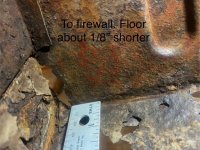
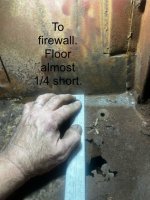
The floor and firewall repair that I started before pulling off to tackle the inner fender.

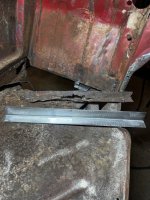
I cut out a small area of the floor for better access to the firewall. I am still not 100% clear on some aspects of the inner sill and floor replacements. Have watched several Youtube videos and have the restoration book of course. Have also read many great posts on this forum. I want to try and do as much as possible while on the frame. The gaps on the doors (and boot and bonnet for that matter!) were all pretty good as they were. So lots of measurements and maybe some templates and jigs for location, then would then like to remove the floors before adding the interior bracing as I don't crawl around and over stuff quite as easy as I used to! :p The sill, a and b post, front firewall and kick panels, and rear quarter sections I believe will all hold the shape without the floorpan. I can then use the old ones, (removed carefully) for measurements to trim and fit the new ones. (Will complete one side at a time, and test fit the tranny cover as I go. Will tack floors in place, with minimum if any to old sills. Then, after floors placed, I will add my interior bracing and cross bracing. Will then dive into the inner sill replacements! One side at a time again...I think I can rig up my gantry crane to lift the tub straight up far enough to work old sill out and new sill in. Or can jack and block one side at a time. Any critiques or recommendations on these steps would be highly appreciated!
 

Attachments

  • 188e.jpg
    188e.jpg
    109.5 KB · Views: 8
Nice work, looks like you do not mind getting right in there and going for it. Working on those inner sills, a guy really earns his pay check. I have found the doors are small, but can go sideways easily--- then again it looks like you have a lot of experience with rebuilding stuff and you will probably get through it no problem.

I take it you have heard of Moss Motors. They have a great free catalog and are the gold standard for the parts that are available.

There are also books in PDF form: like the owner’s manuals and factory repair books. Some of the others guys are better with computers, but I will try and post some of the stuff I have collected over the years, but I am slow.

Steve
 
Thanks guys!
Steve, yes on Moss motors...so far I have used them almost exclusively. Try to spread some love to TRF and Rimmer for some stuff. Ebay for a couple of things. and I always try and acquire lots of resources as far as the manuals, parts books etc. And I watch lots of Youtube videos!! Have 3 guys I follow pretty closely, and occasionally others. Surprised there are not more people creating and posting stuff on there rebuilds and repairs. I considered doing that, but I am way to embarrassed about the mess my shop is in! My jack of all trades personality has led to way to many projects and my working space has deteriorated considerably!!! I have an OCD desire for a completely organized and clean shop, but can't seem to ever devote enough time and energy into making it happen! Have started the dirtwork and plans for a shop expansion which I am sure will solve the problem!:ROFLMAO::ROFLMAO:
The doors fortunately are in really good shape! Other than surface rust, they won't take much other prep. Since the gaps were decent to begin with, should make all the sill fitting go a little easier I am thinking! Just need to take good measurements and jigs/patterns and put A/B post etc to exactly where they were! We will see!
John, the tig and spot welder do come in handy. Extended the tongs on spot welder which allows a few more areas for it to be used in.

Progress update...
Have a few parts which I decided to try and reuse as I am attempting to maintain some originality. Not sure why really! Not destined for a concourse restoration!!! I would just like a really nice driver! But...since it was a "barn find " that was already mostly original, and not a lot of damage (other than the typical midwest US rust issues) I am trying to refurbish and reuse as much as I reasonably can.
So I dug out my electroplating set up that I originally used on my 55 Chevy pickup rebuild and am spending a few days replating some odds and ends. Hopefully back to the firewall and floor repairs soon.
Charles
 
Back
Top