

-
 Hey Guest!
British Car Forum has been supporting enthusiasts for over 25 years by providing a great place to share our love for British cars. You can support our efforts by upgrading your membership for less than the dues of most car clubs. There are some perks with a member upgrade!**Upgrade Now**
(PS: Upgraded members don't see this banner, nor will you see the Google ads that appear on the site.)
You are using an out of date browser. It may not display this or other websites correctly.
You should upgrade or use an alternative browser.
You should upgrade or use an alternative browser.
TR2/3/3A Overdrive [Type A] Brake Ring Gaskets
- Thread starter RonR
- Start date

Despite the manual's warning, I have always used a thin coat of sealer, without a problem. I don't understand the reasoning behind the warning-maybe a possibility of clogging a oil passage with sealer.
I am in the process of removing the trans./OD as we speak. One of my goals is to have a leak free OD, a fool's mission , for sure.
Berry
I am in the process of removing the trans./OD as we speak. One of my goals is to have a leak free OD, a fool's mission , for sure.
Berry


TR3driver
Great Pumpkin - R.I.P
Offline
Odd though, that it's only that one joint. If they were worried about clogging passages (a very real possibility with RTV IMO), seems like they'd warn against using it on other joints as well.I don't understand the reasoning behind the warning-maybe a possibility of clogging a oil passage with sealer.


Offline
I was meticulous on the rebuild of my OD last year. I really cannot recall everything I did, though I know I tried to follow the "Buckeye" and other materials to the letter. The Buckeye article says: "A small amount of sealer was then spread on the surface of the brake ring that mates with the main casting." My OD does leak, but not from the brake ring. My leak is at the solenoid housing. Just little dribbles but it all adds up.
https://www.buckeyetriumphs.org/technical/AOD/AOD3/AOD3.htm
https://www.buckeyetriumphs.org/technical/AOD/AOD3/AOD3.htm
Offline
Oh, I need to add something to that last post. No way could I have rebuilt that OD without the constant help of those on this Forum. I could probably assemble at least 150 posts and responses, including from a number of you who clearly are the world's data bank for these cars. So I wanted that clear.
Forty-five years ago, over a mere $50, I passed on a cute little MGB and drove 60 miles north of Town to buy a strange car called a TR4. That was surely a major turning point, a fork in the road. I have so many stories, and have learned so much. Like who Kettering was. I also remember two bits of good advice from a guy in a garage. Ninety-nice percent of your troubles are spark or fuel, and no matter how small it is, don't get under it without jack stands.
Forty-five years ago, over a mere $50, I passed on a cute little MGB and drove 60 miles north of Town to buy a strange car called a TR4. That was surely a major turning point, a fork in the road. I have so many stories, and have learned so much. Like who Kettering was. I also remember two bits of good advice from a guy in a garage. Ninety-nice percent of your troubles are spark or fuel, and no matter how small it is, don't get under it without jack stands.
Thaks to everyone for their replies.
I wonder how the 518 sealant functions as a gasket if it is disolved by oil.
I have read the Buckeye articles a couple of times, as well as the one by the two geneltmen in Oklahoma.
KVH, did you expereience the same issues with the clutch release spring lengths mentioned in the Buckeye article?
The difference in length in the springs I removed is miminal, unlike the pictues of new springs included in the article https://www.buckeyetriumphs.org/technical/AOD/AOD4/AOD4.htm
I need to decide if I should buy new springs or not. I don't have a way to bench test the overdrive so I only want to do this once. I know, it is a british car)
I wonder how the 518 sealant functions as a gasket if it is disolved by oil.
I have read the Buckeye articles a couple of times, as well as the one by the two geneltmen in Oklahoma.
KVH, did you expereience the same issues with the clutch release spring lengths mentioned in the Buckeye article?
The difference in length in the springs I removed is miminal, unlike the pictues of new springs included in the article https://www.buckeyetriumphs.org/technical/AOD/AOD4/AOD4.htm
I need to decide if I should buy new springs or not. I don't have a way to bench test the overdrive so I only want to do this once. I know, it is a british car)
TR3driver
Great Pumpkin - R.I.P
Offline
If you only want to do it once, FIND a way to test it on the bench! It's not that hard. Beg, borrow, buy or build a pressure gauge; then cobble up some way to spin the gearbox. I use a 1/2" drill motor & a chunk of radiator hose as that's what I had handy; plus some 2x4 cutoffs to support the gearbox.I don't have a way to bench test the overdrive so I only want to do this once. I know, it is a british car)
I do have a pressure gage.
Randall, how did you connect the drill to the gearbox (or rear flange of the overdrive) using a radiator hose?
I have the gearbox finished. My intention on the overdrive, as it was working when I removed it from the car, was to simply disassemble, clean, and install new gaskets as it leaked more oil than the engine. (engine has been rebuilt) However, I discovered two broken thrust washers in the overdrive and a bent adapter plate (which may have been the cause of most of the oil leaks.)
Randall, how did you connect the drill to the gearbox (or rear flange of the overdrive) using a radiator hose?
I have the gearbox finished. My intention on the overdrive, as it was working when I removed it from the car, was to simply disassemble, clean, and install new gaskets as it leaked more oil than the engine. (engine has been rebuilt) However, I discovered two broken thrust washers in the overdrive and a bent adapter plate (which may have been the cause of most of the oil leaks.)
Offline
KVH, did you expereience the same issues with the clutch release spring lengths mentioned in the Buckeye article? The difference in length in the springs I removed is miminal, unlike the pictues of new springs included in the article https://www.buckeyetriumphs.org/technical/AOD/AOD4/AOD4.htm
I need to decide if I should buy new springs or not. I don't have a way to bench test the overdrive so I only want to do this once. I know, it is a british car)
Yes, it was very confusing. I marked and measured the springs, and the lengths, due to age, must have changed. They were so close in length that it didn't make sense. I remember even counting the curls. I strongly recommend getting new springs. They are color coded and you won't make a mistake. I'm not recalling all the details, but it's possible that length and strength are factors in the two different springs.
Offline
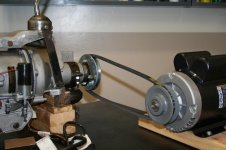
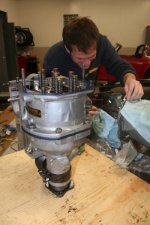
And by the way, I simply couldn't bench test mine with a drill. I conceded here many times that perhaps my bearings just weren't pressed on perfectly, or some other issue existed, but a one-half inch drill wouldn't spin my overdrive. Therefore, I went to a shop and bought a little pulley and drilled four holes to line up with the holes in the rear flange. Then I went to Harbor Freight and bought a 2 hp cooler motor. And I did it like in the Buckeye (or other) article. Here is a pic, plus a pic of my new springs being examined by my son.


Attachments
TR3driver
Great Pumpkin - R.I.P
Offline
Randall, how did you connect the drill to the gearbox (or rear flange of the overdrive) using a radiator hose?
My corded 1/2" drill (an old Milwaukee Hole Shooter) has a section of the chuck that is 1.25" in diameter, same as the outside of the clutch splines on a TR gearbox. I found a section of straight 1-1/4" radiator hose in the junk bin, and used clamps to attach it to the drill motor & input shaft. By positioning the bench vise just so, I was able to lay the drill motor in it, and wrap a tie wrap around the trigger so I could use both hands for other things. Sorry, I didn't think to take a photo.
FWIW, John Esposito sells a thicker adapter plate (which is what I used). It will supposedly fit both 3 and 4 synchro boxes (though I've only tried it on a 4 synchro).a bent adapter plate (which may have been the cause of most of the oil leaks.)