• Hey Guest!
    British Car Forum has been supporting enthusiasts for over 25 years by providing a great place to share our love for British cars. You can support our efforts by upgrading your membership for less than the dues of most car clubs. There are some perks with a member upgrade!

    **Upgrade Now**
    (PS: Upgraded members don't see this banner, nor will you see the Google ads that appear on the site.)
Tips
Tips

TR2/3/3A Tr3a distributor problem

Triguarin

Freshman Member
Offline
Dear Friends,

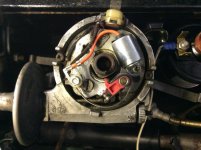
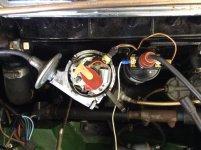
Please see my attached photo. It shows the distributor on my Tr3a with rotor arm and points set for TDC on cylinder 1.
I am puzzled why the distributor body is turned at an angle where by the vacuum unit is not parallel to the engine block. All the photos of distributors I have seen for the Tr3a including the ones in my workshop books are parallel.
Additionally, the car won't fire up when I have the distributor in this position even when I can plainly see the rotor is touching the distributor cap terminal for no.1 cylinder.

Any advice and comments very very welcome! Please help throw some light on this one!
 

Attachments

  • image.jpg
    image.jpg
    70.5 KB · Views: 330
Your drive gear is out of position - you may be able to get around this by repositioning the wires but the better way is to remove the distributor and drive gear and re-insert it clocked correctly.

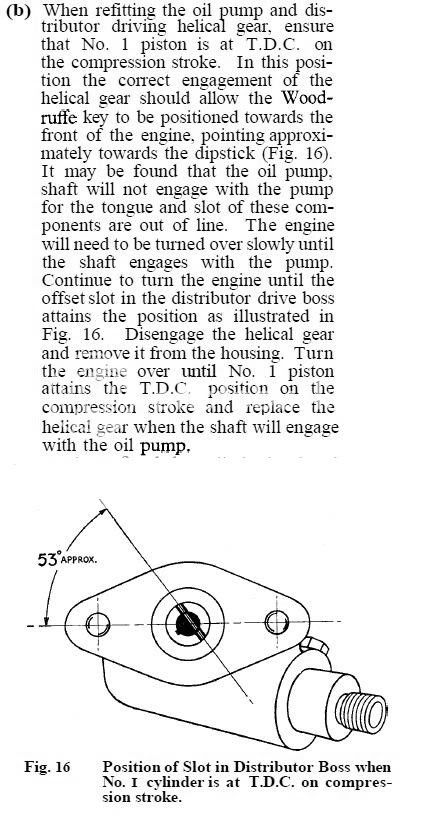
The manual describes the correct orientation:

DistributorDrive.jpg


You will find that as you insert the drive gear it rotates a bit at the last second - you will need to allow for that rotation to end up in the correct final position. All that means is that it may take you a couple of tries to hit the right spot.

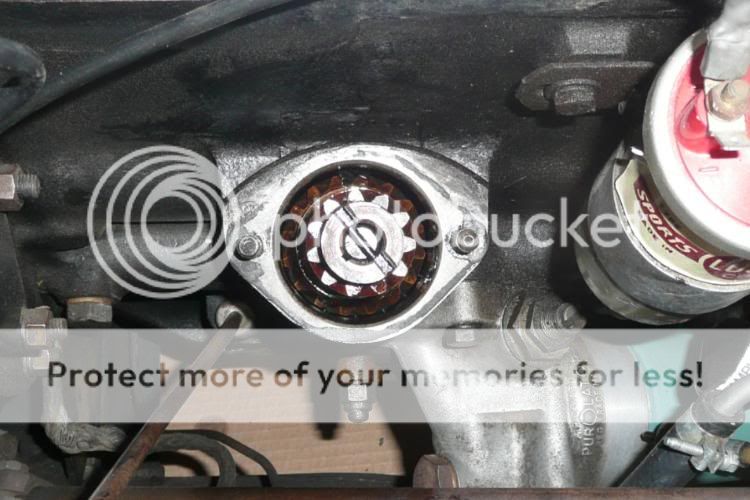
Here's what you'll see when you do:

Driveafter.jpg


Keep in mind that the slot is off-center and be sure it is in the correct position and the distributor dog is similarly oriented.

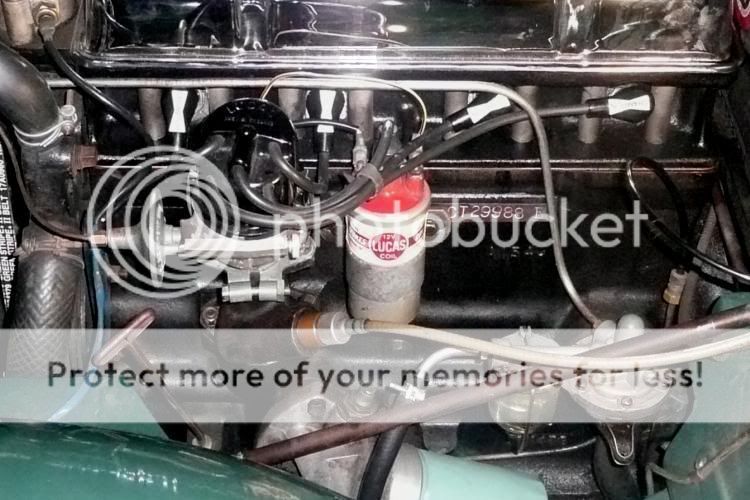
I think this is roughly the position you want to end up with:

After.jpg
 
Thinking about this some more - the solution may be much simpler.

...the car won't fire up when I have the distributor in this position even when I can plainly see the rotor is touching the distributor cap terminal for no.1 cylinder...

I do not think it is pointing to #1 in the cap in that photo. You might try turning the distributor body about 45° anti-clockwise so it looks like my last picture and see if the engine fires and runs in that orientation.
 
I do not think it is pointing to #1 in the cap in that photo.
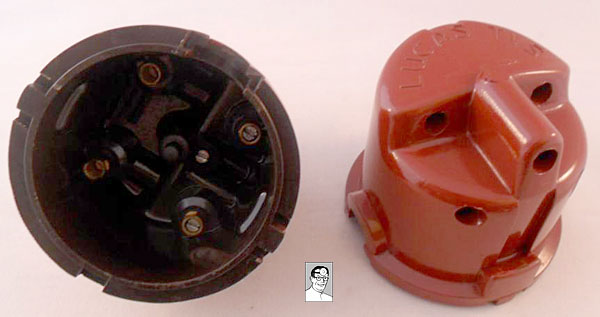
I agree. The #1 terminal should be about 45 degrees away from where the clip fits onto the cap, but your photo shows the rotor pointing directly towards the clip.
54412472DistributorCap-600.jpg

If that is really where your points line up properly, then I suspect a problem inside the distributor. I'd pull the point plate out and have a look at the advance mechanism.

PS, that photo is an MG cap (just one I found on the web), your TR cap will have the wires oriented differently. But the posts should be in the same positions relative to the clips.
 
Thank you very much for the info. I turned the distributor round 45 degrees (see photo). And ignored the manual telling me to continue turning the distributor anti clockwise so that the points just begin to open. I have to back the distributor up clockwise towards the cam and then the points just begin to open. Yes the cap is different from the TR type, I noticed that too. Yes, it is an MG one. Because of the 45 degree shift I have re wired the cap and it is lined up on the No.1 post in the cap. The drive gear was offset in the correct way. The car now runs. The static timing was sufficient to get it running but it popped and banged a good deal. I had to play about a lot with the vernier adjuster. Running the engine up to speed and advancing retarding to see how it was. I have it reving without pops and bangs. Interestingly at first it popped through the carbs and after some adjustment it banged a good deal out the exhaust. Still it wasn't too bad out on the road. It pulls doesn't pop and bang. Idles kind of ok at 650/700. I have the carbs turned to the weakest setting because of the stink of petrol out the exhaust. The vacumn unit is disconnected. Using a lot of fuel now. Carbs are rebuilt and sensitive to adjustments / tuning. But not satisfied with the timing yet. The vacumn pipe is missing at the carb end have the nipple and screw but no pipe. Will the air leak with the screw out effect the carb performance on that side a good deal. The plugs are very black and sooty after running. The other carb is showing running too lean as per the mixture setting. Haven't tried colour tune yet.

dies anyone have strobe light settings for this engine? I would like to check the timing with a strobe.

i obviously don't want to increase the rich mixture on the one carb running rich yet but I am hoping with the vacumn pipe restored and the timing spot on I can proceed to adjust and colour tune the carbs.
 

Attachments

  • image.jpg
    image.jpg
    66.8 KB · Views: 145
Hi again,
the perils of ipad and index finger....

'will the air leak with the screw.....' That was a question. I missed the ? Mark.

also meant Does, not dies.

Many thanks again!
 
I would plug the vacuum line to eliminate any leak there. I do not think you really need the advance unit working to get a good state of tune.

Sounds like you are very close now.

A strobe light could be used - in particular to see what the total advance is at high RPMs. Off hand I think you should see about 32° advance at 2800 RPM (static + centrifugal advance).

I like to leave the vernier alone until I have the static set -- then I use it to fine tune the advance for ideal timing. If you start with the vernier at a known point (I use zero or the big mark - some set the static advance with it) then you always know where you are as you fiddle with it later.
 
Perhaps you know this, but I'll repeat it anyway. The TR engine has an advance curve that starts way down low (lower than most engines will idle smoothly), which makes it difficult to get an accurate initial timing setting with a strobe light. It really is more accurate to set initial timing with the engine stopped (eg test light showing when the points open).

Then once you get everything else adjusted to suit, you can make some fine adjustments to the timing based on a road test. Advance the timing in small steps (with the vernier) until you can just force the engine to ping (or pink if you prefer) by using heavy throttle at low rpm (with the engine thoroughly warmed up or even just slightly over normal operating temperature). Then retard until the ping almost goes away under those conditions. (Personally, I prefer to retard about 2 more degrees just for safety, but I'm probably being overly cautious.)

The advance port should not leak at all at idle, since there should be no vacuum at the port with the throttle closed. And the leak with larger throttle openings is probably not enough to have much effect on mixture. But, it's probably still best to plug it, just in case and to keep any dirt or foreign object from being sucked in.

The vacuum advance has almost no effect on performance or tuning; it is mostly to improve fuel economy. So there is no reason you can't deal with the other issues now, and reconnect the pipe later (or never).

BTW, valve lash (and timing) can have a large effect on mixture and other tuning parameters. Make sure the lash is set first, noting that the .012" figure given in some sources is only for early TR2. Your TR3A should take .010" for both intake and exhaust, measured cold; unless of course you have a performance cam installed.
 
Perhaps you know this, but I'll repeat it anyway. The TR engine has an advance curve that starts way down low (lower than most engines will idle smoothly), which makes it difficult to get an accurate initial timing setting with a strobe light. It really is more accurate to set initial timing with the engine stopped (eg test light showing when the points open).

can you set initial timing with the engine off, using a test light on a pertronix Electronic ignition?
 
can you set initial timing with the engine off, using a test light on a pertronix Electronic ignition?
Yes (if you have an original Ignitor), just don't take a terribly long time to do it. The Ignitor module can overheat if left with current flowing (virtual points closed) for a long time. But AFAIK you can't static time an Ignitor II.

Also, the older Crane XR700 can be set with a test light; while the newer XR700 modules incorporate an LED that must be used in place of a test light. (The newer ones shut down current through the coil when the engine is not running.)
 
Hi everyone,

thanks again for continued input! Randall, I didn't know about the advance curves being so low. Many thanks. I have plugged the vacuum at the carb today but haven't had much opportunity to get much further other than to set up for a fresh static setting and discover that the points are spark / flashing when I slowly separate them. The condenser is new from last week, so I put the old one back. I plan to do a few more checks tomorrow with a test light to find the cause. The coil is also brand new. Plan to check valve clearances too before I get to the carbs. With be back with my findings....

Neale.
 
One good check would be coil primary resistance. The stock TR3 ignition needs a 3 ohm coil; but 1.5 ohm coils are much more common. Using a low resistance coil without a ballast resistor will greatly shorten the life of the points, if it doesn't cause them to fail outright. When I made that mistake, the plastic rubbing block literally melted, disabling the engine.

Fortunately, I always carry the old points (and condenser) as spares, so it only took a few minutes to get back on the road.

If you do have a 1.5 ohm coil, you can add an external ballast resistance to make it work. Such resistors were common in the 60s and 70s, so your friendly local auto parts store (FLAPS) should have one in stock for a reasonable price (less than 100 SEK).
 
As long as we're talking about ignition timing....
I've reckon I have maybe 2,000 miles on a new engine build. Running 87.5 mm bores, 9.0:1 compression (best guess), BPNW road cam, stock carbs and exhaust. Rebuilt and recurved dizzy by Jeff at Advance. With Pertronix. Premium fuel.
I set static timing and then dialed it in to about 12 degrees BTDC at 1,000 rpm (per Jeff at Advance).
The car pulls very well through the RPM range - is smooth right up to 5,000 rpm. But, under load, I have noticed pinging that begins right about 3,000 rpm. I can't duplicate the pinging under load at lower RPMs. This is particularly noticeable when in 4th or 5th gear (HVDA) and giving the accelerator a good hard push.

Is it plausible that the advance curve could be set such that the ignition timing is advancing further around 3,000 rpm? I thought the engines would achieve full advance well prior to 3,000 rpm.

I plan to retune the engine and then adjust the timing vernier to see if I can mitigate this pinging.

Thanks for any thoughts or experience on this.

pat
 
Hello Randall,
interesting point about the coil. I put a new one on last week. It's a 3,4 ohm coil according to my reading. I took the existing one off. If was. Remy Delco unit with 043 12v stamped into it. I checked if out and found it to be 4,9 ohms. Taking into account 0,3 ohms of resistance from my meter reader it brought if close to 4,6. I wondered if that was what the 043 meant. In any case I junked it as the manual says between 3 to 3,5. I have another car with ballast type resistor. That's all proper Lucas stuff, I think it is a 1,8 coil.


I have understood too low is bad news for ignition requiring 3 ohms but too high?


I have a suspision that that the swapped condenser is a little iffy now to but I am pushing on regardless due to lack of availability of spares right here just now.


Anyway, here is the real pressing issue just now. I drove 12km in the car to test it out today and adjust the vernier. I got through 4 litres of fuel! The car ran out 100 metres from home. I measured the fuel remaining in the tank, it really has gone.

Ok. No fuel leaks anywhere. Timing good enough for reasonable running. New spark plugs. New coil, dizzy cap rotor, points condenser. Plugs gapped to 032 inc. vacuum pipe plugged. Carbs rebuilt, new needles, jets, glands, seals, spindles. Have checked fuel float levers to correct measurements and new needle valves. Jets flush with bridges in carbs. No air leaks and adjusted right up for leanest mixture possible. Oil in dampers. How can it be hand petrol is puring through the engine like oil? Real stink of petrol out the back. Plugs black after running. Haven't bothered to colourtune as conclusion is forgone at this point.

running with standard fuel pump. Could the pump be overwhelming the pressure on the floats and forcing the petrol right through?? Can't think what else it can be? Drawing a blank here. Short of boxing the carbs up and sending them to Burlen Fuel in England I am out of ideas.

Pat, I am so envious of how you have your engine set up. If I could now just get mine to use petrol the way it should and not 3km to the litre. How is this possible?

once again, many thanks.

Neale.
 
Pat-Probably Jeff would be the best source of info, but you might play around with limiting the total advance. Either by slipping bushing of various thickness over the stops that limit the travel of the weights or attaching blobs of weld on the weights and grinding them down. Good entertainment for retirees.
Berry
 
Jeff at Advance does great work. But as far as I know, he doesn't provide info on the advance curve he sets up. When I emailed him, he said the advance curve "depended on a lot of things and is engine specific". I suppose I could put marks on my crank pulley and rev the engine at various RPM and try and measure the advance with a timing light. I'll do that and see what I learn regarding advance near the 3,000 RPM range. Stay tuned.

Pat
 
Jeff at Advance does great work. But as far as I know, he doesn't provide info on the advance curve he sets up. When I emailed him, he said the advance curve "depended on a lot of things and is engine specific"...

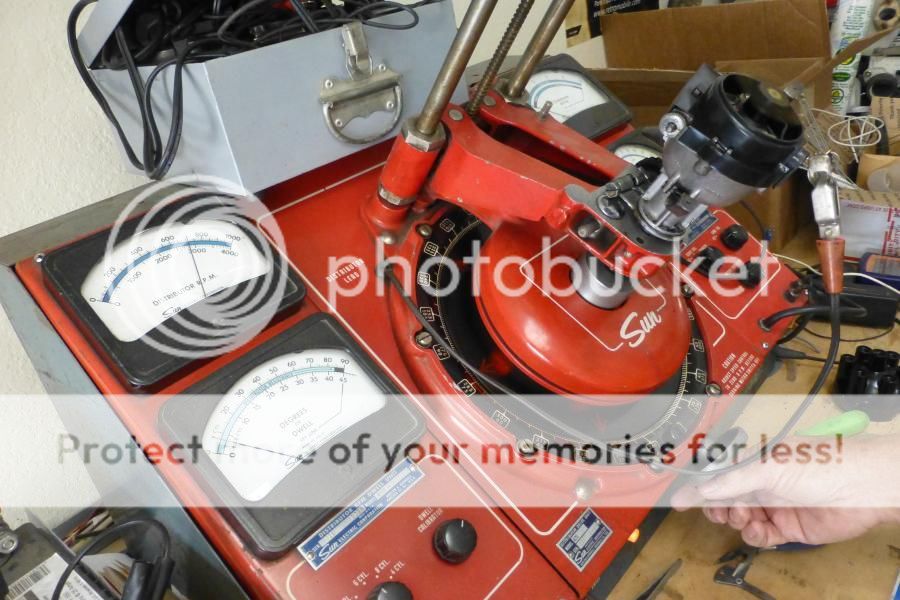
Nice that it is 'engine specific' (I assume he uses some info you provide him rather than the actual engine) but I don't know why he won't tell you what the curve is. If he set it he must know it and if not it is the work of a moment to plot it on a Sun machine.

Sun_zpsxfb0ontr.jpg


Prior to having access to that machine I crudely plotted my advance curve using a timing light with an advance dial - got a pretty good approximation that way.
 
Is it plausible that the advance curve could be set such that the ignition timing is advancing further around 3,000 rpm?
As noted, it's hard to say what Jeff has done, especially since he won't tell you. (Which would be a red flag to me; if he won't say what he did, you can't say he did it wrong even if he did. "Oh yeah, I meant to do that.") But the stock curve keeps going and isn't "all in" until past redline, so it's quite possible Jeff did the same thing. (Note that many specs, including the curves I posted, are in "distributor rpm", which is 1/2 of engine rpm.)

Also, with the modifications you have, it's also possible the engine needs less timing at 3K rpm than lower, especially if that is close to the beginning of the power band for your cam.
 
I drove 12km in the car to test it out today and adjust the vernier. I got through 4 litres of fuel! The car ran out 100 metres from home. I measured the fuel remaining in the tank, it really has gone.
Wow! Something wrong, for sure.
Plugs gapped to 032
Not likely to be the issue, but spec is .025".
Jets flush with bridges in carbs. No air leaks and adjusted right up for leanest mixture possible.
Seems odd; normally nuts all the way up would be way too lean. Is there any chance the wrong jets and/or needles got used during the rebuild? If a needle for a .090" jet got mixed with a .100" jet, you'd have problem for sure.

Also, have you checked that the carb pistons can be lifted to the top, and fall smoothly to land with a distinct click?

Some replacement fuel pumps do put out too much pressure, but usually you'd notice the fuel running out of the bowl vent.

Have you checked the crankcase oil recently? The only other possibility that comes to mind is a bad fuel pump diaphragm, which can leak fuel into the crankcase. I don't know if Sweden has been afflicted, but around here they frequently put ethanol (alcohol) in the fuel, which will eventually damage the original pump diaphragms and cause them to leak.

PS, I assume you've double-checked that the jets return to ride against the mixture nut after using the choke. Sometimes they tend to hang in the rich position. Just reach under and try to push them up; if there is any movement you have a problem.
 
Back
Top