• Hey Guest!
    British Car Forum has been supporting enthusiasts for over 25 years by providing a great place to share our love for British cars. You can support our efforts by upgrading your membership for less than the dues of most car clubs. There are some perks with a member upgrade!

    **Upgrade Now**
    (PS: Upgraded members don't see this banner, nor will you see the Google ads that appear on the site.)
Tips
Tips

TR2/3/3A OD low pressure vs Operating valve shaft setting

Jim_Stevens

Jedi Warrior
Gold
Country flag
Offline
Hi
On bench testing my A-type OD, the operating pressure (after warm up) is around 200#. It shifts into OD mode just fine. Upon investigating, I noticed the solenoid lever was way loose. The pin didn't even go all the way into the bottom hole, so the hole for the pin is a bit oversized now. That step in the procedure where you put a 3/16" pin into the lever to secure it is a bit useless due to the play in the shaft.

As I order a new and larger pin, my question: would a mis-setting of the operating shaft cause this low operating pressure? Seems like it should... Thanks, jim
 
Unfortunately...no. The pressure is controlled by the strength of the accumulator piston spring. It could also be affected by ring leakage, but we can assume that's not an issue in most cases. The loose lever only influences how and when the shift occurred, but has nothing to do with operating pressure.

To increase pressure, you can first try adding washers to the spring. That is limited by the minimum compressed length of the spring. In other words, it is possible to shim so much that the spring gets coil bind before the pressure relief hole is opened. You know this is the case when the pressure just keeps climbing out of control without stabilizing.

After trying shimming, you will have to go with a new accumulator spring.
 
Not very likely IMO. All that screwball linkage winds up doing is lifting a ball off it's seat. If the ball is off the seat at all, the pressure is going to eventually rise to what is in the accumulator. It might take longer, if the ball is just barely off the seat, but should still get there. Only exception I can think if is if perhaps the operating piston rings are leaking badly enough to keep a constant flow through the operating valve; in which case you're going to have other problems.

Shifting into OD on the bench is a lot different than actually transmitting power through the OD clutch. 200 psi is not nearly enough.

Also, that "setting" pin may not be accurate. As old as these units are, it's possible for the linkage to wear or distort until the lever needs to travel farther to reliably lift the ball. I would suggest measuring the ball lift directly at least once (to confirm whether the setting pin is still accurate or not).

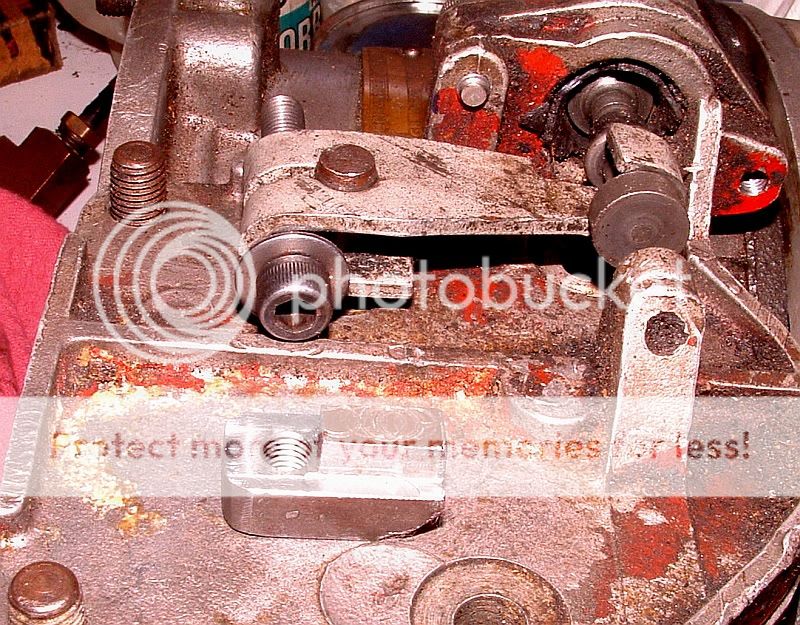
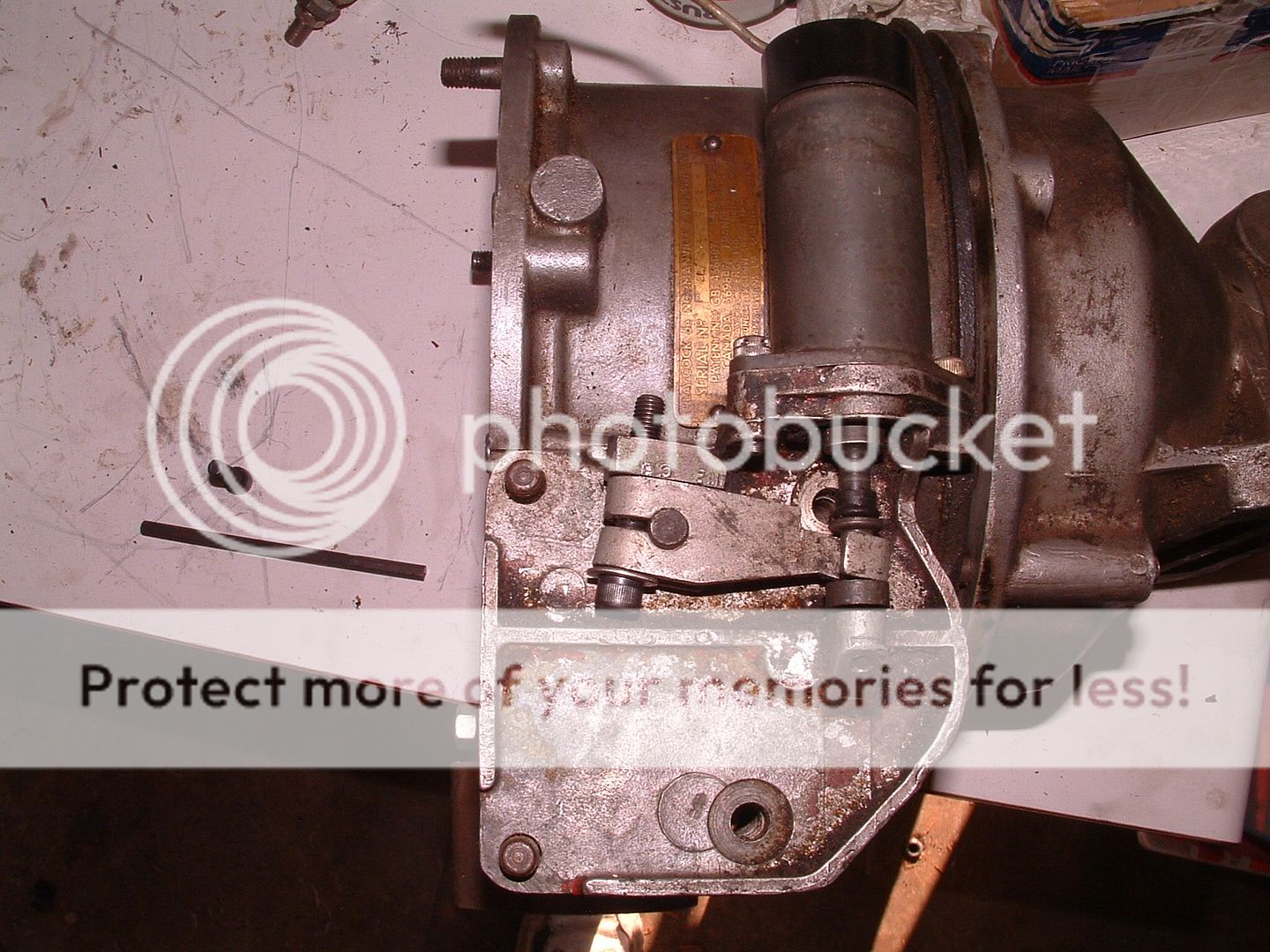
Not sure I follow about the pin going into the bottom hole. The solenoid lever is supposed to be somewhat loose on the solenoid shaft, but has to be clamped very firmly on the operating shaft that runs through the body of the OD. I got frustrated with mine slipping in service, so I made a custom nut and used a high tensile socket head screw for the clamp. Now I can get it plenty tight, even with the unit in the car and the tunnel installed.
DSCF0004_crop.jpg~original


DSCF0003-1.jpg~original
 
In other words, it is possible to shim so much that the spring gets coil bind before the pressure relief hole is opened. You know this is the case when the pressure just keeps climbing out of control without stabilizing.
Something I learned the hard way : It's possible for the spring plus shims to reach coil bind with the relief hole(s) only partially uncovered. The pressure looks fine on the bench at relatively low rpm (my bench setup only turns about 800 rpm), but goes crazy high at 5000 rpm!

I don't really have a good solution; what I did was to stick the spring in the hydraulic press and measure the length fully compressed, then compare that to some careful measurements of the housing & piston. The measurements confirmed what I could already see from the damage. The force had bent the bridge pieces, and the clutch sliding member was forced out of the thrust bearing, tearing the side out of the snap ring groove.
 
Last edited:
Thanks guys. It's worse than that: the pressure drops off rapidly after shutdown, so I think I'm in for a rebuild. Must be some seals. It sat empty for a few years, according to the PO of the OD. Caveat Emptor!

as for Randall's post, it's the lever on the other side of the unit in question...
 
as for Randall's post, it's the lever on the other side of the unit in question...
So you mean the setting lever is loose on the shaft? That's really strange as normally that lever just waves in the breeze. Someone must've had it off and then not gotten it put back properly.

Shouldn't be too hard to ream the holes in the lever and shaft back to round, then find a spring pin that will fit. Might need to buy a reamer, but they are cheap in those little sizes.
https://www.use-enco.com/CGI/INPDFF?PMPAGE=60&PARTPG=INLMK32

But afterwards, you will definitely want to check the ball lift, since the lever might not wind up in exactly the same place as before. The Buckeye Triumphs article outlines how to do it.
https://www.buckeyetriumphs.org/technical/AOD/AOD4/AOD4.htm

BTW, the link in the Buckeye article to the "Mr Finespanner on the Overdrive" article does not work. I put up a PDF copy of the referenced article at https://drive.google.com/file/d/0B2H2NJt34OffcVp0TUJiU29Sa214cXVOQzJCTGJXUQ/view?usp=sharing
And personally, I use the 1/32 - 1/16 range given by Mr Finespanner. Hmm, I just noticed a typo in the article, obviously the pressure gauge needs to read more than 100 psi full scale!
 
Thanks for that, Randall. I'm going to try the washer-spacer trick and re-adjust the operating valve with my dial indicator. The pressure starts out at 375#, the slowly decreases as the oil heats up. And when I shut it down, pressure falls rather quickly to zero... Definitely don't want to install it until it's sorted out...
 
The pressure starts out at 375#, the slowly decreases as the oil heats up. And when I shut it down, pressure falls rather quickly to zero... Definitely don't want to install it until it's sorted out...
To me, that would suggest a leak (or several of them), rather than the accumulator spring being too weak. I would start by changing the O-rings on the operating pistons (assuming you have O-rings instead of the earlier cast iron rings), plus the ball & spring on the check valve and try it again without any shims (or maybe just one shim) on the accumulator spring.
 
That is worth checking before going too far...if a bit of dirt is holding the operating ball off the seat, then you will bleed pressure past the ball. That's easy to get to and check.
 
Back
Top