What year TR2 or TR3 were fitted with windscreen stanchions that did not require guides? I have a pair of stanchions that appear to bolt directly to the body without the need of guides. There are no slots in the stanchions. I have never seen these before as all of my cars require stanchion guides, both early and late versions.


-
 Hey Guest!
British Car Forum has been supporting enthusiasts for over 25 years by providing a great place to share our love for British cars. You can support our efforts by upgrading your membership for less than the dues of most car clubs. There are some perks with a member upgrade!**Upgrade Now**
(PS: Upgraded members don't see this banner, nor will you see the Google ads that appear on the site.)
You are using an out of date browser. It may not display this or other websites correctly.
You should upgrade or use an alternative browser.
You should upgrade or use an alternative browser.
TR2/3/3A Windscreen Stanchions
- Thread starter tedwone
- Start date

Marvin Gruber
Yoda
Offline
The late TR3's had no guide plate, not sure what year they started but guess 1960 or 61. My 62 TR3b doesn't have them
Marv
Marv

TR3driver
Great Pumpkin - R.I.P
Offline
According to the SPC, none of the bolt-on stanchions had guide plates. It doesn't give a change point, but Piggott claims the change was documented at TS60000. He goes on to say that the change point was "not exact", and that some pre-60K cars got the post 60K body. Since the body changed as well for the bolt-on stanchions, I'd guess those early cars with the late body also had the late stanchions. To complicate matters further, there are clearly more types of stanchion than are listed in the SPC. Looks like they probably had to replace the molds, but didn't bother changing the part number.
Thanks Randall. I have a 60 TR3 that I am restoring for my son, but it has the earlier stanchions that require a guide. I guess the old British cars are like everything else out there. You just have to accept the fact that changes were made at some unknown point in time.
TR3driver
Great Pumpkin - R.I.P
Offline
It's also entirely possible that someone has made a substitution in the past. "They're all the same" was a common refrain at the parts stores back in the 70s; but they weren't all the same. Lots of folks installed wrong parts without even realizing they were wrong.Thanks Randall. I have a 60 TR3 that I am restoring for my son, but it has the earlier stanchions that require a guide. I guess the old British cars are like everything else out there. You just have to accept the fact that changes were made at some unknown point in time.
My most memorable moment was installing a TR4 rear axle under my TR3A, then trying to use the old 3A axle shafts, hubs and brakes. It all bolted right up, but for some reason the shafts didn't reach the differential ... D'oh!

TR4nut
Yoda
Offline
According to the SPC, none of the bolt-on stanchions had guide plates. It doesn't give a change point, but Piggott claims the change was documented at TS60000. He goes on to say that the change point was "not exact", and that some pre-60K cars got the post 60K body. Since the body changed as well for the bolt-on stanchions, I'd guess those early cars with the late body also had the late stanchions. To complicate matters further, there are clearly more types of stanchion than are listed in the SPC. Looks like they probably had to replace the molds, but didn't bother changing the part number.
Most definitely the SPC is incomplete - I have a set of bolt on stanchions which need guide plates too. The guide plates do not have the wires for the dzus fasteners.
TR3driver
Great Pumpkin - R.I.P
Offline
Yup, I've got a set of those in the parts bin as well. There aren't even any separate screws to hold the plates to the body, they just get trapped by the same bolts that hold the stanchions. They look more like filler pieces than guide plates.Most definitely the SPC is incomplete - I have a set of bolt on stanchions which need guide plates too. The guide plates do not have the wires for the dzus fasteners.

CJD
Yoda
Offline
My TR3A came with one bolt on (which was correct) and one guide plate stanchion. Of course there was no plate for the guide plate stanchion, it was just bolted on like the other. I did not notice there was a difference until AFTER they got back from the chrome shop! At the time I searched for another bolt on stanchion, with no luck, and I finally just bolted the guide stanchion right back on like I had received it. It actually fits that way. And, although not a perfect fit, I would have to point it out before most people could see the difference.
Last year I responded to a Craig's list add and picked up a half dozen more stanchions of all kinds, so my TR3A finally has a matching pair of bolt on stanchions, and I have a stack of spares if anyone needs...
Last year I responded to a Craig's list add and picked up a half dozen more stanchions of all kinds, so my TR3A finally has a matching pair of bolt on stanchions, and I have a stack of spares if anyone needs...

martx-5
Yoda
Offline
Here's a picture of four different sets that I've run across. Who knows, there may be more out there. :tennis:
The one on the right is the only one that takes the slide-on guide plate. The next one is probably the one that takes the "spacer, filler" plate mentioned above. There is a sort of evolution going on.
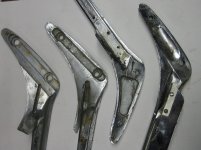
The one on the right is the only one that takes the slide-on guide plate. The next one is probably the one that takes the "spacer, filler" plate mentioned above. There is a sort of evolution going on.
TR3driver
Great Pumpkin - R.I.P
Offline
Yup. The one I dug out last night falls between the one on the far left in your photo, and the one next to it. Takes the filler plate, but the slot is finished so, in theory, it could slide off of the filler plate. As I recall, the plate was pretty well stuck to the paint, so that is actually the way I took it apart.Here's a picture of four different sets that I've run across. Who knows, there may be more out there. :tennis:
The one on the right is the only one that takes the slide-on guide plate. The next one is probably the one that takes the "spacer, filler" plate mentioned above. There is a sort of evolution going on.
There were also some post-60K stanchions that were aluminum instead of chromed brass; I assume to reduce weight in racing classes where a full windscreen was required. But I hear they are too weak for everyday use and so there are very few left in circulation. One of our club members has the aluminum surround, but I think she has chrome stanchions.