• Hi Guest!
    If you appreciate British Car Forum and our 25 years of supporting British car enthusiasts with technical and anicdotal information, collected from our thousands of great members, please support us with a low-cost subscription. You can become a supporting member for less than the dues of most car clubs.

    There are some perks with a member upgrade!
    **Upgrade Now**
    (PS: Subscribers don't see this gawd-aweful banner
Tips
Tips

How not to start a freshly rebuilt 100/6 engine

Nice setup, Patrick.
Thanks John. It was built by Jim Hockert when he was building his Rally car(I believe), and donated to the our local club. It has wheels/casters and two guys can load/unload it into the back of a pickup truck. We are going to be refurbishing it this Spring, fresh paint, etc.
 
:eagerness:
Thanks John. It was built by Jim Hockert when he was building his Rally car(I believe), and donated to the our local club. It has wheels/casters and two guys can load/unload it into the back of a pickup truck. We are going to be refurbishing it this Spring, fresh paint, etc.
.

Patrick, Maybe you should send your test stand photos to the guys in the video for enlightenment purposes! :eagerness:
 
Bob S.
You have completely missed the point. Modern engines don't need to break in the cam because they use roller cams, not because because they have better machining. Our Healeys, on the other hand, have flat tappet cams. That's why we need zinc in our oil, otherwise known as ZDDP. Roller cams do not need zinc.
 
Point taken Richard. But, please re-read my post and point out to me where I mentioned cam breakin (I didn't). I did, however, refer to ring break-in, and the bad things that happen to aircraft engines that aren't broken-in properly (BTW, almost all a/c engines have flat-faced hydraulic lifters). I recall when new cars came with specific break-in instructions, usually something like 'keep it below 50 MPH for the first 500 miles.' I doubt that had anything to do with cam break-in, which apparently occurs within the first hour or so, but if someone knows otherwise please say so.
 
I've never seen a roller cam engine, the majority of our Japan-sourced domestic fleet use OHC flat tappet multivalve arrangments. The difference is in 60 odd years of metal technology- it is possible to swap lifters around to any position without issue because they don't wear to each other like the old ones did and they even run quite well without a continual supply of oil. Also the loads they are seeing are much smaller due to ohc and multivalve removing the majority of mass from the valve train so the springs are comparatively weak now.

Fast forward to 29 minutes for how Porsche ran in engines in 1957


Andy.
 
:eagerness:.

Patrick, Maybe you should send your test stand photos to the guys in the video for enlightenment purposes! :eagerness:
Good idea, but after watching the video I somehow don't think they would be interested. Too complex!
 
Hi Patrick,

I'm making a similar rig this week with the addition of a water brake dyno on the back for load testing. The pic above is when I was using my old chassis for an engine stand but due to lack of space it got cut up and scrapped. This one looks a bit neater than the rusty old chassis. Andy.

View attachment 30084
The "open" design would make it easier to get at all the parts while the engine is running. Do you really need a water brake dyno for load testing for the initial break-in? We usually only run the engines once or twice at a little over 2k rpm for breakin and do some quick tuning such as timing and carb adjusting.
 
Do you really need a water brake dyno for load testing for the initial break-in?

Not just for break-in but also for performance measuring, plus it is much easier to find things like oil leaks and dud gearbox synchros before fitting the engine to the car.

This summer I have an old racecar engine that broke a piston over 40 years ago to get back running again (anyone remember a "Swan Healey"?) then I'll be modifying a Longbridge head to remove the studs from the inlet gallery and testing a pair of stealth EFI-converted SU carbs which should keep the dyno busy.

Andy.
 
Its the way weve always done it too Bob, great success.

We go a little further, fire-it up in the chassis if possible. Go almost wide open, let off and allow the engine breaking to bring us back down, do it again, hit the gas get it at a high RPM, let off and allow the engine breaking to bring it back down. This is the method we do three consecutive times and shout it down. NEVER LET IT IDLE and stay at a constant RPM for ore than a second or too, and carb sync is after breakin....If new cam, run 20 min above 2k. Always add ZINC as Richard mentioned too......

We then let it cool, start the process again with longer rpm duration's and now 5 incremental and off throttle breaking times. Once it cools this time, we change oil. Reason for this is that most particles will now be loose and do not want these rotating through cylinder walls, crank, so on.... Ive done this with all my new cars, changed oil after 20 miles of new.

Yes, thats just 20 MILES!!! Dealer once thought i was a nut and had a bet .I said it would pour glitter at the end of the drain on a 2011 Tundra with 18 miles, they said I was nuts. Up it went on their lift, they drained it and when the pour turned to a trickle, it was glittering from metal flake that would have gone through the system until the filter caught it. .....

This procedure instead of a heat sync has given us the highest compression, longer lasting, and NO blow by in any engine, even toys like snowmobiles, motorcycles and so on. Heres a link to a guy that explains it too. https://www.mototuneusa.com/break_in_secrets.htm


Somewhat off topic, but aircraft piston engines absolutely must be broken-in at full power, full rich, at low (as possible) altitudes and for extended times (an hour or more). This is so you get max BMEP and the rings will seat; if you don't do it this way you're all but guaranteed to have low compression (and will likely void the rebuilder's warranty). Some resort to putting Bon Ami in the cylinder in an attempt to break the glaze. If you have CHTs (cylinder head temperature gauges) you will see the temps rise to scary levels for a few minutes, then come down quickly as the rings seat. They're run full rich to purposely wash oil off the cylinder walls to assist "final machining."

This is a religious topic, but my dad who was an auto shop instructor and factory rep for Ford says "break them in how you're going to drive them." Others say "break them in slow, get a slow engine." One thing that does make sense to me is if you baby an engine for too long you'll get a ridge at the top of ring travel, then when you finally punch it the rings may hit the ridge and possibly be damaged. Modern engines are so precisely machined that usually no specific break-in is required.

 
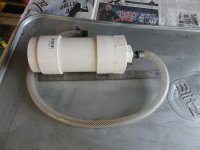
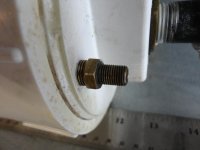
Here are pics of our clubs Engine Test Stand that our local club members can borrow to use to break-in their engine before it goes into the car. We have a dummy transmission to support the engine and exhaust pipes w/ mufflers. The engines owner must use their radiator, battery, etc. Also a pic of the "Engine Oil Primer" that a club member made to get oil through the engine before spinning and starting it up. It uses a home made oil tank and is hooked up to a small air-compressor and the engine is primed until oil is coming out of the rocker shaft and going down to the lifters. After starting the engine we run it up to a little over 2k rpm and adjust the timing, carbs, etc.
Well that's the best rig yet; pressurizing the (auxiliary) oil tank fills/pressurizes the galleys without undue spinning of the engine. This is what Richard alludes to, preventing the wiping of all your camshaft assembly lube off the lobes & lifters.

Nice that the local club makes that available to anyone that needs it.
 
Well that's the best rig yet; pressurizing the (auxiliary) oil tank fills/pressurizes the galleys without undue spinning of the engine. This is what Richard alludes to, preventing the wiping of all your camshaft assembly lube off the lobes & lifters.

Nice that the local club makes that available to anyone that needs it.
Here's some photos of the Oil Pressurizing unit. Very simply made and effective. Best used with a drip pan, which I assume everyone with a Healey has at least one or two of(I have two).
 

Attachments

  • DSC01310.jpg
    DSC01310.jpg
    183.8 KB · Views: 98
  • DSC01311.jpg
    DSC01311.jpg
    186 KB · Views: 94
Back
Top