 but were afraid to ask:
 May be you guys have already seen this but interesting to note the sale price and that the Le mans kit was installed by Donald Healey works on this prototype for sale.https://www.classiccarsforsale.co.u...ibute4%%&att5=%%__AdditionalEmailAttribute5%%


-
 Hey Guest!
British Car Forum has been supporting enthusiasts for over 25 years by providing a great place to share our love for British cars. You can support our efforts by upgrading your membership for less than the dues of most car clubs. There are some perks with a member upgrade!**Upgrade Now**
(PS: Upgraded members don't see this banner, nor will you see the Google ads that appear on the site.)

Tips
- We have a special forum called "Member Articles" where you can submit actual articles for consideration for publication. Learn More
- Don't have an Avatar? If not, your avatar will default to the 1st character in your username. Go into "Account Details" to change your Avatar.
- Some basic forum navigation info: click
 Hey - did you know if you click on the title of a thread it will take you to the first unread post since you last visited that thread?
- Hey Guest - Is your British Car Club in our Clubs database? If not, send me a PM - Basil

- Looking for a local club? Click the "Clubs" tab above and browse hundreds of clubs world-wide.
- Add Android or iPhone APP: click
- Did you know - any picture or video you add in your posts in any marque-specific forum will also get added to the Media Gallery automatically.
- A few more tips about posting and replying: click
- Hey there Guest - be sure to keep your profile page up to date with interesting info about yourself: learn more
- More tips and tricks on Posting and Replying: click
 STOP!! Never post your email address in open forums. Bots can "harvest" your email! If you must share your email use a Private Message or use the
  smilie in place of the real @
- Want to mention another member in a post & get their attention? WATCH THIS

- So, you created a "Group" here at BCF and would like to invite other members to join? Watch this!
- Hey Guest - A post a day keeps Basil from visiting you in the small hours and putting a bat up your nightdress!
- Hey Guest - do you know of an upcoming British car event?
 Pretty Please - add it to our Events forum(s) and add to the calendar! >> Here's How <<
- Hey Guest - you be stylin' Change the look and feel of the forum to fit your taste. Check it out
- If you run across an inappropriate post, for example a post that breaks our rules or looks like it might be spam, you can report the post to the moderators: Learn More
- If you would like to try some different "looks" or styles for the site, scroll to the very bottom, on the left and click the Style Selector.
You are using an out of date browser. It may not display this or other websites correctly.
You should upgrade or use an alternative browser.
You should upgrade or use an alternative browser.
Austin Healey prototype with Le mans kit sold at auction
- Thread starter emgeetf
- Start date


Offline
Rare Testa Rossa?


Offline
May be you guys have already seen this but interesting to note the sale price and that the Le mans kit was installed by Donald Healey works on this prototype for sale.
Here we go again. The warning signs:
They have used the recently popularized label loved by auction-hypesters (think carnies), "100 M Le Mans," that serves to confuse the ignorant into thinking that it is a 100M, which, of course, it is not. I guess you could say that any 100 is a "100M prototype" in the sense that they are a previous model. And a Model T is a prototype of the Veyron, too (you know, four rubber tires, etc. - the list of similarities is almost endless).
"THIS AUSTIN HEALEY IS A SPECIAL PRE SERIES TEST CAR WITH LE MANS WORKS KIT." Oh, really? How is it different from any other 100 with a Le Mans Kit installed, by someone, at some time?
And nice job woking the terms "special," "test," and "car" into the same phrase. (If it were really a Special Test Car, it would be worth much, much more. Ever heard of NOJ 393 and NOJ 392?)
"THE CAR WAS PREPARED BY THE DONALD HEALEY MOTOR COMPANY IN 1953 FOR RALLYS." Oh, really? We'll be happy to examine the extensive original documentation you must have to prove such an important claim. Don't have any? Didn't think so.
Also note that the 100 was never a factory "rally" car. Brush up on your Healey history, just a little bit, and you'll see that in those days the Donald Healey Motor Company was making special cars for racing and record-setting. Healeys in rallying came later with the six-cylinder cars, and they were prepared by BMC.
"THE CAR HAS FINISHED THE 2013 MILLE MIGLIA." I'll bet that was fun! Doesn't add anything or prove anything about its history or provenance, but nice job sepia-toning the photo of the car from the modern Mille Miglia of this year; it helps give the impression of some historical connection.
Next.
Last edited:
RandyHicks
Senior Member
Offline
I emailed earlier today for the numbers on the car but just got back more pictures and no information. Trying again. Will post if I get anything worthwhile.
Randy
Randy
Guys,
Sorry to say that this outfit are well known here on the continent for 'hyping' cars to extract more money from the pockets of people looking to fulfill a boyhood dream in owning a Healey. I am sure that they will give you the engine number but they are far from experts on Healeys but more very slick sales people.. Should be hung drawn and quartered..
Sorry to say that this outfit are well known here on the continent for 'hyping' cars to extract more money from the pockets of people looking to fulfill a boyhood dream in owning a Healey. I am sure that they will give you the engine number but they are far from experts on Healeys but more very slick sales people.. Should be hung drawn and quartered..
I e mailed them too and wanted them to authenticate that the car was genuine prototype and to date have not had a reply. Will try to call the number that is provided if everything fails.I emailed earlier today for the numbers on the car but just got back more pictures and no information. Trying again. Will post if I get anything worthwhile.
Randy

magman
Member
Offline
Hello to all members; I am brand new here so cut me some slack if I seem to be speaking out of turn. Early Healey history is something I am very interested in. I just want to add a bit of information from my experience with my car and what I have found or observed in restoring it over the last fifteen years. The more we share this stuff the more we will all know, or maybe just be more confused? My car is #93 and the build date makes it the last or next to last 1953 BN-1. It was modified for competition. I say that based on the fact that in addition to the usual "Le Mans" modifications, carbs, cold airbox, 40422A distributor, the special hand etched numbers on the AUC 6040X manifolds, the car also has a 28 lb. flywheel and drilled brake backing plate front and rear. It would seem someone was serious about racing as some of this is not needed for a road car. Obviously all of this could of been done any time after the build date, even years later, I can't say for certain when, nobody can unless they have some information about my car I haven't seen and boy would I be happy to get it. In the interim all I can do is apply some common sense and logic. The two most meaningful items to my way of thinking are first of all the fact that the distributor is stamped with the date 1/53 so I think it makes sense to believe the modifications were done close to the cars build date. The flywheel and backing plates are a step beyond what you would expect if you weren't planning on racing. This all says to me that it was "state of the art" at the time it was done. Add in that no high compression pistons or special camshaft seem to of been part of the package and I think that is because they were not yet available otherwise why not add them too? The pistons were developed late in 1953, I haven't seen a date for the camshafts. Also we must remember that nothing gets older faster than last years race car so it seems you wouldn't want to use a BN-1 as a starting point if you are serious when the BN-2 came along. If this all makes sense then where in August of 1953 do you find the knowledge and expertise and parts except down the road at Warwick?
Offline
magman, welcome to the Forum. Interesting car you have there. Do you have a BMIHT certificate for it?
Do you know anything of the car's history, such as where it was sold new and where its owners have lived?
Remember that the high-compression pistons were not part of the Le Mans Engine Modification Kit, and if your car doesn't have the Le Mans kit camshaft, then maybe it was never purchased or maybe it was just not installed due to the extra trouble to do so. (The rest of the major components of the Kit - carbs and distributor - are pretty much bolt-on with no major disassembly required.)
It sounds as if a likely early history of the car would be that a US serviceman stationed in England bought it there, also bought some performance mods for it (perhaps directly from the Donald Healey Motor Company) and then shipped it to the USA upon completion of his assignment. Of course that's just speculation based on very limited info.
Would love to see a few pics of the car!
Do you know anything of the car's history, such as where it was sold new and where its owners have lived?
Remember that the high-compression pistons were not part of the Le Mans Engine Modification Kit, and if your car doesn't have the Le Mans kit camshaft, then maybe it was never purchased or maybe it was just not installed due to the extra trouble to do so. (The rest of the major components of the Kit - carbs and distributor - are pretty much bolt-on with no major disassembly required.)
It sounds as if a likely early history of the car would be that a US serviceman stationed in England bought it there, also bought some performance mods for it (perhaps directly from the Donald Healey Motor Company) and then shipped it to the USA upon completion of his assignment. Of course that's just speculation based on very limited info.
Would love to see a few pics of the car!
magman
Member
Offline
Hi Reid, here are a few pictures for you.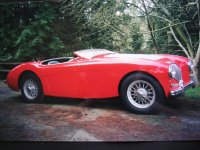
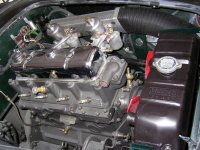
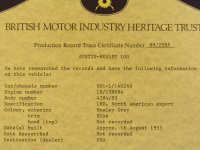
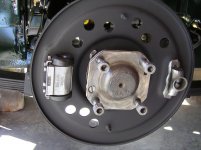 I have no information about the early ownership, I wish I did! I agree that the car was most likely bought by a serviceman. If one presumes he had the mods done at the time of purchase then I believe the only place it could be done in Aug 1953 is Warwick as they were just starting to modify cars for customers. The first car done was for Lord Samuelson in August 1953 and perhaps my car was done near that time. All speculation but still interesting. The backing plate work shows me somebody knew what they were doing. There were to my knowledge no "kits" available at that time, in fact the official kit release date usually seems to be 1955 but I am sure those in the loop could get parts earlier.
I have no information about the early ownership, I wish I did! I agree that the car was most likely bought by a serviceman. If one presumes he had the mods done at the time of purchase then I believe the only place it could be done in Aug 1953 is Warwick as they were just starting to modify cars for customers. The first car done was for Lord Samuelson in August 1953 and perhaps my car was done near that time. All speculation but still interesting. The backing plate work shows me somebody knew what they were doing. There were to my knowledge no "kits" available at that time, in fact the official kit release date usually seems to be 1955 but I am sure those in the loop could get parts earlier.
Offline
Magman,
That engine-turned airbox sure is pretty. Any pics from the other side?
That engine-turned airbox sure is pretty. Any pics from the other side?
magman
Member
Offline
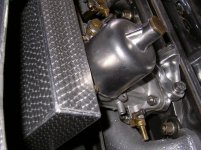

DerekJ
Luke Skywalker

Offline
Hi,
Welcome to the forum. I see from the certificate your car was painted the rare Healey Grey colour. I wonder if anyone out there has a good photo of a car in this original colour?
What is the weight of a standard BN1 flywheel? 28lbs is still very heavy and is the normal weight of a 3000 flywheel.
Welcome to the forum. I see from the certificate your car was painted the rare Healey Grey colour. I wonder if anyone out there has a good photo of a car in this original colour?
What is the weight of a standard BN1 flywheel? 28lbs is still very heavy and is the normal weight of a 3000 flywheel.
magman
Member
Offline
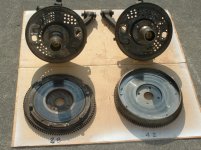
According to Clausager Healey Grey may be another name for Healey Blue but is called that only on the early cars. The normal weight of the flywheel is 42 lbs. perhaps that's because the four is not as naturally balanced as the six, I don't know, maybe somebody else can tell us. I also think 42 is heavy and mine seems to be fine at 28. No fancy foot work or killing the engine etc. so why? Perhaps in saloons which are heavier and where it comes from? Here is a picture of my flywheel next to my friends taken when we were rebuilding his engine a few years ago.
Attachments
Offline
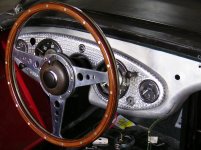
Hi, glad you like it. I have a picture from the left side but it isn't much to look at. Hard to get a decent angle from that side. If you like the air box I thought you might like to see the dash.
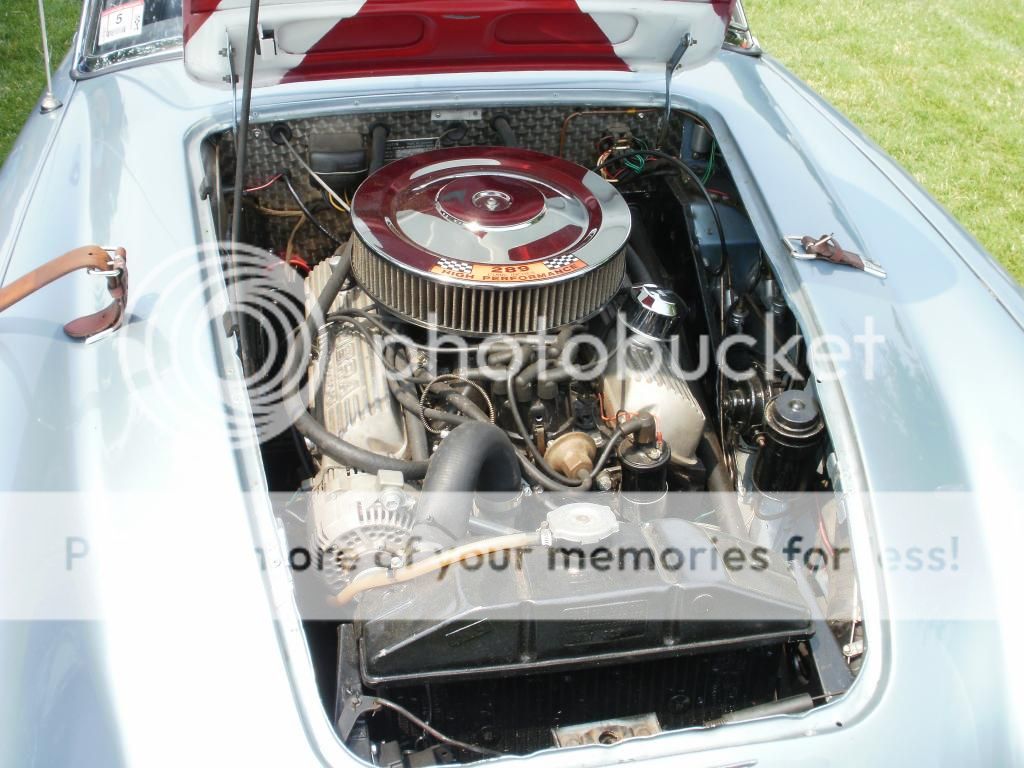
That box (including the welds) and dash are really works of art as are those brake backing plates. I can stare for hours at the engine compartment of a Bugatti with all that engine turning. I used some on the firewall of my BJ7, but cheated a bit by buying a machine-made sheet of engine-turned stainless:
Offline
Maybe some of the 100 experts could comment on the colour. I understood there was a Healey grey colour.
It's long been my understanding that "Healey Grey" is just another name for Healey Blue, like "Ice Blue Metallic" - all the same thing, although with variations. Things were not so standardized in those days.
Offline
It's long been my understanding that "Healey Grey" is just another name for Healey Blue, like "Ice Blue Metallic" - all the same thing, although with variations. Things were not so standardized in those days.
FWIW, I've read in a couple of places that "Healey Grey" was a non-metallic blue color and not identical to "Ice Blue Metallic.aka "Healey Blue". So says Anderson-Moment and here's some more info: https://www.netbug.net/blogmichael/?p=838
Offline
An interesting old post from the mail list from Rich Chrysler:
"
The original inquiry regarding a non metallic version of Healey Blue is another very confusing thing. On the build cards it isn't stipulated as being a different colour at all. In fact there are some build cards for very early Hundreds that note"Healey Grey". I have body #156 (built August 7/53) in the shop right now that stated that on the build card, yet a metallic Healey Blue has been found on it. I have seen this non metallic colour and it is as described, similar in shade to Healey Blue (metallic) but with absolutely no metallic. The preproduction car AHX14 and the first production car (138031) body #24 were both metallic Healey Blue, so it isn't a question of early vs. later. Interesting stuff anyway."
"
The original inquiry regarding a non metallic version of Healey Blue is another very confusing thing. On the build cards it isn't stipulated as being a different colour at all. In fact there are some build cards for very early Hundreds that note"Healey Grey". I have body #156 (built August 7/53) in the shop right now that stated that on the build card, yet a metallic Healey Blue has been found on it. I have seen this non metallic colour and it is as described, similar in shade to Healey Blue (metallic) but with absolutely no metallic. The preproduction car AHX14 and the first production car (138031) body #24 were both metallic Healey Blue, so it isn't a question of early vs. later. Interesting stuff anyway."
Here we go again. The warning signs:
They have used the recently popularized label loved by auction-hypesters (think carnies), "100 M Le Mans," that serves to confuse the ignorant into thinking that it is a 100M, which, of course, it is not. I guess you could say that any 100 is a "100M prototype" in the sense that they are a previous model. And a Model T is a prototype of the Veyron, too (you know, four rubber tires, etc. - the list of similarities is almost endless).
"THIS AUSTIN HEALEY IS A SPECIAL PRE SERIES TEST CAR WITH LE MANS WORKS KIT." Oh, really? How is it different from any other 100 with a Le Mans Kit installed, by someone, at some time?
And nice job woking the terms "special," "test," and "car" into the same phrase. (If it were really a Special Test Car, it would be worth much, much more. Ever heard of NOJ 393 and NOJ 392?)
"THE CAR WAS PREPARED BY THE DONALD HEALEY MOTOR COMPANY IN 1953 FOR RALLYS." Oh, really? We'll be happy to examine the extensive original documentation you must have to prove such an important claim. Don't have any? Didn't think so.
There is another dealer prepared 100 M Le mans on ebay for sale. listing price $ 104,000. It says dealer prepared Le mans and the delaer who did the work on the car is identified Chrysler ? They have a Heritage certificate for a BN 1 100/4 but a price close to a Le mans car