• Hi Guest!
    If you appreciate British Car Forum and our 25 years of supporting British car enthusiasts with technical and anicdotal information, collected from our thousands of great members, please support us with a low-cost subscription. You can become a supporting member for less than the dues of most car clubs.

    There are some perks with a member upgrade!
    **Upgrade Now**
    (PS: Subscribers don't see this gawd-aweful banner
Tips
Tips

Does a texas cooler make a real difference ? I now am using an a moss flex fan !

Jeffsbj8

Senior Member
Country flag
Offline
Does a texas cooler make a real difference I now am using an a Moss flex fan . My temp runs normally 190 - 200 degrees.
Isn't that about right? Everything in my car seems healthy , clean radiator new water pump ,160 tstat, water wetter(waste of $) . Should I change to a texas cooler? I see they are on sale @ Moss , thanks, Jeff
 
I have one on each car and they seem to work great. No overheating problems at all. Yours appears to be operating well given the temperatures you state. I don't think you would see any significant improvement on that. Would not seem to be worth the expense and headache to put it in to me.
 
I have one on each car and they seem to work great. No overheating problems at all.

Me Too--Keoke--​
 
Thanks Guys , so 190- 200 sounds about normal ? One more question for the record, The radiators that are sold by V. B. are they decent units., wonder if they have brass tanks, has anyone ever purchased one ? They are a little less expensive that others on the market. thanks again, Jeff
 
I have a texas cooler in mine and like it. I run a 190 t-stat because I am a firm believer in getting the block up to temp along with the pistons. The alum. pistons will expand more that the cast iron block so I like to get it to 190-195 before the t-stat opens to avoid scuffing. Do you have a good radiator shop in your area ? Have yours re-cored. My guy put the biggest tubes in mine that he could and it stays cool even in traffic. Good luck !
 
Thanks Guys , so 190- 200 sounds about normal ? One more question for the record, The radiators that are sold by V. B. are they decent units., wonder if they have brass tanks, has anyone ever purchased one ? They are a little less expensive that others on the market. thanks again, Jeff

180-190 sounds normal, but that's with a 180 thermostat. In other words, the car generally runs just above the thermostat set point. To me this means that the cooling system has some excess cooling capacity, and the thermostat only has to open enough to hold 180. If it's hot outside or you're pulling a hill, it has to open more to hold 180, but it has the cooling capacity to keep the engine around 180. Of course when you pull a hill in hot weather, you temporarily exceed the cooling capacity and the temperature climbs to 200 or so.

If you're running at 180-190 with a 160 thermostat, I think it means that you don't have enough cooling capacity. What happens when you pull a hill in hot weather? If you don't go too much above 210, you're probably OK.

The fan is really only a factor when you're sitting at a light or moving slowly. At speed, I think the movement of the car creates most of the airflow through the radiator.

Just out of curiosity, why are you running a 160 t-stat? I think most people run a 180. I'm no expert on this, so others with more knowledge should chime in if I'm wrong.
 
>>>
If you're running at 180-190 with a 160 thermostat, I think it means that you don't have enough cooling capacity. What happens when you pull a hill in hot weather? If you don't go too much above 210, you're probably OK.
<<<

This site has a pretty good explanation of how the cooling system & thermostat works: https://www.2carpros.com/articles/how-an-engine-thermostat-works

To add to the above, I think it means you don't have enough capacity to reduce the heat to 160 on a summer day, so the t-stat just stays open all the time. This is how my car runs; 190-200 with a 160 t-stat. The t-stat opens early on then the cooling capacity kicks in. If I had a better radiator and oil cooler with a 180 t-stat, could see it cooling down to the point where the t-stat would close, allowing the cycle to start all over again. If we had real winter weather here in sunny SoCal the t-stat would keep the engine at a too-cold 160 all the time.

I'm running the 160 sleeved thermostat from British Car Specialists. This is only because they didn't have a 180 version and I made a judgement (not necessarily correct) that the sleeved 160 is better than a non-sleeved 180.
 
The thermostat does not control the temperature at which the engine runs at under normal circumstances. If your engine has issues and a tendency to overheat the thermostat will do nothing to prevent that. The thermostat is there to ensure that the engine achieves a minimum operating temperature not a maximum. So, if it is very cold outside you do not want a 160 degree thermostat you want a 180 or 190 to ensure your engine will reach that temperature before allowing water to circulate to the radiator.
 
The thermostat does not control the temperature at which the engine runs at under normal circumstances. If your engine has issues and a tendency to overheat the thermostat will do nothing to prevent that. The thermostat is there to ensure that the engine achieves a minimum operating temperature not a maximum. So, if it is very cold outside you do not want a 160 degree thermostat you want a 180 or 190 to ensure your engine will reach that temperature before allowing water to circulate to the radiator.

I sorta (respectfully) disagree. At least I think it depends on your definition of "normal circumstances". It all depends on how hot it is outside and how good your radiator is. I have substantially upgraded the radiator in my BT7. The car has a 180 t-stat and runs at 185 most of the time. If I had a 160 t-stat, I think it would run at 160 most of the time. So, in that sense, the thermostat DOES determine engine running temp. If your radiator is marginal for the engine, then I think you're right (at least for summer months), engine temperature rises above above t-stat temperature and is controlled by the balance of heat load and cooling at maximum t-stat openness. Most modern cars have really good radiators and run at thermostat temperature most of the time.
 
Keith,
Here's my respectful partial disagreement - here's my reasoning: your car could be running at 185 on a winter day due to the thermostat and you could install a 160 thermostat and the cooling system would have the capacity to lower the temperature to the point where the thermostat would keep your car at 160. You could do the same thing on a 90 degree day in summer and it wouldn't do a thing because the cooling system wouldn't have the ability to lower the temperature to 160. The thermostat would just stay open and the cooling system would cool it to whatever it was capable of under the circumstances.

We switched here to talking about modern cars but that's not really appropriate. If a modern car has the excess capacity to cool the engine down to the thermostat temp on a 110 degree day that's about like a Healey radiator cooling the engine down to 160 on a 70 degree day.
 
Hi All,

Hate to pass up this discussion as I am always interested as to how Healeys are kept cool on a very hot day.

Many years ago I cam to the conclusion that the Healey’s cooling system was never sized properly to control operations in Hot summer temperatures. To address this issue of keeping cool, I did some investigation and found some interesting results. First, without a fan shroud, air leaks off the end of the fan blades and looses draw. Additionally, loss if air flow and direction is further thwarted by air passing around and under the radiator to form a high pressure block within the engine compartment. Some have installed fender vents or hood louvers to eliminate this air block and regain direction and flow through the engine compartment. However, for those that do not wish to cut their panels up, there are some easy approaches to gain proper air flow within the engine compartment and is explained in this article (https://www.healey6.com/Technical/I always wanted a COOL Car.pdf).

By the way, although I have had a Texas Cooler over 10 years, I find the air draw good, but loud, when going slow or stopped. However, I find it a drag at speed. With the mods presented in the article, I have gone back to the original 4 blade Healey fan a couple of weeks ago to see if I really need the Texas Cooler. So far, I see no issue during 80 degree days but the real test will be during a traffic jam at the Jersey Shore when the weather is in the mid 90s.

By the way, as I understand, a thermostat controls the minimum engine operating temperature and, since the Healey cooling system is under configured for our hot weather, will do nothing to lower the engine’s operating temperature. Additionally, when not using a sleeved thermostat or some sort of recirculation block-out, on a hot day, your Healey’s cooling capacity will build to as much as a 25% capacity loss when this sizable amount of your coolant does not pass through the radiator.

Cool Man Cool,,,,its not just a frame of mind.
Ray (64BJ8P1)

 
Ray,
Just finished reading your paper. Loved it and plan to implement the under-engine air blocking.

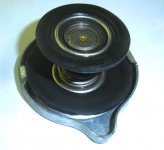
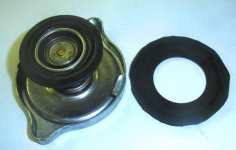
One thing - the stock filler cap can be made into a recovery cap with the simple addition of a home-made rubber gasket:

CapWithGasket.jpg CapGasketSeparated.jpg
Don't ask me how this works but I've been using it for years.
 
Keith,
Here's my respectful partial disagreement - here's my reasoning: your car could be running at 185 on a winter day due to the thermostat and you could install a 160 thermostat and the cooling system would have the capacity to lower the temperature to the point where the thermostat would keep your car at 160. You could do the same thing on a 90 degree day in summer and it wouldn't do a thing because the cooling system wouldn't have the ability to lower the temperature to 160. The thermostat would just stay open and the cooling system would cool it to whatever it was capable of under the circumstances.

We switched here to talking about modern cars but that's not really appropriate. If a modern car has the excess capacity to cool the engine down to the thermostat temp on a 110 degree day that's about like a Healey radiator cooling the engine down to 160 on a 70 degree day.


Hi Steve,
We're really saying the same thing. If the cooling system is large enough, the thermostat controls the temperature. If not, it just sets the minimum temperature. I think that really sums it up, and I think you would agree.

With my upgraded radiator, my Healey DOES run like a new car in that even on the hottest days, it rarely gets over 185. I would guess that even on a summer day it could keep the temp near 160 with a 160 t-stat. The only time I really heat up is when I pull a mountain pass on a 90+ day.

Keith
 
If you put the thermostat in water and heat it to boiling, it will OPEN as the temperature rises. As the engine heats up, the thermostat opens and allows the coolant to flow into the radiator where is cools (some). Once open it stays open until the engine cools. All you are doing when you change the rated temperature on the thermostat is raising or lowering the temperature that water will enter the radiator. It cannot cool the engine once opened. It only allows the engine to warm up faster to a predetermined temperature. Once the thermostat is opened the engine determines the heat of the coolant and the radiator cools the coolant. If the other logic (lower thermostat equals lower running temps) were true, no thermostat at all would equal ambient air temperature. By that logic, a higher rated thermostat would raise the running temperature higher, increasing the over heating problem.
 
Another phenomenon I've never understood: on cool days, my BJ8 will run below the coolant setpoint (180degF). For example, it'll run at about 160 even though it should go up to 180 and stabilize once the thermostat opens. The only explanation is there is enough internal cooling from unburnt fuel--though my mileage is nominal, plugs read good and I never get any black smoke--and/or the block itself dissipates enough heat to keep the temp down. I've had this effect for years, and just had my safety gauge refurbished and calibrated, so I'm confident what the gauge is displaying is reality.
 
Another phenomenon I've never understood: on cool days, my BJ8 will run below the coolant setpoint (180degF). For example, it'll run at about 160 even though it should go up to 180 and stabilize once the thermostat opens. The only explanation is there is enough internal cooling from unburnt fuel--though my mileage is nominal, plugs read good and I never get any black smoke--and/or the block itself dissipates enough heat to keep the temp down. I've had this effect for years, and just had my safety gauge refurbished and calibrated, so I'm confident what the gauge is displaying is reality.

I'm completely out of my depth here (indeed, most readers will realize that I've been out of my depth for the whole thread), so I won't even tackle your question. But I will comment on how much conflicting information about cooling systems is out there. Everyone seems to have a different ideas about how things work. I for one have never understood why removing the thermostat causes the car to run hotter. People say that the thermostat slows the water down enough so that it stays in the radiator longer. But it also stays in the engine longer! Hard to see how that makes the engine cooler. Seems like it should just make the temperature difference between engine and radiator larger. And what about the fan? My intuition tells me that the fan should only be important when the car is stopped or moving very slowly, but there doesn't seem to be general agreement on that either.

It would be really interesting to do a rigorous mathematical model of the whole system, complete with thermal transfer coefficients for the engine and radiator, flow rates, residence times in the radiator and engine, etc. It's not a trivial problem, but it's not so difficult that someone out there must have done it. It would be nice have something like this where you could do "experiments". Like---What would happen if we increase the thermal transfer coefficient for the cooling system? (put in a bigger/better radiator), or What would happen if you always had maximum flow? (removed the thermostat) Anyone out there know of such a beast?
 
Another phenomenon I've never understood: on cool days, my BJ8 will run below the coolant setpoint (180degF). For example, it'll run at about 160 even though it should go up to 180 and stabilize once the thermostat opens. The only explanation is there is enough internal cooling from unburnt fuel--though my mileage is nominal, plugs read good and I never get any black smoke--and/or the block itself dissipates enough heat to keep the temp down. I've had this effect for years, and just had my safety gauge refurbished and calibrated, so I'm confident what the gauge is displaying is reality.
There is another explanation: the thermostat is not an on/off switch, it begins opening at some temperature probably before the rated temp and is probably fully open at the rated temp. You'd need to test it with a thermometer in a pan of water heated gradually.
 
I tested my 160 Robertshaw BCS sleeved tstat a week ago - it starts opening at 160. My guess would be if you were able to keep the water at 160 it would continue opening. It's all pretty slow - maybe takes 1/2 min to open.
 
There is another explanation: the thermostat is not an on/off switch, it begins opening at some temperature probably before the rated temp and is probably fully open at the rated temp. You'd need to test it with a thermometer in a pan of water heated gradually.

I've tested thermostats before, and they all seem to start to open at the rated temp. I'm taking a long road trip through the Southwest so I'll see what she does in a hotter climate. Before, I've seen the temp go up just past 180 then drop down and hold at 180 (until I pull a long grade or get stuck in traffic).
 
I've tested thermostats before, and they all seem to start to open at the rated temp. I'm taking a long road trip through the Southwest so I'll see what she does in a hotter climate. Before, I've seen the temp go up just past 180 then drop down and hold at 180 (until I pull a long grade or get stuck in traffic).

My car acts similarly, particularly on cooler days. The temp goes up to 180-85, then drops abruptly down to like 160 as the thermostat opens and the cool water from the radiator rushes in. Temp then slowly climbs back to 180 and and stabilizes. I love watching it; it's just one of those things that makes driving an older car fun.
 
Back
Top