• Hey Guest!
    British Car Forum has been supporting enthusiasts for over 25 years by providing a great place to share our love for British cars. You can support our efforts by upgrading your membership for less than the dues of most car clubs. There are some perks with a member upgrade!

    **Upgrade Now**
    (PS: Upgraded members don't see this banner, nor will you see the Google ads that appear on the site.)
Tips
Tips

TR2/3/3A Maintenance on Drive Shaft

Redoakboo

Jedi Warrior
Country flag
Offline
I am in the late stages of restoring the chassis on my 1954 TR-2. I have removed the driveshaft and the "U" joints seems to be in good condition, well lubricated. Question: The grease fitting on the front of the shaft obviously lubricate the inner splines. Should there be any back and forth motion of this front section of the shaft?

Thanks, Dick
 
I'm not quite sure what you are asking, so apologies if I got it wrong.

The splined joint does need to move fore/aft a very small amount, as the rear axle moves up and down on the suspension and the engine deflects a bit on it's mounts. But it's not very much. There is also a cork seal inside, that can make it a bit stiff to move with your hands.
 
I noticed that you can unscrew the outside ribbed collar and it looks like it would change the length of the driveshaft?
 
Only if the yoke is up against the collar, which it shouldn't be in operation. The collar is to retain that seal I mentioned.

Don't forget, these cars were cobbled together from pieces of other non-sports cars. Things don't always make "sense" in terms of having been designed for this specific application.
 
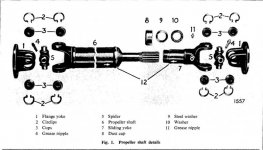
Why would you want to leave the dust cap loose?
 
See item number 8.

M.
 

Attachments

  • Tr propeller shaft .jpg
    Tr propeller shaft .jpg
    53.1 KB · Views: 183
Yes, that's the plan.
Screwed tight.

M.
 
And as Randall noted above, allow for fore and aft movement of the spines even when screwed tight.
Tom
 
Tom,

After the collar is screwed tight, and all are lubricated, how do you know whether you have allowed fore and aft movement?

Dick
 
It's built into the design. The collar, aka dust cap, should simply hold the seal in place inboard of the splines and the yoke should not bottom out and the seal should not contact the splines. If you've got the correct shaft and yoke, simply put it together. You can usually feel a little play and sometimes need to compress or stretch the unit a bit to get it to fit, but pretty easy to do.
The reason for the play is that the length of the driveshaft changes, albeit very slightly, as the rear axle bounces up and down and or twists with torque (and also with wear on the engine and trans. mounts).
Tom
 
The yoke should slide on the splines on the driveshaft. It is actually called a slip joint; #6 and #7 in post 8 above. Hope we are talking about the same thing. The collar (8 dust cap) will compress the seal (9) and may make it a bit tight but it does need to move.
Tom
 
If you pull the shaft apart at the splines for cleaning, note the arrows etched into the metal for alignment as you mate the two pieces back together. ==> <==
 
If you pull the shaft apart at the splines for cleaning, note the arrows etched into the metal for alignment as you mate the two pieces back together. ==> <==

Very important. You want the yokes to be in proper phase. If you look closely at the orientation of the yokes in Merlin pic above (post #8), you can see how they are lined up.
 
Yes,

When together and lubricated, I can move it back and forth 3-4".

Thanks for all the help, guys

It WILL move with the force of the car bouncing down the road. So no worry there. If you have doubt as to how free the slip joint is...take it apart and clean the dried out grease until it slips easily. A dry joint can creak as you hit bumps.
 
Back
Top