• Hi Guest!
    If you appreciate British Car Forum and our 25 years of supporting British car enthusiasts with technical and anicdotal information, collected from our thousands of great members, please support us with a low-cost subscription. You can become a supporting member for less than the dues of most car clubs.

    There are some perks with a member upgrade!
    **Upgrade Now**
    (PS: Subscribers don't see this gawd-aweful banner
Tips
Tips

General Tech Crank bearing cap broke...Torque??

rooster

Jedi Trainee
Country flag
Offline
After replacing the trust bearings on the crank, while torquing down the main bearing the bearing cap broke. :sorrow:

I had my torque wrench set to 65 lbs as per the manual.

So is the manual correct?

What did I do wrong?

How do I go about getting a new bearing cap?

Is it something that requires machining?

Thanks
 
Man, that sucks!

I don't know of a source for a new main cap; and yes, it does require machining. Easier to start looking for a used block (with caps).
 
Once you have Marv’s new cap, you will need to look around for a machine shop that has a line bore machine. They will grind a few thousandths off all your caps, and then re-bore the main bearing bores into perfect size and alignment. Price it ahead of time, because it may cost more than a decent used block.

That is a first, too. I have never heard of a cap cracking. Could you post a pic??
 
@ Marvin...It's a 76 TR6. The one that broke is the back one (with the thrust washers).

Is it possible that I put it on the wrong way around? I had put new thrust washer (std and .005 over) and new standard bearing. I used some moly grease on the bearing and thrust washer since I'm in the middle of a frame off resto, and it will be a while before I get the engine running again. I'd really like to know what I did wrong, so I don't do it again!

Ok, looking at my options...Lets say I go with a used block. Does one transfer the parts over from the original engine, or just do a rebuild?

Other option is as stated above, get a used cap. I guess I have to get the block line bored. To get that done, I guess I have to remove all the parts (crank, pistons etc.) from the engine?
 
Oh, I'll get a pic posted tomorrow.

I'm also going to double check the size of the crank bearigs, maybe I got sent the wrong size.

Thanks guys for your help!
 
I am by no means an expert on this, but did learn by doing once that if you don't put the bearing cap on the same way it came off (180 degrees out) it can cause the crank to bind, so maybe that was your issue. The last rebuild I did I got one of those machinist numbering sets where you hit the one end with a hammer and the other end imprints a number on the part. I marked all the bearing caps and corresponding surface on the block with matching numbers so there would be no confusion on reassembly.

As others have said getting replacement parts to work right will be more than a mere bolt on. Good luck.
 
Also spin your crank as you tighten cranks past snug (pre lubed of course) the motor will tell you if something is going wrong (obvious resistance beyond mere tight clearances)
 
A friend of mine broke the center cap on a TR3 engine, It was installed with the right orientation but it accidentally became wedged before seating and snapped from the stress of bolting down. We tried several spare caps from broken engines and it was surprising the variability seen in the different parts - he found one that was close and the machine shop line bored the best one to fix. Unfortunately the advice you've already received about finding a replacement block may wind up being the cheapest solution.
 
You are correct, in that the engine will have to come apart to repair. Even the oil passage plugs, since you will get metal in the oil passages from the boring operation.

It would always be best to rebuild any used motor you find too, unless it was already rebuilt by someone you trust. I would lean towards using your parts in the new block, simply because you know their history. An engine that is running well is rarely pulled from a car...so chances are something is off with a used engine. Fortunately most problems are with the moving parts, so blocks are normally in good shape.

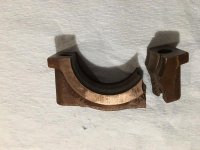
I would really be interested in seeing pics of the crack, from both sides of the cap. I hate to guess what could have caused it until I see where it happened.
 
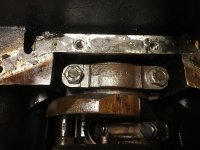
Here it is:
crack.jpg

from another perspective:
block.jpg

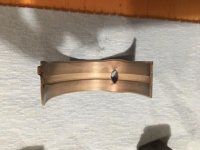
the bearing:
bearing.jpg


I'm going to get a quote from a machine shop or two to get an idea of how much the line bore will cost.

Also since I've worked so hard at breaking the bearing block I should reward myself by getting an engine hoist and stand.
 
I think the bearing insert pic says it all. Some FOD was on the crank when you were tightening the cap. Perhaps a bit of the old thrust bearing? Hopefully it was only soft metal material, so it didn't hurt the crank bearing surface. Be sure to spin the crank and look closely for corresponding damage. The good news...at least that means there is nothing inherently wrong with your block or original cap.
 
FOD?

I am thinking that it was oriented the wrong way round. It's not as evident in the photo but the side of the bearing is flattened out. When I put the new bearing on I checked and cleaned the surfaces to make sure there wasn't any dirt or what not. Also when inserting the new upper bearing around the crank it was difficult to do, I had to wiggle it about a lot. Maybe there was something in there, but the old upper bearing didn't look like it had fallen apart.
 
I'm going to ask something and please don't think I am an idiot (or you may think so, but spare me hearing it):

I look at that break and wonder:

attachment.php


Could JBWeld save that part?

Intuitively it seems that the mains are under much less stress than the connecting rods -- in fact I think the idea is that with good oil pressure the crank is not touching the bearing surface.

I think there is some 'whipping' or whatever you call it at certain high RPMs so maybe those forces rule out such a ghetto repair... but thought I'd bring it up.
 
Geo, I don't think you're an idiot, not at all but ask yourself, would you put an engine together with a JB welded main bearing cap? I don't think you would and I sure as heck would not. Beyond that I doubt that with JB weld you could maintain any tolerances. Too much risk, what's that noise? Is that the cap I glued together or worse was that big bang I just experienced because of the cap I glued together? Why did I do that? Also as he mentioned it's the cap with the thrust washers so it's resisting the clutch pressure every time the gears get shifted.
 
In truth JB WELD is really as Jerry calls it GLUE. It is not a weld. Keep that in mind when using it.
Charley
 
FOD?

I am thinking that it was oriented the wrong way round. It's not as evident in the photo but the side of the bearing is flattened out. When I put the new bearing on I checked and cleaned the surfaces to make sure there wasn't any dirt or what not. Also when inserting the new upper bearing around the crank it was difficult to do, I had to wiggle it about a lot. Maybe there was something in there, but the old upper bearing didn't look like it had fallen apart.

Foreign Object Debris. Something really squished that bearing insert at one spot. There had to be debris in there to do that. The debris lifted the cap slightly off the crank, and then the bolt placed a teeter totter action over the debris spot. Sorta like when you snap a stick over your knee to get leverage. The debris would be your knee.
 
Foreign Object Debris. Something really squished that bearing insert at one spot. There had to be debris in there to do that. The debris lifted the cap slightly off the crank, and then the bolt placed a teeter totter action over the debris spot. Sorta like when you snap a stick over your knee to get leverage. The debris would be your knee.

Thanks for the explanation.

I'm going to try and get a couple of quotes for the line bore. I'll post back here with the quotes. If not too expensive I'm leaning towards keeping my block if there is no other damage and getting it machined, as I know where it's been the last 23 years, and it has been solid till now.
 
Back
Top