• Hi Guest!
    If you appreciate British Car Forum and our 25 years of supporting British car enthusiasts with technical and anicdotal information, collected from our thousands of great members, please support us with a low-cost subscription. You can become a supporting member for less than the dues of most car clubs.

    There are some perks with a member upgrade!
    **Upgrade Now**
    (PS: Subscribers don't see this gawd-aweful banner
Tips
Tips

TR2/3/3A Which way does the TR3 front crankshaft oil seal face?

AHS

Senior Member
Country flag
Offline
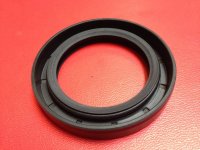
I've got a new front crankshaft oil seal but I'm not sure which way it should face. One side is a tight fitting sealing ring, wrapped with a tensioning spring, while the other side is a very loose fitting wiper that barely touches the pulley surface.

Unfortunately the original one was of a very different design and isn't any help. Does anyone have definitive info on this?

Thanks,
Andy
 
The side with the spring goes inside.
 
Make SURE that you lube around the 'wiper' sealing surface before installing the TC cover on the crank. Also use a gentle twisting motion (vs pushing straight on the crank) as you install the TC cover to prevent damage to the seal.

btw - the spring/open side of the seal always faces the fluid on seals like this.
 
Thanks guys. All the other information I have agrees with you both, though none of it is specific to Triumph. The SKF seal handbook makes the same recommendation. The odd thing about this is that the side with the flat metal front surface of the seal will need to press against the inside metal surface of the timing cover, meaning I need to press against the thin metal ring on the back of the seal. I'll use a flat plate in a press to avoid damage.

I think what has me unsure is other cars are made differently - I dug out a small block Chevy timing cover, and the seal presses in from the outside, so it can easily be installed by pressing against the front metal face of the seal. I've also found a picture of a Sprite seal as installed in a Haynes book, and it was clearly pressed in from behind on the thin rim. The timing cover & seal design are the same as Triumph (installed from the inside), so everything agrees.
 
Yes, it's important that you use something that presses against the outside edge of the seal. The original seals were made differently (remember this was a 1940's engine), literally used leather as the sealing surface; but no one makes them like that any more (thank goodness).

Since the seal doesn't touch the crank, you can just worry about getting the timing chain tensioner in place while installing the cover. Also don't forget the fiber washer that goes on the support post. Without it, you'll have a small leak there. It doesn't seem to be in the gasket sets, so I cut off a corner of an otherwise unused H4 carb gasket. When you install the hub, give the sealing surface a coat of grease If you can't polish out the mark from the old seal, you might want to consider a Speedi-sleeve.
 
The job's done, thanks for the help. I used the old fiber washer on the inside with a new one on the outside and a little permatex, hopefully that will keep the oil puddles to a minimum. The old pulley did have a groove, but I have another in perfect shape that doesn't need a sleeve. The first coat of engine paint is now drying!
 
Its not done till the speedy sleeve is installed on the pulleys flange.Critical detail !!
You will very quickly spend more than the cost of the speedy sleeve in lost motor oil
at 3.50$ a qrt. Randall was spot on here. even if it looks perfect sleeve it to make sure.
MD(mad dog)
 
I found this older thread that I have a question about , as I am re-sealing my timing cover, etc.


I've got a new front crankshaft oil seal but I'm not sure which way it should face. One side is a tight fitting sealing ring, wrapped with a tensioning spring, while the other side is a very loose fitting wiper that barely touches the pulley surface.

Unfortunately the original one was of a very different design and isn't any help. Does anyone have definitive info on this?

Thanks,
Andy

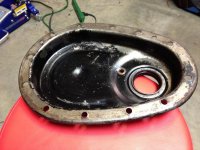
I am in the exact same place Andy was in 3/2013. ( installing the newer, different design oil seal), however I need advice on removing the old metal flange type oil seal.
I don't want to tear anything up I might need.

i'm tempted to just pry it out, but I would appreciate input, from those who know.

Thx!
 

Attachments

  • image.jpg
    image.jpg
    68.5 KB · Views: 208
  • image.jpg
    image.jpg
    65.2 KB · Views: 163
Well then just pry it out, and if that does not work ,flip it over and knock it out with a hammer and screw driver.
 
Back
Top