

-
 Hey Guest!
British Car Forum has been supporting enthusiasts for over 25 years by providing a great place to share our love for British cars. You can support our efforts by upgrading your membership for less than the dues of most car clubs. There are some perks with a member upgrade!**Upgrade Now**
(PS: Upgraded members don't see this banner, nor will you see the Google ads that appear on the site.)
You are using an out of date browser. It may not display this or other websites correctly.
You should upgrade or use an alternative browser.
You should upgrade or use an alternative browser.
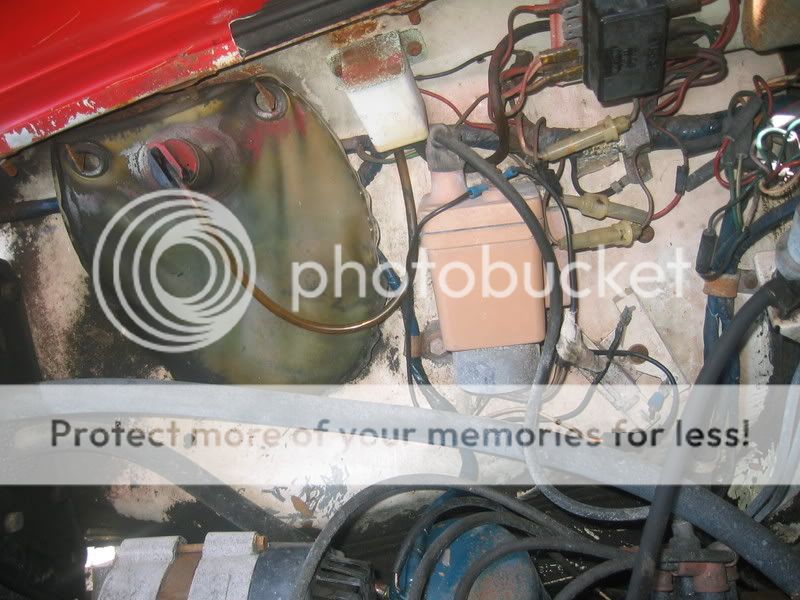
What in the world is this setup?
- Thread starter vping
- Start date


Offline
The hot water bottle or the potato salad container? /bcforum/images/%%GRAEMLIN_URL%%/jester.gif


19_again
Jedi Warrior
Offline
Hey Doc, when soldering connectors do you just use regular solder? Special electrical composition? I think I'll start doing that, got a new harnes coming in from BritishMCEE (probably in about three years at the rate they're shipping them!)and would like to elimninate all the Lucas gremlins I can.

rick_ingram
Yoda
Offline
Yep...factory fluid reservoir for the windscreen washer fluid.

Offline
Yup. standard rosin core solder. Tin the wire end ahead of time, place the bullet end on the wire and heat the connector from the side. 'Feed' solder into it from the tip. Takes longer to type than to do most times. Thinner solder is best. Vermicelli thin, at least.
OP

vping
Yoda
Offline
I know what the washer bottle is you sillies!
It's the beige square box Coil & the white porceline electrical bars on the inner fender that are in question. I've got a spare coil and will install this back to it's original condition.
So far the electrical "seems" ok. Some lights do not work but I have to check some of the bulbs. Horn, wipers, hazzards, and radio work. Signals do not and I do not hear the fuel pump.
It's the beige square box Coil & the white porceline electrical bars on the inner fender that are in question. I've got a spare coil and will install this back to it's original condition.
So far the electrical "seems" ok. Some lights do not work but I have to check some of the bulbs. Horn, wipers, hazzards, and radio work. Signals do not and I do not hear the fuel pump.
R
RonMacPherson
Guest
Guest
Offline
Hey Doc,
Did you used to work at MB assembly plant back in the mid 70's?
Reason I ask was we were getting a number of 117's in the field with about 20K miles on them that were losing continuity on their soldered connections. We had several factory engineers come out and engage in extensive forensic diagnosis on the wiring harnesses.
The common term for this malady was "cold solder joint".
It was traced down to the wiring harness assemblers(solderers) using non electrical solder. So I would urge you to do a little research on this, you may want to upgrade your response.
I believe you'll find that all electrical carrying connections should use silver solder.
Did you used to work at MB assembly plant back in the mid 70's?
Reason I ask was we were getting a number of 117's in the field with about 20K miles on them that were losing continuity on their soldered connections. We had several factory engineers come out and engage in extensive forensic diagnosis on the wiring harnesses.
The common term for this malady was "cold solder joint".
It was traced down to the wiring harness assemblers(solderers) using non electrical solder. So I would urge you to do a little research on this, you may want to upgrade your response.
I believe you'll find that all electrical carrying connections should use silver solder.
19_again
Jedi Warrior
Offline
Ron, I stopped in at Home Depot to pick up some tiki torch fuel and while I was there I checked out the solder and saw the electrical solder and that's what I picked up. My primary reason for picking it up was that it was the size Doc recommended, vermicelli, or was it elbow? Anyway I just figured it made sense to pick up the electrical solder, so it's easy enough to find. I sell electronic equipment and we commonly have what our engineering guys call cold solder problems. I just figured it was the old "reverse angled t-extender" line of bull that they are known for. Nice to know thee really is such a thing as cold solder problem.

David_DuBois
Jedi Warrior
Offline
Cold solder joints are a common problem. They are the result of insufficient heat on the joint to ge proper solder flow. It is not sufficient to just melt the solder, the wires themselves have to be hot enough that the solder flows over them and into each strand. Silver bearing solder is not necessary for electrical soldering, just plain old eutetic solder (37/63 tin/lead) is the solder of preferance. There are numerous other types of bad solder joints, including fractured joint (moving the leads before the solder solidifies), rosen joint (held together just by the rosen from the core), dirt and othe foreign material in the joint, etc. Acheving a really good solder joint is not as simple as just sticking som solder tothe tip of a hot iron in the vacinity of the wires.
Cheers,
Cheers,
Offline
No MB factory experience; mine was all Porsche. No cold solder joints either, Ron. I ~assumed~ since the topic was ELECTRICAL in nature the solder chosen WOULD be for electrical work, not sweating copper pipe. I also said -tin the wire first-. Doing the work the way I described it will result in a good joint.
Just to pick a nit or two: "silver solder" would be problematic for the wiring we're discussing, as the temperatures needed would result in a lot of melted insulation.
I have at my side two spools of solder, the same as I've been using for these automotive jobs (along with electronic circuitry: vacuum tube thru transistor to solid state) for over forty years: Ersin "Multicore solders LTD., Hemel, Hempstead, England." 7lb. spool of 20 Ga. and a 1 lb. spool of 22 Ga. I made no implication making a good solder joint was: "...as simple as just sticking som solder tothe tip of a hot iron in the vacinity of the wires." If I'd thought a tretise on "Proper Soldering Techniques for Electrical/Electronic Wiring" were called for, I'd have referred 19_again to Google.
/bcforum/images/%%GRAEMLIN_URL%%/mad.gif
Just to pick a nit or two: "silver solder" would be problematic for the wiring we're discussing, as the temperatures needed would result in a lot of melted insulation.
Dave said:(37/63 tin/lead) is the solder of preferance. There are numerous other types of bad solder joints, including fractured joint (moving the leads before the solder solidifies), rosen joint (held together just by the rosen from the core), dirt and othe foreign material in the joint, etc. Acheving a really good solder joint is not as simple as just sticking som solder tothe tip of a hot iron in the vacinity of the wires.
I have at my side two spools of solder, the same as I've been using for these automotive jobs (along with electronic circuitry: vacuum tube thru transistor to solid state) for over forty years: Ersin "Multicore solders LTD., Hemel, Hempstead, England." 7lb. spool of 20 Ga. and a 1 lb. spool of 22 Ga. I made no implication making a good solder joint was: "...as simple as just sticking som solder tothe tip of a hot iron in the vacinity of the wires." If I'd thought a tretise on "Proper Soldering Techniques for Electrical/Electronic Wiring" were called for, I'd have referred 19_again to Google.
/bcforum/images/%%GRAEMLIN_URL%%/mad.gif

Offline
Reminds me of another life very long ago at Lockheed Missiles & Space Division. All new shop employees were required to attend, pass, & be certified at a "solder school".DrEntropy said:I made no implication making a good solder joint was: "...as simple as just sticking some solder to the tip of a hot iron in the vicinity of the wires." If I'd thought a tretise on "Proper Soldering Techniques for Electrical/Electronic Wiring" were called for, I'd have referred 19_again to Google.
/bcforum/images/%%GRAEMLIN_URL%%/mad.gif
Much of the missile assemblies had multi pin electrical connectors. Each pin was soldered to a wire end. The pins had "solder cups" for the wires. A carefully stripped wire end, no nicks, was inserted into the cup. A resistance soldering "unit" which looked like tweezers with needle tips was clamped over the solder cup & an adjustable current passed through the cup. When the cup was considered to be the correct temperature a bit of 60/40 rosin core solder was applied to the joint & filled the cup. Heat maintained only long enough to get a perfect joint.
Each row of soldered pins was inspected & marked if acceptable by an inspector. The objective was a bright, fully filled joint, with no solder on the outside of the pin & most importantly, no solder creep up the wire strands above the joint which would make the wire brittle above the pins. A perceptible insulation gap above the connection allowed solder creep to be observed.
The completed wiring & various component assemblies were subjected a rigorous vibration test on a "shaker table" to further verify that things were able to stay intact under the very severe vibration & "G" forces encountered in a misile launch.
Later on, crimped connections with no solder were used. I believe that crimped connections are still used in aircraft & considered to be superior to soldered connections for reliability. (Maintaining a good vibration resistant connection). Solder creep destroys the needed flexibility in the wire.
Newer automotive electrical connections are also crimped only. Not just to save labor costs but to improve reliability.
Some folks crimp LBC pins, others solder them, & a few do both. IMO, a properly crimped connection - Pin ID properly sized to the wire, & with the correct amount of crimp, is only degraded by soldering. A pin designed for crimping & fastened with a ratcheting crimper that is calibrated to apply the proper pressure & not release until the crimp is fully made, is all that is needed. Bullets designed for crimping come in specific internal sizes the match the intended wire size.
Further "insurance" by also soldering the crimped connection is likely to cause solder creep up the wire strands which degrades the wire flexibility & vibration resistance.
Then again, we're not driving rockets, so wire nuts may even work.
D
Offline
Twisting them together and taping will "work".
I know the argument for crimp vs. solder. My EE buds and I get into it all the time. /bcforum/images/%%GRAEMLIN_URL%%/wink.gif
My rationale for soldering Lucas' Lucar ends is mostly:
A) "Because THEY did it that way!"
B) It withstood forty+ years of LBC shake, rattle and roll (unless it's been 'fussed with').
C) It ain't aircraft. /bcforum/images/%%GRAEMLIN_URL%%/wink.gif
I HAVE the Variac, soldering guns and "pencils", along with a lifetime supply of solder and bullet connectors. Crimp tools and specific bullet fasteners would mean a whole new bunch of $$. bah. No need for me to re-invent the wheel to get the lights to work.
EDIT: HEY VINNIE!?! Ya get that coil R&R'd yet? /bcforum/images/%%GRAEMLIN_URL%%/devilgrin.gif
I know the argument for crimp vs. solder. My EE buds and I get into it all the time. /bcforum/images/%%GRAEMLIN_URL%%/wink.gif
My rationale for soldering Lucas' Lucar ends is mostly:
A) "Because THEY did it that way!"
B) It withstood forty+ years of LBC shake, rattle and roll (unless it's been 'fussed with').
C) It ain't aircraft. /bcforum/images/%%GRAEMLIN_URL%%/wink.gif
I HAVE the Variac, soldering guns and "pencils", along with a lifetime supply of solder and bullet connectors. Crimp tools and specific bullet fasteners would mean a whole new bunch of $$. bah. No need for me to re-invent the wheel to get the lights to work.
EDIT: HEY VINNIE!?! Ya get that coil R&R'd yet? /bcforum/images/%%GRAEMLIN_URL%%/devilgrin.gif
OP
vping
Yoda
Offline
Not yet. I got the brakes all freed up though and the rotors are not that bad. Sorry Tony. Wheels spin awful nice and the few crap tires I was able to scrounge up now all hold air. I did a lot of cleaning and inspecting and a lot of wiring fault diagnosis. I think it is either dirty connectors or bad bulbs.
An MG friend of mine has the tune up parts and might have a pertronix. If I go to pertronix I might keep one of my spare dizzies ina trunk for "in case of". He's gonna come over and help get her running. Until then there is more cleaning and fluid changes to do.
An MG friend of mine has the tune up parts and might have a pertronix. If I go to pertronix I might keep one of my spare dizzies ina trunk for "in case of". He's gonna come over and help get her running. Until then there is more cleaning and fluid changes to do.