

-
 Hey Guest!
British Car Forum has been supporting enthusiasts for over 25 years by providing a great place to share our love for British cars. You can support our efforts by upgrading your membership for less than the dues of most car clubs. There are some perks with a member upgrade!**Upgrade Now**
(PS: Upgraded members don't see this banner, nor will you see the Google ads that appear on the site.)
You are using an out of date browser. It may not display this or other websites correctly.
You should upgrade or use an alternative browser.
You should upgrade or use an alternative browser.
water in fuel?
- Thread starter NutmegCT
- Start date


Offline
The water will be in the bottom of the tank - does it have a drain? Can you run a hose to the bottom and siphon it to see what comes out?

SilentUnicorn
Yoda
Offline
are you talking about Budweiser again?:highly_amused:
OP

Offline
The water will be in the bottom of the tank - does it have a drain? Can you run a hose to the bottom and siphon it to see what comes out?
That's a great idea. Siphon from the bottom. There a drain plug - but it's a pain to open (what else is new?).
If there's water in the sample - then I move to the Budweiser.
Thanks!
Tom

Offline
In general aviation aircraft, there is a small push-up valve in the bottom of each wing; during the pre-flight you push up on the valve and obtain a small sample. Since as JP says, the water is at the bottom you will see it in the sample cup.
In your case it will be a little harder to obtain the sample but it can be done.
In your case it will be a little harder to obtain the sample but it can be done.
D
Deleted member 8987
Guest
Guest
Offline
Disconnect the line at the carb, put the line into a glass container. Crank it until you get 2-3". You may have all water, and not see a dividing line.
Have a friend who had that happen in Colombia on a Helio. Indians out at the strip had siphoned all the gas out of the 55 gallon drums and refilled with water.
He did the check under the wings, no separation, 50 feet off the end of the strip it quit.
Smell it. Taste it by dabbing the tip of your finger into it and touching your tongue. If it does not smell explosive, and tastes like water, it probably is.
Pull the bottom jet on your carb, drain the float bowl, crank the engine enough to have something resembling petrol, then try it.
Have a friend who had that happen in Colombia on a Helio. Indians out at the strip had siphoned all the gas out of the 55 gallon drums and refilled with water.
He did the check under the wings, no separation, 50 feet off the end of the strip it quit.
Smell it. Taste it by dabbing the tip of your finger into it and touching your tongue. If it does not smell explosive, and tastes like water, it probably is.
Pull the bottom jet on your carb, drain the float bowl, crank the engine enough to have something resembling petrol, then try it.

AN5Sprite
Jedi Knight
Offline
Elliot - when I was taking flying lessons, I remember doing that drain-and-view test of the avgas during every pre-flight. With auto fuel, is it obvious what the water/fuel split looks like? I've googled for some examples, but none are very clear.
Tom
Methinks there won't be any separation IF the fuel is Gas/Ethanol. You'll have goo that looks like fat in water.

Banjo
Yoda
Offline
With the fuel sample in a clear jar, let it rest for a minute or two, and you will see clearish "bubbles", or, a stratified layer of liquid rolling around at the bottom. It will be seperated like italian dressing that has been sitting for a while. It will be quite obvious that there are two seperated substances in the jar. The fuel will look like foggy Budweiser, and the water will look like the fluid you drain out of a coconut, kinda clearish white
Outside of a contamination issue from the gas station,it's more of an issue in older cars and power equipment that have vented fuel systems. as the ethanol in the fuel will literally pull the moisture right out of the air.
Outside of a contamination issue from the gas station,it's more of an issue in older cars and power equipment that have vented fuel systems. as the ethanol in the fuel will literally pull the moisture right out of the air.
OP
Offline
...
Outside of a contamination issue from the gas station,it's more of an issue in older cars and power equipment that have vented fuel systems. as the ethanol in the fuel will literally pull the moisture right out of the air.
We're talking about my 1960 Mercedes-Benz. A *very* vented fuel system. And the fuel had been kept in a fuel can with a loosely fitting cap, in a very cold garage, in very damp winter weather. hmmmm
Thanks!
Tom


TR3driver
Great Pumpkin - R.I.P
Offline
Prezactly. Note that the "water" is actually a water/ethanol mix, and is likely still mostly ethanol (over 100 proof but I sure wouldn't want to drink it). Depending on how much dirt and/or dye is present, it may be other colors than off-white.With the fuel sample in a clear jar, let it rest for a minute or two, and you will see clearish "bubbles", or, a stratified layer of liquid rolling around at the bottom. It will be seperated like italian dressing that has been sitting for a while. It will be quite obvious that there are two seperated substances in the jar. The fuel will look like foggy Budweiser, and the water will look like the fluid you drain out of a coconut, kinda clearish white
Outside of a contamination issue from the gas station,it's more of an issue in older cars and power equipment that have vented fuel systems. as the ethanol in the fuel will literally pull the moisture right out of the air.
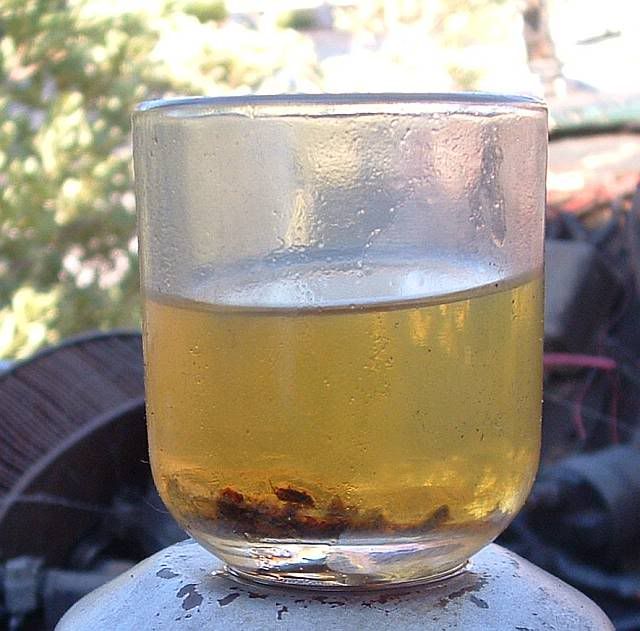
Here's a shot of what came out of my TR3A after it had been sitting for a few years. It's hard to see the separation mixed in with the crud, but it's there.

TR3driver
Great Pumpkin - R.I.P
Offline
I'm not sure how Stabil works; but the gas line antifreeze is mostly methanol (aka wood alcohol). It works by keeping the water in solution so it can't freeze and block the line. The small amount of water and alcohol mix together with the gasoline and get burned harmlessly.Do Stabil and gas line antifreeze actually somehow eliminate the water which came from humid air?
Ethanol would actually do the same thing, but there is a limit to how much water it can cause to be absorbed. With too much water, the water and ethanol separate from the gasoline. The water/ethanol mix will burn (I once drove my TR3A around town on a gallon of denatured alcohol, which is about 5% water), but requires a much richer mixture than usual.

Offline
Stabil Blue, Marine version, was designed mostly for boats, as they are very prone to fuel contamination from water, plus it supposedly counter acts the damaging effect of Ethanol on fiberglass and rubber components. Ethanol will eat/soften fiberglass fuel tanks. You don't want that happening in a boat! I use it in all my old gas engine stuff. PJ