

-
 Hey Guest!
British Car Forum has been supporting enthusiasts for over 25 years by providing a great place to share our love for British cars. You can support our efforts by upgrading your membership for less than the dues of most car clubs. There are some perks with a member upgrade!**Upgrade Now**
(PS: Upgraded members don't see this banner, nor will you see the Google ads that appear on the site.)
You are using an out of date browser. It may not display this or other websites correctly.
You should upgrade or use an alternative browser.
You should upgrade or use an alternative browser.
TR6 TR6 Questions
- Thread starter oxendine
- Start date

M_Pied_Lourd
Darth Vader
Offline
To replace the side seals in the diff you will need a press to separate the flanges and a shop that has the proper equipment so as not to bend or distort the flanges. The bang when the come apart is shocking. To replace the front seal, I believe there is a crushable spacer in there to set the pre-load...I haven't done this yet so others will have to coach you on this. I have read a good write up on how to do it including counting the number of turns of the nut when loosening to allow you to put it back on the same way....
To replace the door check straps you need to drill out the rivets to remove the retainer spring that will slide off the front of the strap. The unit is them removed through the back of the A post. I found the new ones quite difficult to get back in. Instead of using the rivets on the new ones, I used a couple of ss set screws and lock washers.
Cheers,
M. Pied Lourd
To replace the door check straps you need to drill out the rivets to remove the retainer spring that will slide off the front of the strap. The unit is them removed through the back of the A post. I found the new ones quite difficult to get back in. Instead of using the rivets on the new ones, I used a couple of ss set screws and lock washers.
Cheers,
M. Pied Lourd

TR6BobNF
Jedi Hopeful
Offline
Not to question Dave, who's probably done the job and I agree that you would follow his instruction to replace both the seals and the bearings, because I have researched that and that is the advice I got on my other forum, from the Haynes adn the workshop manual. But I understood that to replace the seals only you would not have to remove (press out) the bearings, just use a seal puller or something suitable to pry out the old seals and pop in the new ones. I just got an e-mail from a forum buddy advising me to proceed this way and I am about to tackle the job myself if I could just get the old diff degreased and ready to work on, maybe this weekend. If the seals are in plain view when the inner side axles are removed it may be possible to remove them at that point. I also have to replace the front pinion seal and hope it will work the same as anticipated. According to the TRF Bluebook, when working on the front pinion shank bearing, the oil seal is encountered first, so it may be possible to remove it without disturbing the bearing. Again, I may be wrong and Dave has given the definitive answer. If you're not in a hurry Donnie I will probably be able to post results this weekend.


Online
I replaced the pinion seal on my diff a few months ago. The original seal is leather and will leak due to its age.
One word of caution.... use a seal puller to remove the old seal. Don't be tempted to use a screw driver as you run the risk of scoring the wall.
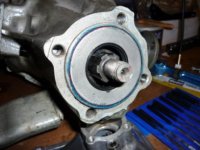
Here's my new seal installed...
One word of caution.... use a seal puller to remove the old seal. Don't be tempted to use a screw driver as you run the risk of scoring the wall.
Here's my new seal installed...
Attachments

TR3driver
Great Pumpkin - R.I.P
Offline
For the pinion seal, it depends on which differential you have. On the early diffs with the fixed spacer, you don't need to worry about the bearings at all. Just remove the flange (tapping gently with a mallet if necessary), change the seal, and torque the nut back to spec.
But the later diffs use a one-time collapsible spacer inside, which the books claims must be replaced every time. Usually, however, you can squeak by without changing it. The trick is to mark the position of the nut relative to the shaft, then put it back exactly where it was (rather than checking torque or preload).
But as Pied says, to replace the side seals, you have to pull (or press) the flanges off of the stub shafts. It seems to vary how hard that is, the ones on my Stag (which are identical to the TR6) came apart in the press with no drama at all.
Whether to replace the side bearings or not depends on their condition, IMO. If they show any signs of roughness or wear, I'd replace them. But if they still feel like new, then you know you've got good bearings (while new ones are sometimes questionable), so I'd leave them in there.
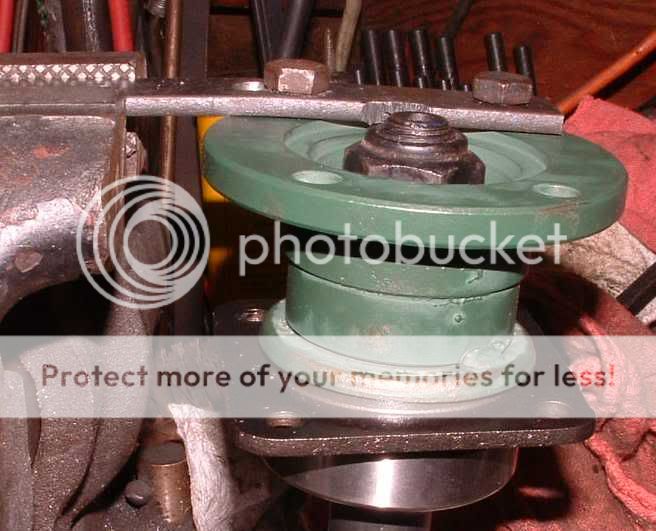
BTW, it takes a lot of torque to remove and replace those big nuts. A simple bar of steel drilled to fit over a pair of bolts makes the job a lot easier.
Normally, Nyloc nuts should be replaced every time as they lose their holding power. But if you have a collapsible spacer, you'll have to reuse the nut. If it seems to turn easy, you can lay the nut on a hard surface and gently tap the nyloc side with a hammer, to spread the nylon out a bit more.
But the later diffs use a one-time collapsible spacer inside, which the books claims must be replaced every time. Usually, however, you can squeak by without changing it. The trick is to mark the position of the nut relative to the shaft, then put it back exactly where it was (rather than checking torque or preload).
But as Pied says, to replace the side seals, you have to pull (or press) the flanges off of the stub shafts. It seems to vary how hard that is, the ones on my Stag (which are identical to the TR6) came apart in the press with no drama at all.
Whether to replace the side bearings or not depends on their condition, IMO. If they show any signs of roughness or wear, I'd replace them. But if they still feel like new, then you know you've got good bearings (while new ones are sometimes questionable), so I'd leave them in there.
BTW, it takes a lot of torque to remove and replace those big nuts. A simple bar of steel drilled to fit over a pair of bolts makes the job a lot easier.
Normally, Nyloc nuts should be replaced every time as they lose their holding power. But if you have a collapsible spacer, you'll have to reuse the nut. If it seems to turn easy, you can lay the nut on a hard surface and gently tap the nyloc side with a hammer, to spread the nylon out a bit more.
TR6BobNF
Jedi Hopeful
Offline
Regarding previous posts, Dave is entirely correct above. It is definitely necessary to pull the bearings to get at the side axle oil seals. I finally got my diff degreased and disassembled today and the bearings have to come out first to get at the side axle seals. On the front pinion, once the oil seal was removed (with a proper puller as somebody indicated) and the diff was tipped into the tub I was using to contain gear oil, the bearing fell right out, along with the large spacer (early unit) between the pinion head bearing and the pinion shank (forward) bearing and all the very thin shims. There was some play in the pinion shank bearing so it will definitely be replaced. The side axle bearings seem just fine and they are Timkens but since my new ones are Timken also I will just put the new ones in. On my other diff, there are three threads showing on the pinion shaft with the castle nut in place but on this one there was only one thread showing. It seems somebody used a bunch of shims here. I'll have to dig through the gear oil tomorrow to see exactly how many there are but I'm leery about reducing the number of shims. I think I'll just reinstall it as I found it as the diff was not making noise, just leaking like a wicker basket.