
• Hey Guest!
    British Car Forum has been supporting enthusiasts for over 25 years by providing a great place to share our love for British cars. You can support our efforts by upgrading your membership for less than the dues of most car clubs. There are some perks with a member upgrade!

    **Upgrade Now**
    (PS: Upgraded members don't see this banner, nor will you see the Google ads that appear on the site.)
Tips
Tips

TR4/4A TR4A front suspension quesions

Popeye

Obi Wan
Silver
Country flag
Offline
First, a big "THANK YOU" to the many folks who have posted on this forum. I am rebuilding the front suspension on my TR4A, and have been relying heavily on searches of the vast quantities of data in The British Car Forum. Thank you!!!

A few questions to which I could not find answers to:

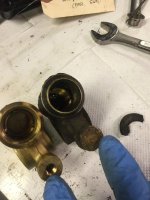
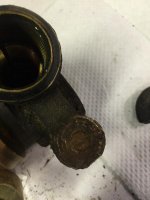
1. Lower tunnions. What is the small threaded hole / bolt for? It appears to be a blind hole, but I suspect I am overlooking something. On my old trunnion, a bolt in the hole seems to have been sheared off. Per the workshop manual, there is also a distance piece that is missing from the original. See attached photo.

2. Lower A-arm / wishbone assembly: the two wishbones and trunnion are secured with a bolt. Do I need to ream the metal spacers to size? The bolt diameter is larger than the bushings, albeit not much. I did not try to force the parts together.

3. Stub axle: How to remove it? As part of my rebuild, I am installing the uprated axle kit. The instructions say to use a big hammer to remove the old axle. "Hard" is explicitly stated! I removed the nylock nut, and beat the shaft end with a 3# sledge, but no luck. (I also tried the trick of hitting the side of the housing - this worked for the taper on the ball joints and tie rod ends.) Do I just need to hit harder? Or is this a task for a hydraulic press? Randall made mention of applying tension to the axle (via a set of sockets and a nut on the end) while hitting with a hammer (https://www.britishcarforum.com/bcf/showthread.php?86184-TR6-Heavy-duty-front-Stub-axles); I have not tried that yet. Heat? Does PB Blaster help with tapered joints?
IMG_8276.jpg IMG_8277.jpg
 
That (should be) the steering stop. The piece under the bolt head is drilled off-center, making the stop adjustable.
 
That bolt does need to pass thru so some work may be required and in two kits I had that issue only on one spacer. I recall just slightly working it. Also, when I looked at my stub axle I decided to keep it rather than remove and replace. It just seemed like new and, like you, I was told of the work and force to remove it, and in my case I chickened out. It's been there another 10 years.
 
Thanks for the replies.

The steering stop is still available, albeit for a TR6, and non-adjustable (i.e. hole is drilled on-center). How important is adjustment? (It looks like a part I can easily make, but for $4, the time may not be worth it.)

Regarding reaming the bushings, I spoke to TRF, and they tell me I need to ream the bushings to 5/8. I just bought a hand reamer from DrillsandCutters.com (no affiliation / recommendation) for a tick less than $40, including shipped handling charges. https://drillsandcutters.com/5-8-hss-straight-flute-hand-reamer/
 
The only question left seems to be the stub axles. The problem with hammering is that tends to compress the metal, making it thicker as you are trying to free it. A press will do the job quickly. Or, try adding a touch of heat just to the link (not the axle) right before tapping it.
 
Thanks for the replies.

The steering stop is still available, albeit for a TR6, and non-adjustable (i.e. hole is drilled on-center). How important is adjustment? (It looks like a part I can easily make, but for $4, the time may not be worth it.)

Regarding reaming the bushings, I spoke to TRF, and they tell me I need to ream the bushings to 5/8. I just bought a hand reamer from DrillsandCutters.com (no affiliation / recommendation) for a tick less than $40, including shipped handling charges. https://drillsandcutters.com/5-8-hss-straight-flute-hand-reamer/

Very difficult to get a precision fit with a hand reamer.I think having an automotive machine shop hone to size would get a better fit and probably cheaper than buying a reamer.
Tom
 
I've heard of reaming the TR4 and earlier bushings, but never the 4A-6.
 
+1 on only reaming for TR2-4. But IMO a reamer is the right tool to use, don't want to use a hone in there because the abrasive particles will embed in the brass and cause rapid wear. Properly used, a good reamer (not the cheap adjustables) can get within .0001", which is plenty close enough. You can also use a much cheaper "chucking" reamer (I used the bench vise as a chuck and turned the arm around it). Reamer was only about $15, but that was a few years back.

Looks like I was mistaken, the stop is only adjustable on TR2-4. Only time I've ever needed to adjust it was on my TR3A with the front sway bar and wide tires, so they wouldn't rub the bar. But I'll bet you could use the 101407 adjustable stop if you wanted to.
 
I've heard of reaming the TR4 and earlier bushings, but never the 4A-6.

Agree, never heard of this on a 4A thru 6

The internet correlates this on various blogs, threads and discussions. TRF told me the bushings are a tiny bit undersize, and implied that it makes no sense why. The bolt has a nice slip fit through the brass trunnion. But there is no way it will go through the metal sleeve of the wishbone bushing without a lot of force.

I found I can make a simple stub axle puller with 1.5" diameter black pipe and a stack of washers (starting with 3/4") and the nut on the end of the axle. I hope to get to this on Wednesday evening, and will advise how things go.
 
+1 on only reaming for TR2-4. But IMO a reamer is the right tool to use, don't want to use a hone in there because the abrasive particles will embed in the brass and cause rapid wear. Properly used, a good reamer (not the cheap adjustables) can get within .0001", which is plenty close enough. You can also use a much cheaper "chucking" reamer (I used the bench vise as a chuck and turned the arm around it). Reamer was only about $15, but that was a few years back.

Looks like I was mistaken, the stop is only adjustable on TR2-4. Only time I've ever needed to adjust it was on my TR3A with the front sway bar and wide tires, so they wouldn't rub the bar. But I'll bet you could use the 101407 adjustable stop if you wanted to.

Hey Randall,The problem with hand reamers is the hand part and you get what you get which is why I think a precise fit is difficult.But my experience is more with motor building where the tolerances are more important than suspension parts.Honing brass bushings ,like connecting rod upper bushing to wrist pin is the standard method.If a motor builder says hes going to ream your upper rod bushings to fit the wrist pins ,or to get a thumb press fit for wrist pins to alum. pistons, run away.

Also I like adjustable reamers ,which I use for throttle shaft bushings,Linkert not Su, because they are adjustable and you can "fit " the piece.
Did you add an extra zero to pretty close?
Have Fun
Tom
 
An update: I successfully removed the front stub axle (passenger side). I made a puller using a short section of 1.5" black iron pipe, plus a stack of 3/4 inch washers to make up the proper height, followed by a smaller washer, and then the castle nut on the axle. I used a 3" pipe nipple plus washers instead of cutting the pipe to size, as my cut would not be as square as the factory cut. I torqued down the castle nut decently tight (guessing 30-40 ft-lb), then hit the opposite end with a BFH, and the axle popped right out.

On the lower wishbone bushings, I bought the wrong reamer. A 9/16" reamer is needed, not the 5/8 that I bought... should have measured before buying!! I ordered a new one, and hope to finish the job next week.
 
An update: I successfully removed the front stub axle (passenger side). I made a puller using a short section of 1.5" black iron pipe, plus a stack of 3/4 inch washers to make up the proper height, followed by a smaller washer, and then the castle nut on the axle. I used a 3" pipe nipple plus washers instead of cutting the pipe to size, as my cut would not be as square as the factory cut. I torqued down the castle nut decently tight (guessing 30-40 ft-lb), then hit the opposite end with a BFH, and the axle popped right out.

On the lower wishbone bushings, I bought the wrong reamer. A 9/16" reamer is needed, not the 5/8 that I bought... should have measured before buying!! I ordered a new one, and hope to finish the job next week.

Excellent idea on the axle. Pulling tends to contract the axle, whereas pressing and hammering from the back side tends to expand it. I'll have to remember your trick next time. Most come out easily with a press, but the occasional odd axle doesn't want to budge...likely overtightened by an overzealous PO.

Hope you caught the reamer before you oversized the bushings?!?
 
Hope you caught the reamer before you oversized the bushings?!?

:welcoming: Yes; on occasion I get lucky and my brain thinks before the body acts! I will return the untouched reamer.
 
An update:. . . On the lower wishbone bushings, I bought the wrong reamer. A 9/16" reamer is needed, not the 5/8 that I bought... should have measured before buying!! I ordered a new one, and hope to finish the job next week.

Are you talking about the outer lower bushing where the long bolt goes thru, or the rear ones against the frame?
 
For my TR4A extensive forum research led me to just do whatever is done on a TR6. I seem to recall 45 foot pounds. I think I called Moss, too. The consensus was not to follow the TR4 spec.

My internet searching comes to the same conclusion.
 
Just an update, to close the loop. (I've been on vacation for the past two weeks, and celebrated my wife's milestone birthday the week before, so I've not worked on the car for a while.)

I ended up not reaming the bushings. It was very difficult to clamp the thin metal walled bushings without deforming them. The best I could do was to wrap the bushing with rubber and a pair of hose clamps - but even that was awkward at best (i.e. the bushing would spin while trying to ream if I applied too much pressure on the reamer). (How does a machine shop grip the tubing-like bushings??)

The bushing ID was .004-0 inches smaller than the bolt diameter. (I believe the variation in measurement, 0-.004, is due to operator error coupled with a cheap caliper when measuring the bushing ID at various spots. The parts seemed consistent.)

In the interest of not buggering up the smooth walls of the metal bushing, and going with the assumption that metal on poly sliding is better than metal on metal (i.e. better for the bushing and poly bushing to slide, vs. the metal bushing and the bolt), I pressed the metal sleeves on the bolt.

Hope this works out in the long run!

Again, many thanks for all the contributors and assistance!!
 
Back
Top