• Hi Guest!
    If you appreciate British Car Forum and our 25 years of supporting British car enthusiasts with technical and anicdotal information, collected from our thousands of great members, please support us with a low-cost subscription. You can become a supporting member for less than the dues of most car clubs.

    There are some perks with a member upgrade!
    **Upgrade Now**
    (PS: Subscribers don't see this gawd-aweful banner
Tips
Tips

General TR TR4 vs. TR250

TexasPaladin

Freshman Member
Offline
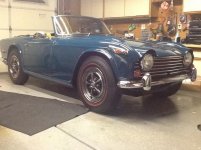
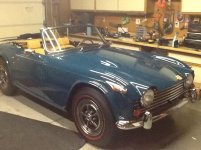
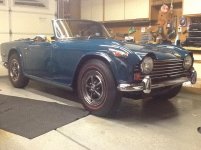
I'm trying to understand the differences in the 4 and the 250. The significant differences appear to be that the 250 is a straight-6 and has IRS, where the 4 is a 4-banger and has a live axle. But the 6 and the 4 make about the same amount of grunt, don't they? The hand brake levers are in different locations. The 250 has backup lights and turn signals on the fender/wing/quarterpanel but the interiors are almost interchangeable aren't they? Are the tubs and frames the same? The 250 has that bangin' stripe, but I like the Triumph badge on the hood of the 4. Is the IRS a plus in a 50-year-old car or are the added parts just more stuff to rattle around and make noise? I can see the difference in the 4 and 5 as the fuel-injected-5 had about 50% more horsepower when new, but the 4 and 250 .... It would seem logical that the 5/250 were constantly refined and represent the culmination of the 4, but maybe the company was focused more on the 6 and just building the 5/250 as an afterthought. Not trying to start any arguments, just looking for thoughtful interaction
 
It was all about being competitive with the MG. Building a car that a customer might select when it came down to a choice between the 2. The largest market was the USA so certain concession were made in regard to emission requirements in this country.
 
There are more smaller differences than you listed. You can't make a proper TR 250 from a TR4a tub w/o some major sheetmetal cutting. B posts door catches are different. Brake servo, etc. I once thought about trying it but after looking it all over I decided against. There are fewer 4A IRS cars than 250s. I like the 250 for the smoother running 6 cyl. The IRS mounts are different on the frames. I once bought a TR4A with a TR6 motor installed. Guy swore it was a TR250. The CTC plate still mounted on the bulkhead. The one year only car makes it a bit more collectible I guess. Bought one many years ago before they were popular for $500. It was a solid car. Have one just like it now but paid many times that for it and in not as good of shape. Some say the TR250 was made because BL ran out of 4 cyl engines and had the 6 cyls there . So not to waste the sheetmetal that was already produced they made the 250. Just one of many stories. Bottom line I like 250's better but a 4A is not far behind.

Marv
 
The 250's are so much cooler! But I am bias!

image.jpg
 

Attachments

  • image.jpg
    image.jpg
    99.2 KB · Views: 192
  • image.jpg
    image.jpg
    99.5 KB · Views: 318
Dan,

Jack and Carol Schmelyun stopped by today from Maryland on the way to AK show. Man, they have the best original looking 250 I've seen. It was perfect.

Marv
 
I think I saw a 4a with a 6 motor on ebay this week. Had a 250 stripe too.
 
The 250's are so much cooler! But I am bias!

View attachment 33294

Note from my grandmother: The 4 is better, more dependable, has a nicer, more classic dash, a far more dependable rear suspension, a less temperamental engine, and more simple classic lines, not to mention the nicer hood badge and the propensity to live a lot longer in many different parts of the world. I'm not sure, but she may be right.
 
Last edited:
Are we comparing a TR4 to a TR250? Or a 4A to a 250? The TR4 is basically a TR3 with updated sheet metal, still has a ladder frame under it. Simple, rugged and primitive. The 4A frame was completely redesigned (even for cars with the solid axle option). IMO the IRS makes a big improvement in ride quality, and isn't overly troublesome. But there is no way I'd trade my TR3 for anything short of a real TR5.

All three have front disc, rear drum as original. Only TR2 and early TR3 had front drums.
 
From personal experience a healthy TR4a will keep up with a TR250/6, but power delivery is quite different so in practice they drive differently. My TR4a is a bit more eager to turn-in as well.
 
Are we comparing a TR4 to a TR250? Or a 4A to a 250? The TR4 is basically a TR3 with updated sheet metal, still has a ladder frame under it. Simple, rugged and primitive. The 4A frame was completely redesigned (even for cars with the solid axle option). IMO the IRS makes a big improvement in ride quality, and isn't overly troublesome. But there is no way I'd trade my TR3 for anything short of a real TR5.

All three have front disc, rear drum as original. Only TR2 and early TR3 had front drums.

I'm just soaking up info from you guys and hoping to understand the differences in the 4/4A/5/250 models. I did not realize that the frames of the 4 and 4A were different. I knew about the change to IRS and I suppose it follows that the frames were remodeled but I didn't know they were completely redesigned. I appreciate your description of the 4 as (basically) a re-skinned 3, while the 4A (with IRS) is a significantly different vehicle. I think I would prefer a 5 for the 6-cyl and added HP, but they're scarce as hen's teeth, it seems. All the info is very helpful!
 
Last edited:
From personal experience a healthy TR4a will keep up with a TR250/6, but power delivery is quite different so in practice they drive differently. My TR4a is a bit more eager to turn-in as well.
I've noticed that during our club runs on mildly interesting roads (eg Santa Monica Mountains, Mulholland Highway, etc), it seems to be the IRS drivers that complain the pace is too fast, while the solid axles want to go faster :smile:

I've even had a TR6 owner comment that there was no way he could keep up with me, when I was trying to catch up with the rest of the group.

For those of you in other parts of the world, here's a couple shots of the area I'm talking about:
mulhwy3a.gif


map.jpg
 
I'm just soaking up info from you guys and hoping to understand the differences in the 4/4A/5/250 models. I did not realize that the frames of the 4 and 4A were different. I knew about the change to IRS and I suppose it follows that the frames were remodeled but I didn't know they were completely redesigned. I appreciate your description of the 4 as (basically) a re-skinned 3, while the 4A (with IRS) is a significantly different vehicle. I think I would prefer a 5 for the 6-cyl and added HP, but they're scarce as hen's teeth, it seems. All the info is very helpful!

I think Triumph was pretty ingenious over the course of the TR2 to TR6. Over that time the basically changed the body styling three times (yes, I know there are lots of differences, but the overall shape went from the sidescreen cars, to the Micholetti TR4/4A/5/250 to the Karman TR6), frame/suspension twice (again, I realize lots of evolution during the TR2-TR4 line), and engine twice (wet liner 4 cylinder to 2.5 liter 6). And none of them were tied to each other!
 
There are more smaller differences than you listed. You can't make a proper TR 250 from a TR4a tub w/o some major sheetmetal cutting. B posts door catches are different. Brake servo, etc. I once thought about trying it but after looking it all over I decided against. There are fewer 4A IRS cars than 250s. I like the 250 for the smoother running 6 cyl. The IRS mounts are different on the frames. I once bought a TR4A with a TR6 motor installed. Guy swore it was a TR250. The CTC plate still mounted on the bulkhead. The one year only car makes it a bit more collectible I guess. Bought one many years ago before they were popular for $500. It was a solid car. Have one just like it now but paid many times that for it and in not as good of shape. Some say the TR250 was made because BL ran out of 4 cyl engines and had the 6 cyls there . So not to waste the sheetmetal that was already produced they made the 250. Just one of many stories. Bottom line I like 250's better but a 4A is not far behind.
Berry

Marv
A bit late now and kind of trival, but the statement about there being fewer IRS 4As than 250s, just doesn't seem right. The 250 was only produced for one year and according to the comm. numbers 8594 was built. The TR4A was made from Jan. 65 to Aug. 67 with over 28,000 made. The vast majority I have seen are IRS cars, which was about a $160 option when new.
Personal preference? I have never had a 250, but owned a 4A with IRS when it was almost new and currently have a TR6. I like the smoothness of the 6 cyl engine, but sometimes I think that a live axle TR4A would offer the best of all worlds.
 
Last edited:
Personal preference? I have never had a 250, but owned a 4A with IRS when it was almost new and currently have a TR6. I like the smoothness of the 6 cyl engine, but sometimes I think that a live axle TR4A would offer the best of all worlds.

I had a live axle 4A for about 15 years, restored it and drove and enjoyed it all over the place. When I am on a rough road a like the IRS, when I was restoring my TR250 I missed the simplicity of the live rear axle, where you usually only have to worry about seals and shocks, not rusty bracket mountings and hubs, and splines and cracked diff mounts.

I would tend to agree with Randle a stock live axle TR is probably a better handler than a stock IRS car. A stock TR4 or 4A four cylinder probably pulls as well or even a little better than a stock US spec TR250/6 six cylinder. I never felt my TR4A engine was rough (at least after I rebuilt everything, it was a bit of a mess when I got it) although maybe not as smooth as the six, it really pulled strong and smooth between about 2-4000 rpm.

However, if you want a fast street car however, I think the later cars have a little more easily tapped potential, it is awfully easy to get about 20 more horsepower out of six with a shaved head and a mild cam, and, unless you have a slower stock car to compare it to, you would never know it is a breathed on motor. My car was a total dog as far as handling when I first got it back on the road, but when I put a matched set of sway bars on it, it now corners flat and neutral and still rides much better than a solid axle TR, and will put the power down out of a tight corner much better than my (admittedly stock) live axle TR4A ever did.

If you get a chance to drive some examples that is the best way to see what you like best. The early cars have more of a vintage ambiance about them as well, with more chrome in the cockpit, where the TR250 is somewhere in the middle, but after getting used to my TR250 was surprised how much the alike yet different 4A cockpit looked to be from a different are just because of the chrome vs. matte black accents on the instrument bezels and such. The look and feel of the TR6 is of course more modern still (to the point where I don't think wire wheels look good on a 6 at all).

There are differences, I like them all, somewhat a matter of taste, and also if you don't have a lot of these cars available locally what decent model comes up for sale.


 
However, if you want a fast street car however, I think the later cars have a little more easily tapped potential, it is awfully easy to get about 20 more horsepower out of six with a shaved head and a mild cam,
I agree to some extent, but the 4-banger also responds very well to such changes. In addition, it is a trivial, no-machining process (just buy and install the parts) to take it up to 2.3 liters. Reportedly you can even go to 2.5 with it, but that does take some machining.

Maybe some day soon, I'll finally get to build the "hot rod" TR3 motor that I've been planning and see how that goes. I had one back in the 70s with just some minor changes (3/4 race cam, 4A valves, little things like that), and it ran like a scalded rabbit. Of course, it did idle pretty fast and still sounded like it needed a tune-up :D
 
Randall, can't argue, my first engine rebuild was on the old 4A, the bottom end had been done before I got it, so I got an 87mm piston and liner set (ordered generic from Vicky British, they sent me Mahle, bonus) had a machine shop do the head and she ran great (and strong, with a real nice kick at about 2000 rpm in 2nd) for years.
 
I had a live axle 4A for about 15 years, restored it and drove and enjoyed it all over the place. When I am on a rough road a like the IRS, when I was restoring my TR250 I missed the simplicity of the live rear axle, where you usually only have to worry about seals and shocks, not rusty bracket mountings and hubs, and splines and cracked diff mounts.

I would tend to agree with Randle a stock live axle TR is probably a better handler than a stock IRS car.

My car was a total dog as far as handling when I first got it back on the road, but when I put a matched set of sway bars on it, it now corners flat and neutral and still rides much better than a solid axle TR, and will put the power down out of a tight corner much better than my (admittedly stock) live axle TR4A ever did.

There are differences, I like them all, somewhat a matter of taste, and also if you don't have a lot of these cars available locally what decent model comes up for sale.

I always accepted as canon that IRS was preferable to live axles, particularly in handling. I guess it was just guilt by association as I think of trucks and Mustangs when I think of live axles. Although I appreciate the simplicity of the live axle versus the relative complexity of IRS. The idea that a tr4 can handle as well as a 4a with IRS is surprising. But I guess the MOST important thing is to find a vehicle with a minimum of rust.

Your point about local availability is well-made. There are precious few 250s available anywhere and only a handful of 4s of any flavor within 1,000 miles of me. But finding the right vehicle is part of the fun.
 
Although I like the smoothness of the 6 cyl engine, in some respects they were a step backwards from the 4 cyl. units. No replaceable bearings for the cam and half circle thrust washers. Cam bearings were added early in the TR2 production. The half circle thrust washer problem surfaced in the Spitfire (same engine family as the 250&6). Both problems could have been remedied at the factory for very little money compared with what it cost the owner later.
Berry
 
Back
Top