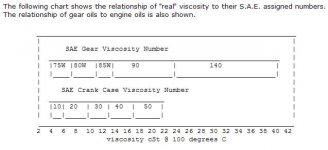
Redline MT-90 is rated GL4, so I wouldn't exactly call it "steering away". But in addition to meeting the GL4 specification (which only covers some aspects of performance, not all of them by any means), MT-90 has been optimized for use in synchronized manual transmissions. Some kind of magic about increased friction between the synchro rings and gear cones, without increasing drag in other places.
But there are a few reasons to not like GL4, take your pick:
<span style="font-weight: bold">1)</span> The one that concerns me is that many (most? all?) conventional gear oils, both GL4 and GL5, use an "active sulfur" "extreme pressure" additive. The additive works well on steel gear teeth and bearings, but it breaks down over time and turns the oil acidic. (The sulfuric acid is what gives old gear oil that distinctive smell.) Over time, the acid can corrode the brass/bronze parts (synchro rings, thrust washers, gear bushings).
Since GL5 oils have to meet a higher standard for "extreme pressure", they tend to use a lot more of this additive, hence the often-repeated warning not to use GL5 oils in TR diffs & gearboxes. But GL4 oils use the same additive, just less of it, so they can still cause some corrosion. When you see the old brass turn black, the dark color is copper sulphide (metal that has been corroded by the acid).
But it seems that most synthetic gear oils, even ones rated GL5, do not use the "active sulfur" additive and so are safe for "yellow metal" (another name for copper alloys like brass and bronze). I've been using Valvoline full synthetic GL5 in my TR diffs for a long time, and I have never seen any signs of yellow metal corrosion. One thing to look for is the "MT-1" rating. Although it is for heavy-duty non-synchro transmissions (think semi tractors), it requires long-term stability at high temperatures; which the active sulfur additive cannot meet.
<span style="font-weight: bold">2)</span> Back in 1954, there was a ST service bulletin that specifically forbade using "hypoid" oil in Laycock overdrives. No specifics were given in the bulletin, except they had a failure of a unit with hypoid oil and that Laycock said "don't do that". The service manual for the A-type also says not to use "extreme pressure" gear oils as the centrifugal effect of the "planets" may cause the additives to separate and form sludge.
But then around 1960, ST/Leyland suddenly switched to recommending <span style="text-decoration: underline">only </span>GL4 oil. Legend has it this was because they were having an unacceptable rate of returns under warranty due to countershaft thrust washer failures. (Note that GL5 did not exist at that time, so they could not have recommended it even if they had wanted to.)
<span style="font-weight: bold">3)</span> John Esposito has an article on his web site, claiming that he did an experiment with using 90 weight and it caused the OD pressure to go too high. With all due respect to John, in my opinion there must be some other explanation for his observations. Even when Triumph did recommend motor oil, they recommended 50 weight motor oil for temperatures above 70 degrees; and 50 weight motor oil is actually <span style="text-decoration: underline">thicker</span> than 90 weight gear oil. (The two scales are deliberately chosed to be different, so that one can tell from the grade whether it is gear oil or motor oil.) Plus Triumph recommended 90 weight for a long time (much longer than the motor oil), so I simply cannot believe that it causes the kind of instant malfunction that John described.
IMHO, YMMV, offer void where not prohibited, etc.


 Hey Guest!

 Hey - did you know if you click on the title of a thread it will take you to the first unread post since you last visited that thread?
 but were afraid to ask:
  STOP!! Never post your email address in open forums. Bots can "harvest" your email! If you must share your email use a Private Message or use the
  smilie in place of the real @
 Pretty Please - add it to our Events forum(s) and add to the calendar! >>