• Hey Guest!
    British Car Forum has been supporting enthusiasts for over 25 years by providing a great place to share our love for British cars. You can support our efforts by upgrading your membership for less than the dues of most car clubs. There are some perks with a member upgrade!

    **Upgrade Now**
    (PS: Upgraded members don't see this banner, nor will you see the Google ads that appear on the site.)
Tips
Tips

TR2/3/3A TR3A Timing [Static or Dynamic ?]

houleyh

Senior Member
Offline
In the spec sheet of the TR3A (Moss Motors), I see "NA" as far as dynamic timing specification...

Does it means that it is useless to perform a dynamic timing on TR3A and just the Static timing can be acheived?

If I am wrong, what is the setting for Dynamic Timing on a TR3A?

Thanks

YH
 
Yvan - I have never used a timing light to time my 1958 TR3A. There is a static method that I have used a few times, but mostly, I just drive the car and then I stop along the side of the road and advance the timing by rotating the distributor or with the knurled ratchet in the direction of advance. Then I close the hood and accelerate away. When I get up to speed in 4th gear, I step on the gas at 1000 RPM in 4th and if it pulls away better, I stop and try the same again. After a few times of this lugging at 1000 RPM in 4th gear will cause some "pinking" which is not good for the engine. It is a sign of detonation. So I stop again, lift the hood and reset the ratchet towards "RETARD". Then I shut the hood and try again. If there is no pinking this time, I know I have found the correct setting for the timing. I have done it this way for 50 years and it works fine.

When you get your TR on the road, come and see me and we can try to set yours this way - if you want to. Then we can try a little drag to see whose TR3A can go better.

But better make it soon, because it's October now, and in about 3 weeks, I'll be putting mine in storage for the winter.

This offer is good till next spring.

 
The problem with setting dynamic timing on a TR3 is that the centrifugal advance curve is allowed to start at idle rpm. The range is something like 0-4 degrees at idle.

So like Don, I've always used the road test method, and it works well for me.
 
Thanks guys,

Yesterday I adjusted the timing at 4 BTDC with the timing light. I sometimes get backfires & smoke from the carbs.

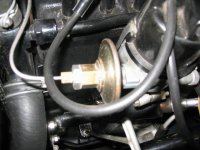
By the way, the final location of the distributor is so much turned clockwise that the vaccum advance unit is touching the water pipe on the engine. Is it normal?

thanks
 
Yvan - If you pull out the distributor and the drive shaft that drives it off the cam, you can index the drive shaft one tooth counterclockwise (or two if needed) and then re-assemble it. This way, the direction of the distributor can become "horizontal" when you look at it.
 

Attachments

  • 13286.jpg
    13286.jpg
    40.8 KB · Views: 285
:iagree:
Also, the backfiring in the intake is likely some other problem, not just timing that is off. Leaking valve, cracked distributor cap, excessive play in the distributor shaft, that sort of thing.

Does the timing mark appear to jump around under the timing light ?
 
Thanks Don, I will try to index the distributor shaft.

Also for Yoda, timing mark looks normal when using the light. I guess my timing is too off because I could not rotate the distributor clockwise enough. Meaning excess of retard?

Does anyone have a writen procedure for static timing?

Thanks

YH
 
This is something I wrote up awhile ago....

TR3 timing is supposed to be set statically...without the engine running.

The procedure as I do it...Make sure your points are set to spec first.

1. On the side of the distributor is a knurled nut that is used to advance and retard the timeing. You will see an A and an R with an arrow. There are also graduations there. One of the graduations is longer then the rest. That's the midpoint...set the timing adjuster there.
2. Bring the engine up to the timing mark on the pulley by turning the engine clockwise as looking from the front. If you go by it, don't back off. Go around again, as you don't want to introduce timing chain slop into this. Now the engine is at TDC.
3.Loosen the clamp on the dizzy.
4. Hook up a test light or voltmeter to the point side of the coil, and turn on the ignition.
5. If the test light is on, turn the dizzy CCW until the light goes out, and then turn it back (CW) until it just goes on.
If the test light is out, turn the dizzy CW until it just goes on.
6.Tighten the dizzy clamp.
7.Turn the knurled nut in the advance direction 2 graduations. Each gaduation is two degrees.

Timing is now set for 4 deg BTDC. You can use the knurled nut to make any running adjustments now, and always know where your timing is set.
 
Maybe Art will write up the details. The basic idea is that you connect the test light in place of the coil or in series with it (to limit the current through the module, thereby removing concerns over leaving the key on for extended periods); then follow the instructions above EXCEPT that you look for the point where the light just goes out, instead of just goes on.
 
Back
Top